
Pulp Fiction, 1917 · page 47 of 228
Adventure, February 1917 — page 47: what you’re looking at
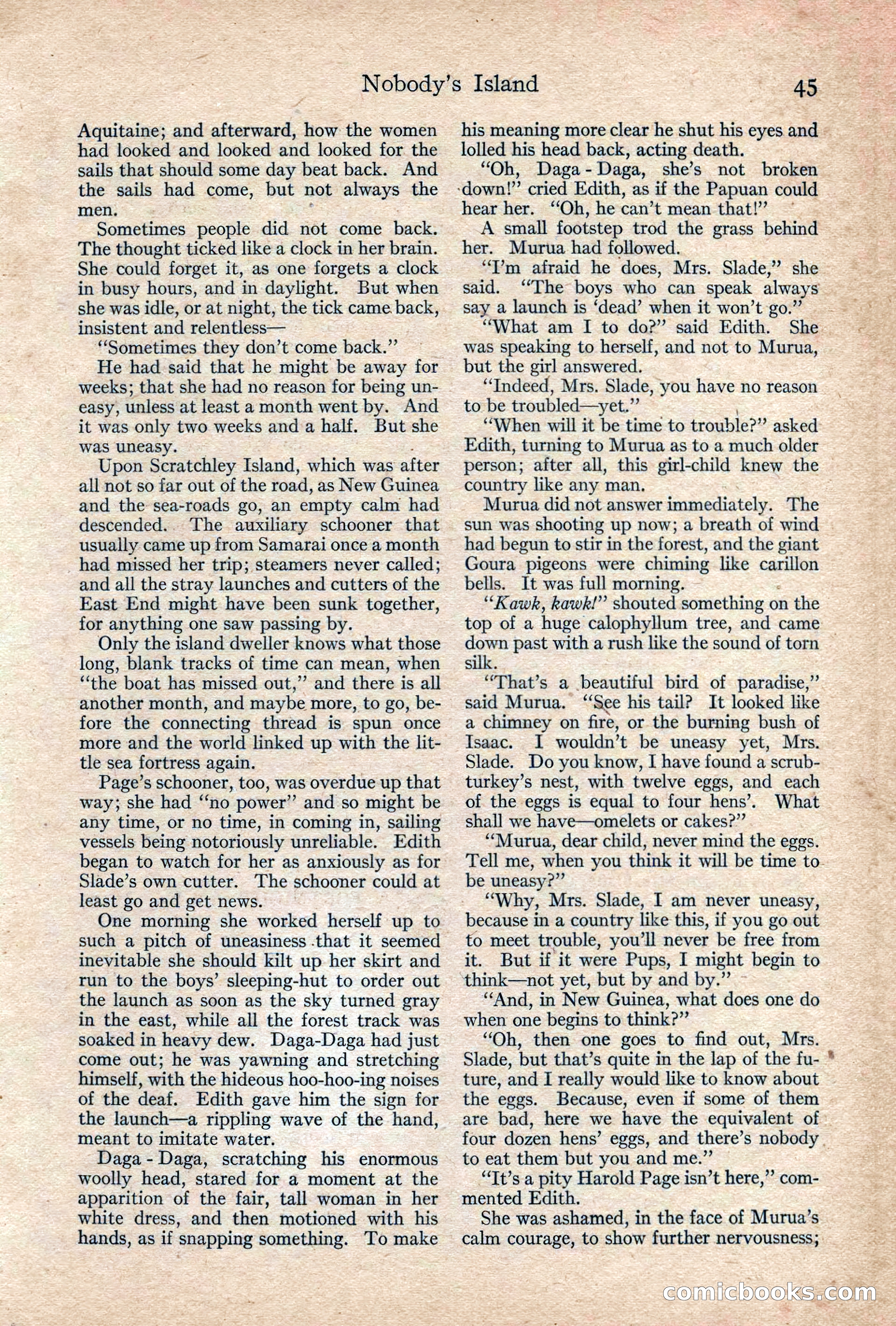
A restored page from Pulp Fiction, 1917. Page through the whole issue in the reader above.
📄 Transcribed text from this page (OCR, searchable)
Machine-transcribed from the original scan — historical spelling and the odd misread are preserved.
Nobody’s Island Aquitaine; and afterward, how the women had looked and looked and looked for the sails that should some day beat back. And the sails had come, but not always the men. Sometimes people did not come back: The thought ticked like a clock in her brain. She could forget it, as one forgets a clock in busy hours, and in daylight. But when she was idle, or at night, the tick came back, insistent and relentless— “Sometimes they don’t come back.” He had said that he might be away for weeks; that she had no reason for being un- easy, unless at least a month went by. And it was only two weeks anda half. But she was uneasy. Upon Scratchley Island, which was after all not so far out of the road, as New Guinea and the sea-roads go, an empty calm had descended... The auxiliary schooner that usually came up from Samarai once a month had missed her trip; steamers never called; and all the stray launches and cutters of the East End might have been sunk together, for anything one saw passing by. Only the island dweller knows what those long, blank tracks of time can mean, when ‘the boat has missed out,” and there is all another month, and maybe more, to go, be- fore the connecting thread is spun once more and the world linked up with the lit- tle sea fortress again. Page’s schooner, too, was overdue up that way; she had “‘no power” and so might be any time, or no time, in coming in, sailing vessels being notoriously unreliable. Edith began to watch for her as anxiously as for Slade’s own cutter. The schooner could at least go and get news. One morning she worked herself up to such a pitch of uneasiness .that it seemed inevitable she should kilt up her skirt and run to the boys’ sleeping-hut to order out the launch as soon as the sky turned gray in the east, while all the forest track was soaked in heavy dew. Daga-Daga had just come out; he was yawning and stretching himself, with the hideous hoo-hoo-ing noises of the deaf. Edith gave him the sign for the launch—a rippling wave of the hand, meant to imitate water. Daga - Daga, scratching his enormous woolly head, stared for a moment at the apparition of the fair, tall woman in her white dress, and then motioned with his hands, as if snapping something. To make 45. his meaning more clear he shut his eyes and ~ lolled his head back, acting death. “Oh, Daga-Daga, she’s not broken -down!”’ cried Edith, as if the Papuan could hear her. ‘‘Oh, he can’t mean that!” A small footstep trod the grass behind her. Murua had followed. ‘“Y’m afraid he does, Mrs. Slade,” she said. “The boys who can speak always say a launch is ‘dead’ when it won’t go.” Mvliat arn Ito daw said bdith Shes was speaking to herself, and not to Murua, but the girl answered. “Indeed, Mrs. Slade, you have no reason to be troubled—yet. a “When will it be time to trouble?” asked Edith, turning to Murua as to a much older person; after all, this girl-child knew the country like any man. Murua did not answer immediately. The sun was shooting up now; a breath of wind | had begun to stir in the forest, and the giant Goura pigeons were chiming like carillon bells. It was full morning. “Kawk, kawk!” shouted something o on the top of a huge calophyllum tree, and came — down past with a rush like the sound of torn silk. “That’s a beautiful bird of paradise,” said Murua. ‘See his tail? It looked like a chimney on fire, or the burning bush of Isaac. I wouldn’t be uneasy yet, Mrs. Slade. Do you know, I have found a scrub- turkey’s nest, with twelve eggs, and each of the eggs is equal to four hens’. What shall we have—omelets or cakes?” “Murua, dear child, never mind the eggs. Tell me, when you think it will be time to- be uneasy?” “Why, Mrs. Slade, I am never uneasy, because in a country like this, if you go out to meet trouble, you’ll never be free from it. But if it were Pups, I might begin to think—not yet, but by and by.” ~ ““And, in New Guinea, what does one do when one begins to think?” “Oh, then one goes to find out, Mrs. Slade, but that’s quite in the lap of the fu- nw ture, and I really would like to know about the eggs. Because, even if some of them are bad, here we have the equivalent of» four dozen hens’ eggs, and there’ S nobody s to eat them but you and me.’ “Tt’s a pity Harold Page isn’t here,” com- mented Edith. She was ashamed, in the face of Murua’s calm courage, to show further nervousness; JOO COME SS