
Pulp Fiction, 1917 · page 51 of 228
Adventure, February 1917 — page 51: what you’re looking at
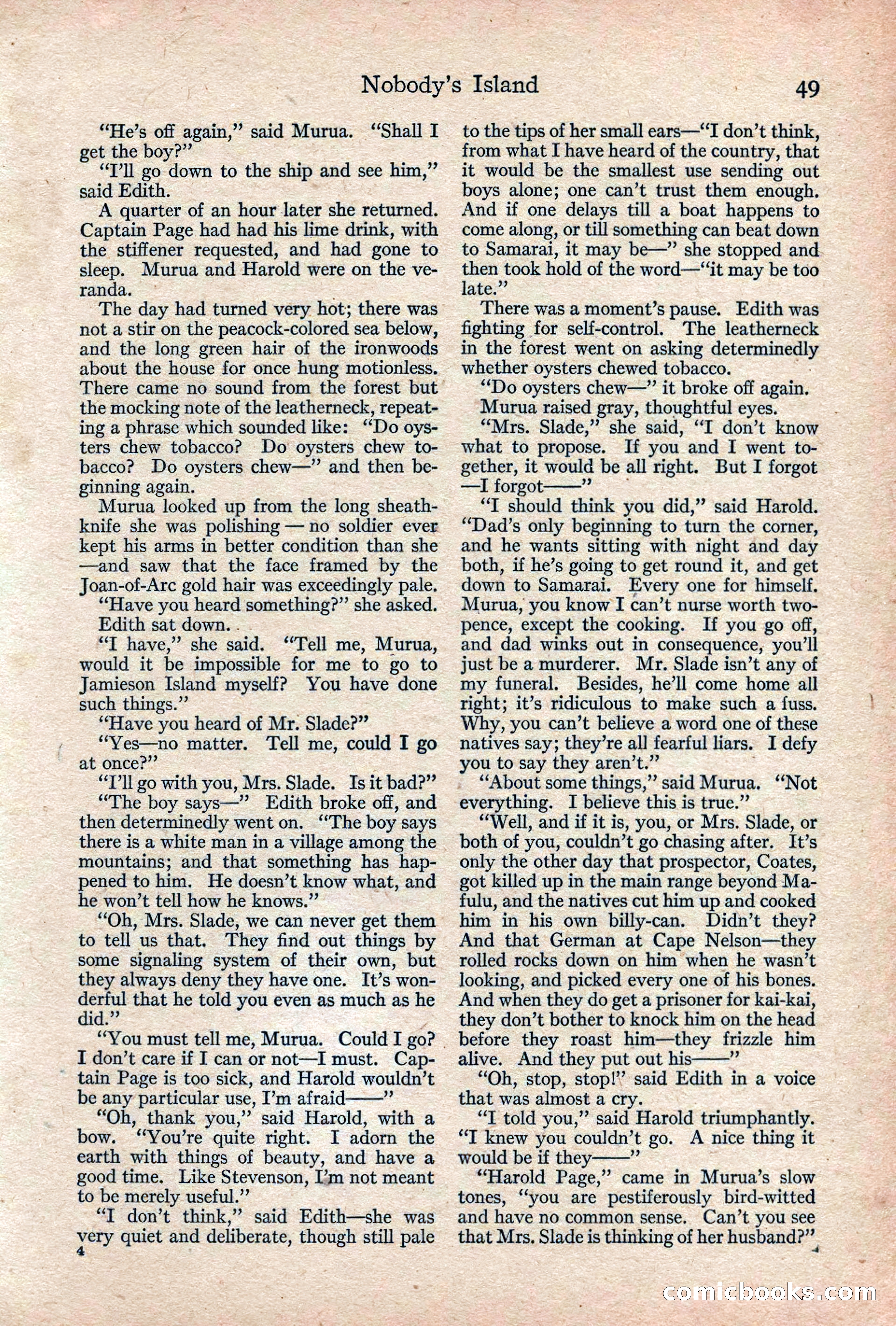
A restored page from Pulp Fiction, 1917. Page through the whole issue in the reader above.
📄 Transcribed text from this page (OCR, searchable)
Machine-transcribed from the original scan — historical spelling and the odd misread are preserved.
Nobody’s Island “He’s off again,” said Murua. “Shall I get the boy?” “T’ll go down to the ship and see him,” said Edith. A quarter of an hour later she returned. Captain Page had had his lime drink, with the stiffener requested, and had gone to sleep. Murua and Harold were on the ve- randa. The day had turned very hot; there was not a stir on the peacock-colored sea below, and the long green hair of the ironwoods about the house for once hung motionless. There came no sound from the forest but the mocking note of the leatherneck, repeat- ing a phrase which sounded like: “Do oys- ters chew tobacco? Do oysters chew to- bacco? Do oysters chew—” and then be- ginning again. Murua looked up from the long sheath- knife she was polishing — no soldier ever kept his arms in better condition than she —and saw that the face framed by the Joan-of-Arc gold hair was exceedingly pale. “Have you heard something?” she asked. Edith sat down. . “T have,” she said. ‘Tell me, Murua, would it be impossible for me to go to Jamieson Island myself? You have done such things.” ‘Have you heard of Mr. Slade?” “Yes—no matter. Tell me, could I go at once?” | “T’ll go with you, Mrs. Slade. Is it bad?” “The boy says—” Edith broke off, and then determinedly went on. “The boy says there is a white man in a village among the mountains; and that something has hap- pened to him. He doesn’t know what, and he won’t tell how he knows.” “Oh, Mrs. Slade, we can never get them to tell us that. They find out things by some signaling system of their own, but they always deny they have one. It’s won- mers that he told you even as much as he “You must tell me, Murua. Could I go? : I don’t care if I can or not—I must. Cap- - tain Page is too sick, and Harold wouldn’t be any particular use, I’m afraid——”’ “Oh, thank you, ” said Harold, with a bow. “Youre quite right. I adorn the earth with things of beauty, and have a good time. Like Stevenson, I’m not meant to be merely useful.” 3 “T don’t think,” said Edith—she was very quiet and deliberate, though still pale to the tips of her small ears—‘“T don’t think, from what I have heard of the country, that it would be the smallest use sending out boys alone; one can’t trust them enough, And if one delays till a boat happens to come along, or till something can beat down to Samarai, it may be—” she stopped and a took hold of the word—“‘it may be too ate.” There was a moment’s pause. Edith was fighting for self-control. The leatherneck in the forest went on asking pda et whether oysters chewed tobacco. “Do oysters chew—’” it broke off again. Murua raised gray, thoughtful eyes. “Mrs. Slade,” she said, what to propose. If you and I went to- gether, it would be all right. But I forgot —I forgot——” “T should think you did,” said Harold. “Dad’s only beginning to turn the corner, and he wants sitting with night and day both, if he’s going to get round it, and get down to Samarai. Every one for himself, Murua, you know I can’t nurse worth two- pence, except the cooking. If you go off, and dad winks out in consequence, you'll just be a murderer. Mr. Slade isn’t any of my funeral. Besides, he’ll come home all right; it’s ridiculous to make such a fuss. Why, you can’t believe a word one of these 49 “T don’t know natives say; they’re all fearful liars. I defy © you to say they aren’t.” “‘About some things,’”’ said Murua. ‘“‘Not everything. I believe this is true.” “Well, and if it is, you, or Mrs. Slade, or both of you, couldn’t go chasing after. It’s only the other day that prospector, Coates, got killed up in the main range beyond Ma- fulu, and the natives cut him up and cooked him in his own billy-can. Didn’t they? And that German at Cape Nelson—they rolled rocks down on him when he wasn’t looking, and picked every one of his bones. And when they do get a prisoner for kai-kai, they don’t bother to knock him on the head before they roast him—they frizzle him alive. And they put out his——” “Oh, stop, stop!’ said Edith in a voice that was almost a cry. “T told you,” said Harold triumphantly. “T knew you couldn’t go. A nice thing it would be if they-——”’ “Harold Page,” came in Murua’s slow tones, “you are pestiferously bird-witted and have no common sense. Can’t you see that Mrs, Slade is thinking of her husband?” EOMICOOOKS (E@)