
Pulp Fiction, 1917 · page 53 of 228
Adventure, February 1917 — page 53: what you’re looking at
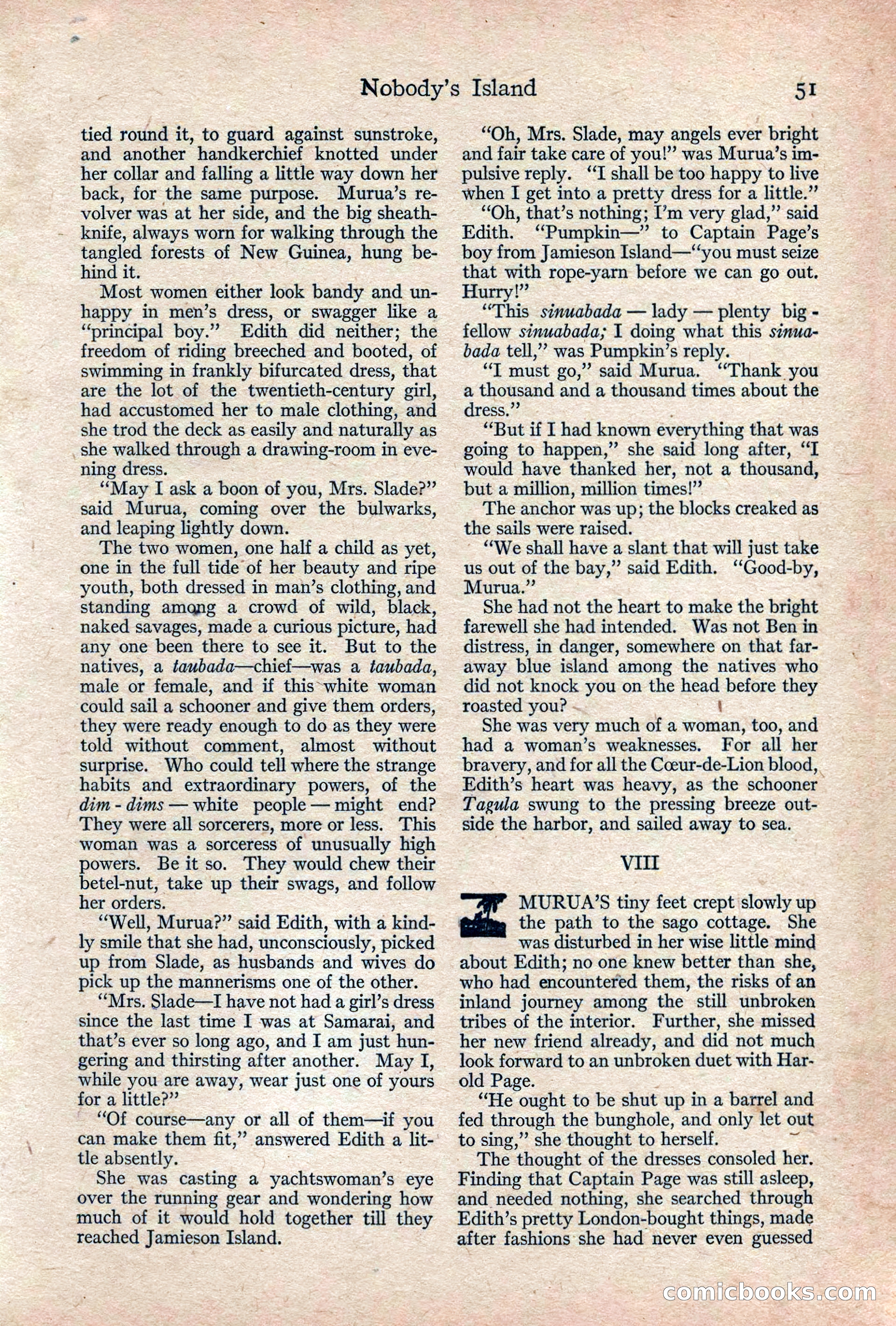
A restored page from Pulp Fiction, 1917. Page through the whole issue in the reader above.
📄 Transcribed text from this page (OCR, searchable)
Machine-transcribed from the original scan — historical spelling and the odd misread are preserved.
Nobody’s Island tied round it, to guard against sunstroke, and another handkerchief knotted under her collar and falling a little way down her back, for the same purpose. Murua’s re- volver was at her side, and the big sheath- knife, always worn for walking through the tangled forests of New Guinea, hung be- hind it. Most women either look bandy and un- happy in men’ S dress, or swagger like a “principal boy.” Edith did neither; the freedom of riding breeched and booted, of swimming in frankly bifurcated dress, that are the lot of the twentieth-century girl, had accustomed her to male clothing, and she trod the deck as easily and naturally as she walked through a drawing-room in eve- ning dress. “May I ask a boon of you, Mrs. Slade?” said Murua, coming over the bulwarks, and leaping lightly down. The two women, one half a child as yet, one in the full tide of her beauty and ripe youth, both dressed in man’s clothing, and standing among a crowd of wild, black, naked savages, made a curious picture, had any one been there to see it. But to the natives, a tawbada—chief—was a taubada, male or female, and if this-white woman could sail a schooner and give them orders, they were ready enough to do as they were told without comment, almost without surprise. Who could tell where the strange habits and extraordinary powers, of the dim - dims — white people — might end? They were all sorcerers, more or less. This woman was a sorceress of unusually high powers. Beit so. They would chew their betel-nut, take up their swags, and follow her orders. “Well, Murua?” said Edith, with a kind- ly smile that she had, unconsciously, picked up from Slade, as husbands and wives do pick up the mannerisms one of the other. “Mrs. Slade—I have not had a girl’s dress since the last time I -was at Samarai, and that’s ever so long ago, and I am just hun- gering and thirsting after another. May I, while you are away, wear just one of yours for a little?” — “Of course—any or all of them—if you can make them fit,” answered Edith a lit-' tle absently. She was casting a yachtswoman’s “eye over the running gear and wondering how much of it would hold together till they reached Jamieson Island. 51 “Oh, Mrs. Slade, may angels ever bright and fair take care of you!” was Murua’s im- pulsive reply. “I shall be too happy to live when I get into a pretty dress for a little.” “Oh, that’s nothing; I’m very glad,” said Edith. “Pumpkin—” to Captain Page’s boy from Jamieson Island—‘“you must seize that with rope-yarn before we can go out. Hurry!” “This sinuabada — lady — plenty big - fellow sinuabada; I doing what this sinua- bada tell,” was Pumpkin’s reply. “T must go,’ said Murua. ‘Thank you a thousand and a thousand times about the dress.” “But if I had known everything that was going to happen,” she said long after, “I would have thanked her, not a thousand, but a million, million times!’ The anchor was up; the blocks creaked as the sails were raised. _ “We shall have a slant that will just take us out of the bay,” said Edith. ‘Good-by, Murua.” She had not the heart to make the bright farewell she had intended. Was not Ben in distress, in danger, somewhere on that far- away blue island among the natives who did not knock you on the head before they roasted you? - ) She was very much of a woman, too, and had a woman’s weaknesses. For all her bravery, and for all the Coeur-de-Lion blood, | Edith’s heart was heavy, as the schooner Tagula swung to the pressing breeze out- side the harbor, and sailed away to sea. Vil MURUA’S tiny feet crept slowly up the path to the sago cottage. She was disturbed in her wise little mind about Edith; no one knew better than she, who had encountered them, the risks of an inland journey among the still unbroken tribes of the interior. Further, she missed her new friend already, and did not much look forward to an unbroken duet with Har- old Page. “He ought to be shut up in a barrel and fed through the bunghole, and only let out to sing,” she thought to herself. The thought of the dresses consoled her. Finding that Captain Page was still asleep, and needed nothing, she searched through Edith’s pretty London-bought things, made after fashions she had never even guessed EOLMIE VOC KS (EO)