
Pulp Fiction, 1917 · page 55 of 228
Adventure, February 1917 — page 55: what you’re looking at
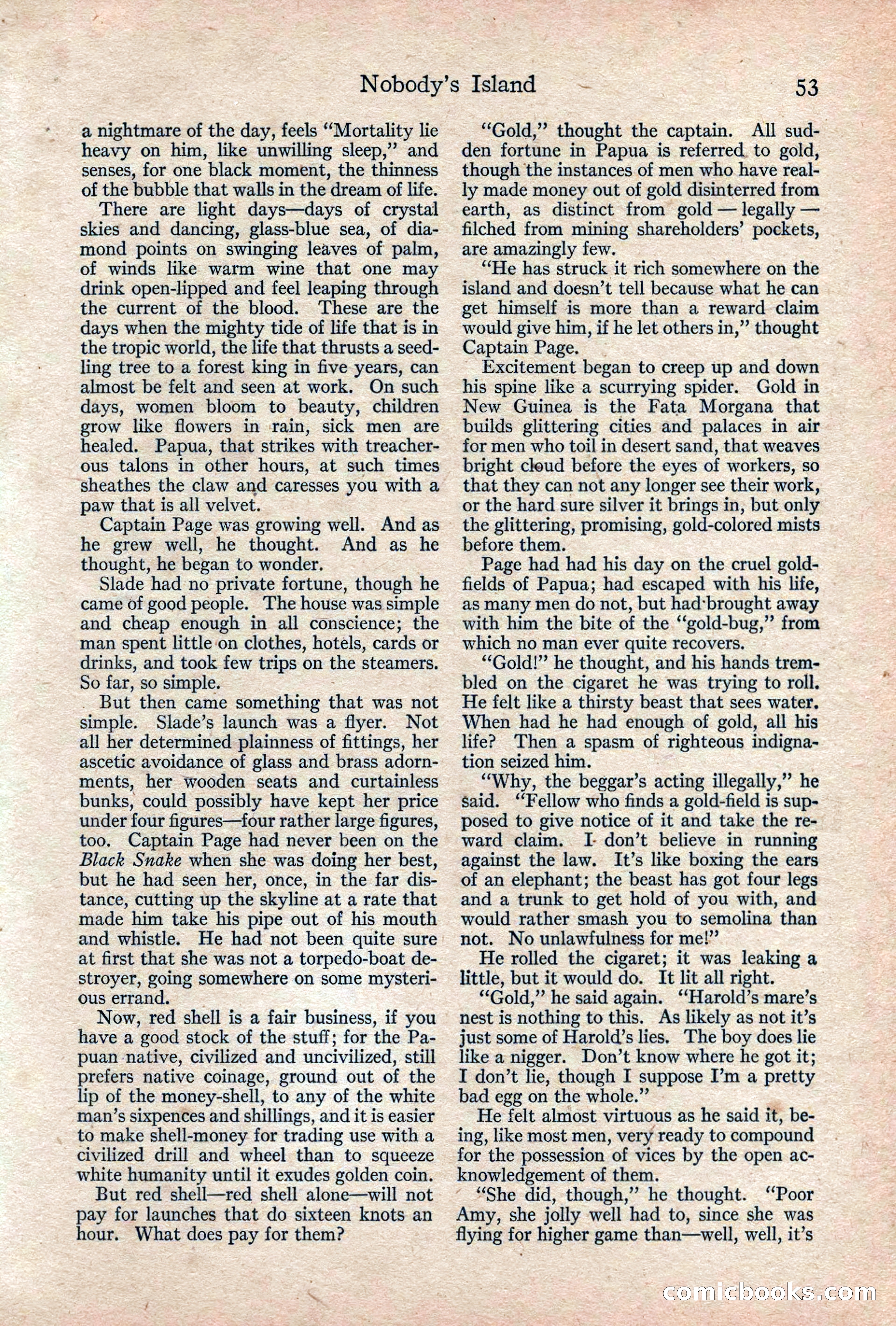
A restored page from Pulp Fiction, 1917. Page through the whole issue in the reader above.
📄 Transcribed text from this page (OCR, searchable)
Machine-transcribed from the original scan — historical spelling and the odd misread are preserved.
Nobody’s Island “Gold,” thought the captain. All sud- a nightmare of the day, feels “Mortality lie heavy on him, like unwilling sleep,” and senses, for one black moment, the thinness of the bubble that walls in the dream of life. There are light days—days of crystal skies and dancing, glass-blue sea, of dia- mond points on swinging leaves of palm, of winds like warm wine that one may drink open-lipped and feel leaping through the current of the blood. These are the days when the mighty tide of life that is in the tropic world, the life that thrusts a seed- ling tree to a forest king in five years, can almost be felt and seen at work. On such days, women bloom to beauty, children grow like flowers in rain, sick men are healed. Papua, that strikes with treacher- ous talons in other hours, at such times sheathes the claw and caresses you with a paw that is all velvet. Captain Page was growing well. And as - he grew well, he thought. And as he thought, he began to wonder. Slade had no private fortune, though he came of good people. The house was simple and cheap enough in all conscience; the man spent little:on clothes, hotels, cards or drinks, and took few trips on the steamers. So far, so simple. ~ But then came something that was not simple. Slade’s launch was a flyer. Not all her determined plainness of fittings, her ascetic avoidance of glass and brass adorn- ments, her wooden seats and curtainless bunks, could possibly have kept her price under four figures—four rather large figures, too. Captain Page had never been on the Black Snake when she was doing her best, but he had seen her, once, in the far dis- tance, cutting up the skyline at a rate that made him take his pipe out of his mouth and whistle. He had not been quite sure at first that she was not a torpedo-boat de- stroyer, going somewhere on some mysteri- ous errand. Now, red shell is a fair business, if you have a good stock of the stuff; for the Pa- puan native, civilized and uncivilized, still prefers native coinage, ground out of the lip of the money-shell, to any of the white man’s sixpences and shillings, and it is easier to make shell-money for trading use with a civilized drill and wheel than to squeeze white humanity until it exudes golden coin. But red shell—red shell alone—will not pay for launches that do sixteen knots an hour. What does pay for them? — 93 den fortune in Papua is referred. to gold, though the instances of men who have real- ly made money out of gold disinterred from earth, as distinct from gold — legally — filched from mining shareholders’ pockets, are amazingly few. “He has struck it rich somewhere on the island and doesn’t tell because what he can get himself is more than a reward claim would give him, if he let others in,” thought Captain Page. _ _ Excitement began to creep up and down his spine like a scurrying spider. Gold in New Guinea is the Fata Morgana that builds glittering cities and palaces in air for men who toil in desert sand, that weaves bright cloud before the eyes of workers, so that they can not any longer see their work, or the hard sure silver it brings in, but only the glittering, promising, gold-colored mists before them. Page had had his day on the cruel gold- fields of Papua; had escaped with his life, as many men do not, but had:brought away with him the bite of the “‘gold-bug,”’ from which no man ever quite recovers. “Gold!” he thought, and his hands trem- bled on the cigaret he was trying to roll. He felt like a thirsty beast that sees water, When had he had enough of gold, all his life? Then a spasm of righteous indigna- tion seized him. “Why, the beggar’s acting illegally,” he said. ‘Fellow who finds a gold-field is sup- posed to give notice of it and take the re- ward claim. I- don’t believe in running against the law. It’s like boxing the ears of an elephant; the beast has got four legs and a trunk to get hold of you with, and would rather smash you to semolina than not. No unlawfulness for me!”’ He rolled the cigaret; it was leaking a little, but it would do. It lit all right. “Gold,” he said again. ‘‘Harold’s mare’s nest is nothing to this. As likely as not it’s just some of Harold’s lies. The boy does lie like a nigger. Don’t know where he got it; I don’t lie, though I suppose I’m a pretty bad egg on the whole.” He felt almost virtuous as he said it, be- ing, like most men, very ready to compound for the possession of vices by the open ac- knowledgement of them. “She did, though,” he thought. ‘Poor Amy, she jolly well had to, since she was flying for higher game than—well, well, it’s EOLPMIC KOOKS (E@) |