
Pulp Fiction, 1917 · page 69 of 228
Adventure, February 1917 — page 69: what you’re looking at
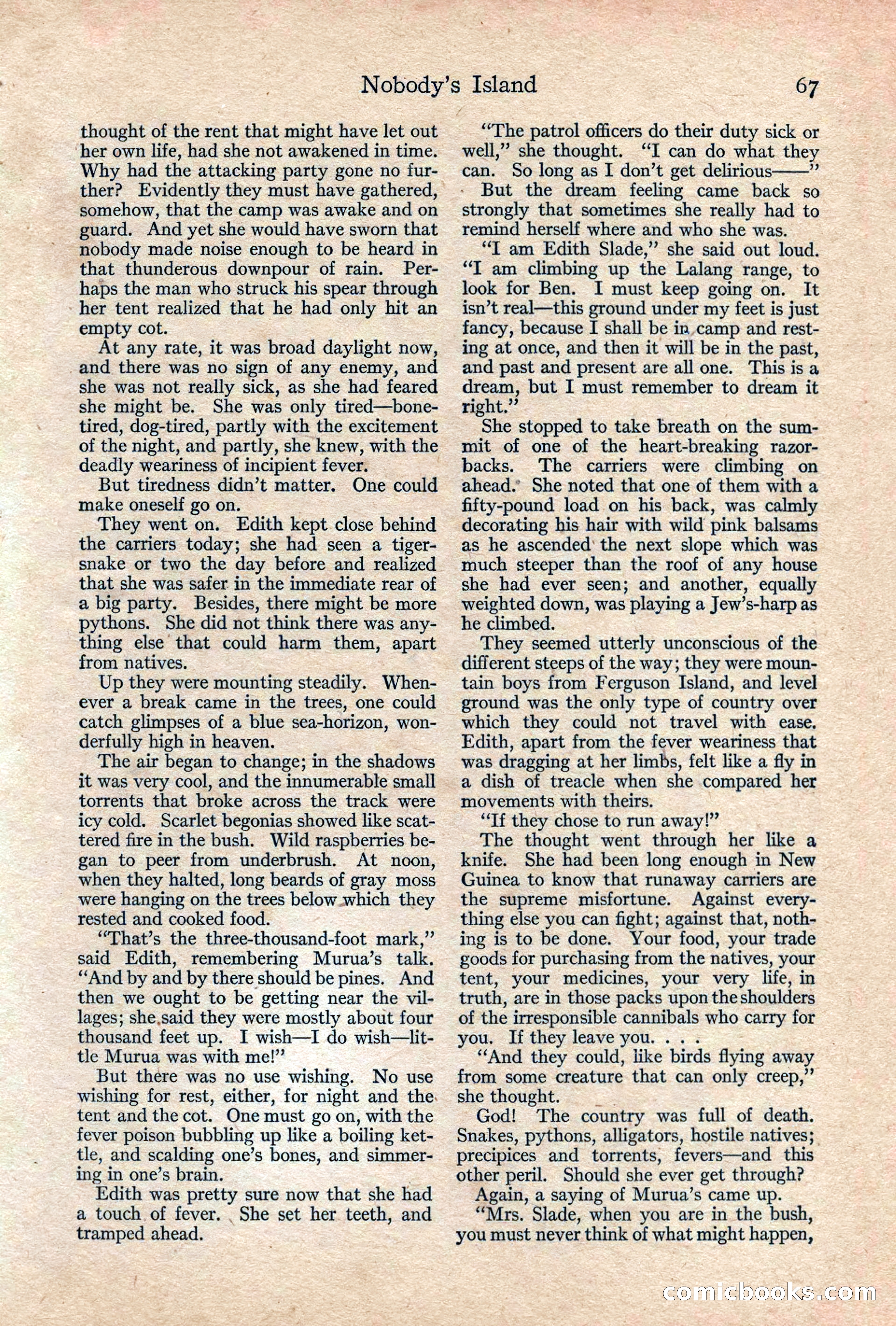
A restored page from Pulp Fiction, 1917. Page through the whole issue in the reader above.
📄 Transcribed text from this page (OCR, searchable)
Machine-transcribed from the original scan — historical spelling and the odd misread are preserved.
Nobody’s Island thought of the rent that might have let out ‘her own life, had she not awakened in time. Why had the attacking party gone no fur- ther? Evidently they must have gathered, somehow, that the camp was awake and on guard. And yet she would have sworn that nobody made noise enough to be heard in that thunderous downpour of rain. Per- haps the man who struck his spear through her tent realized that he had only hit an empty cot. At any rate, it was broad daylight now, _and there was no sign of any enemy, an she was not really sick, as she had feared she might be. She was only tired—bone- tired, dog-tired, partly with the excitement of the night, and partly, she knew, with the deadly weariness of incipient fever. But tiredness didn’t matter. One could make oneself go on. They went on. Edith kept close behind the carriers today; she had seen a tiger- snake or two the day before and realized that she was safer in the immediate rear of a big party. Besides, there might be more pythons. She did not think there was any- thing else that could harm them, apart from natives. Up they were mounting steadily. When- ever a break came in the trees, one could catch glimpses of a blue sea-horizon, won- derfully high in heaven. The air began to change; in the shadows it was very cool, and the innumerable small torrents that broke across the track were icy cold. Scarlet begonias showed like scat- tered fire in the bush. Wild raspberries be- gan to peer from underbrush. At noon, when they halted, long beards of gray moss were hanging on the trees below which they rested and cooked food. “That’s the three-thousand-foot mark,” said Edith, remembering Murua’s talk. “And by and by there should be pines. And then we ought to be getting near the vil- lages; she.said they were mostly about four thousand feet up. I wish—I do wish—lit- tle Murua was with me!” But there was no use wishing. No use wishing for rest, either, for night and the. tent and the cot. One must go on, with the fever poison bubbling up like a boiling ket- tle, and scalding one’s bones, and simmer- ing in one’s brain. Edith was pretty sure now that she had a touch of fever. . She set her teeth, and tramped ahead. 67 “The patrol officers do their duty sick or well,” she thought. ‘I can do what they can. So long as I don’t get delirious But the dream feeling came back so strongly that sometimes she really had to remind herself where and who she was. “T am Edith Slade,” she said out loud. “T am climbing up the Lalang range, to look for Ben. I must keep going on. It isn’t real—this ground under my feet is just fancy, because I shall be in. camp and rest- ing at once, and then it will be in the past, and past and present are all one. This is a dream, but I must remember to dream it right.” “She stopped to take breath on the sum- mit of one of the heart-breaking razor- backs. The carriers were climbing on ahead.” She noted that one of them with a fifty-pound load on his back, was calmly decorating his hair with wild pink balsams as he ascended the next slope which was much steeper than the roof of any house she had ever seen; and another, equally weighted down, was playing a Jew’s-harp as he climbed. They seemed utterly unconscious of the different steeps of the way; they were moun- tain boys from Ferguson Island, and level ground was the only type of country over which they could not travel with ease. Edith, apart from the fever weariness that was dragging at her limbs, felt like a fly in a dish of treacle when she compared her movements with theirs. “Tf they chose to run away!” The thought went through her like a knife. She had been long enough in New Guinea to know that runaway carriers are the supreme misfortune. Against every- thing else you can fight; against that, noth- ing is to be done. Your food, your trade goods for purchasing from the natives, your tent, your medicines, your very life, in truth, are in those packs upon the shoulders of the irresponsible cannibals who carry for you. If they leave you... . “And they could, like birds vine away from some creature that can only creep,’ she thought. God! The country was full of death. Snakes, pythons, alligators, hostile natives; precipices and torrents, fevers—and this other peril. Should she ever get through? Again, a saying of Murua’s came up. “Mrs. Slade, when you are in the bush, you must never think of what might happen, Gomicbooks (E©)