
Pulp Fiction, 1917 · page 89 of 228
Adventure, February 1917 — page 89: what you’re looking at
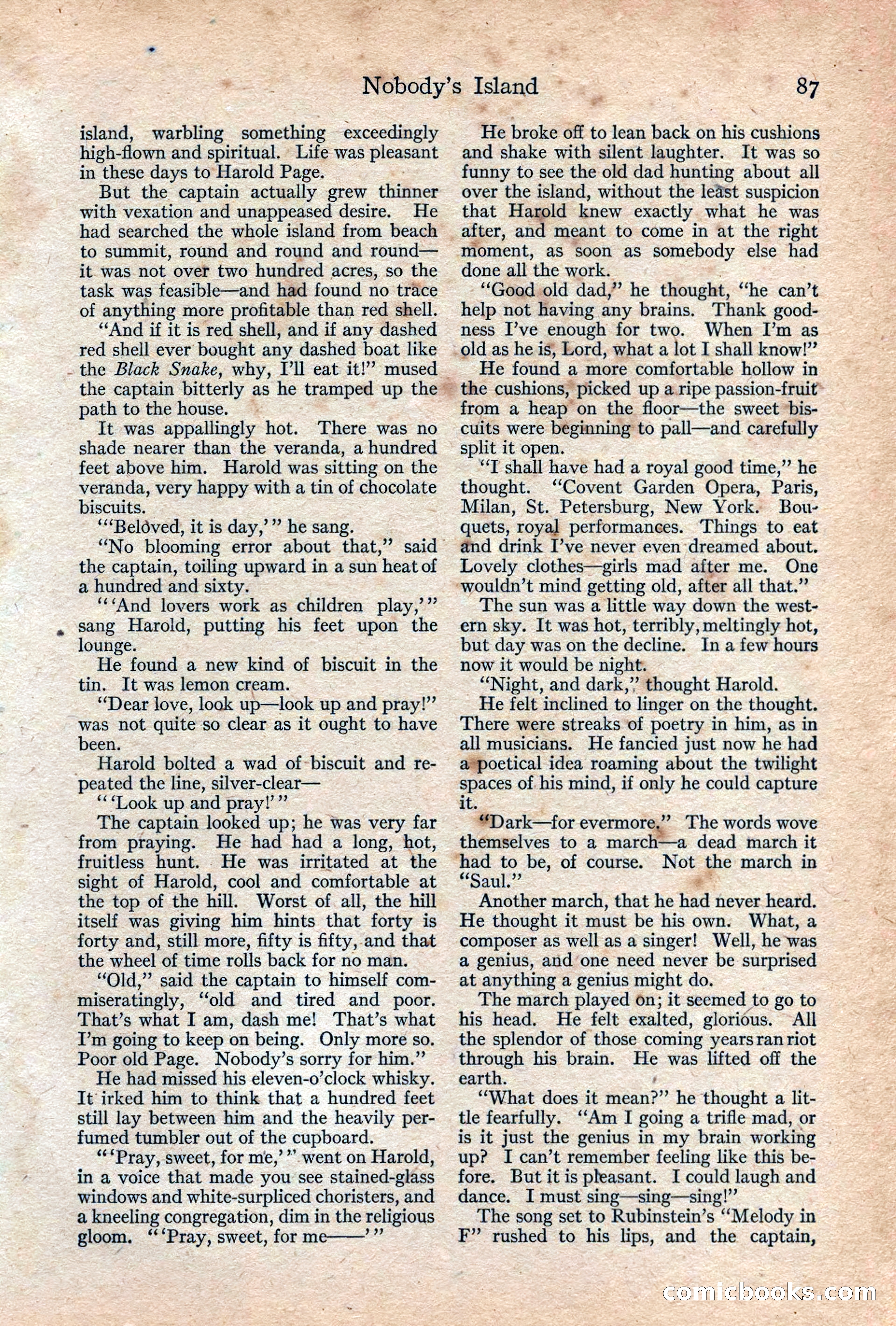
A restored page from Pulp Fiction, 1917. Page through the whole issue in the reader above.
📄 Transcribed text from this page (OCR, searchable)
Machine-transcribed from the original scan — historical spelling and the odd misread are preserved.
a Sd of Nobody’ s Island island, warbling something exceedingly high-flown and spiritual. Life was eee in these days to Harold Page. But the captain actually grew thinner with vexation and unappeased desire. He had searched the whole island from beach | to summit, round and round and round— it. was not over two hundred acres, so the task was feasible—and had found no trace of anything more profitable than red shell. ‘And if it is red shell, and if any dashed red shell ever bought any dashed boat like - the Black Snake, why, I the captain bitterly as he tramped up the ~ path to the house. It was appallingly hot. There was no shade nearer than the veranda, a hundred feet above him. Harold was sitting on the veranda, very happy with a tin of chocolate biscuits. ‘Beloved, it is day,’” he sang. I'll eat it!’ mused | c= “No blooming error about that,” said the captain, toiling upward in a sun heat of a hundred and sixty. “And lovers work as children play, sang Harold, putting his feet upon the lounge. He found a new kind of biscuit in the tin. It was lemon cream. “Dear love, look up—look up and pray!” was not quite so clear as it ought to have been. _ Harold bolted a wad of-biscuit and re- peated the line, silver-clear— ‘Look up. and pray!” The captain looked up; he was very far from praying. He had had a long, hot, fruitless hunt. . He was irritated at the sight of Harold, cool and comfortable at the top of the hill. Worst of all, the hill itself was giving him hints that forty is forty and, still more, fifty is fifty,and that the wheel of time rolls back for no man. “Old,” said the captain to himself com- miseratingly, “old and tired and poor. That’s what I am, dash me! That’s what I’m going to keep on being. Only more so. Poor old Page. Nobody’s sorry for him.” He had missed his eleven-o’clock whisky. It irked him to think that a hundred feet still lay between him and the heavily per- fumed tumbler out of the cupboard. “Pray, sweet, for me,’” went on Harold, in a voice that made you see stained-glass windows and white-surpliced choristers, and a kneeling congregation, dim in the religious gloom. ‘‘‘Pray, sweet, for me——’”’ 99? had to be, of course. He broke off to lean back on his ono and shake with silent laughter. It was so funny to see the old dad hunting about all over the island, without the least suspicion that Harold knew exactly what he was after, and meant to come in at the right moment, as soon as somebody else had done all the work. “Good old dad,” he thought, “he can’t help not having any brains. Thank good- ness I’ve enough for two. When I’m as old as he is; Lord, what a lot I shall know!”’ He found a more comfortable hollow in the cushions, picked up a ripe passion-fruit® from a heap’ on the floor—the sweet ‘bis- cuits were beginning to pall—and carefully split it open. “T shall have had a royal good time,” he thought. ‘Covent Garden Opera, Paris, Milan, St. Petersburg, New York. Bou- quets, ‘royal performanees. Things to eat and drink I’ve never even dreamed about. Lovely clothes—girls mad after me. One -wouldn’t mind getting old, after all that.” The sun was a little way down the west- ern sky. It was hot, terribly, meltingly hot, but day was on the decline. In a few hours now it would be night. “Night, and dark,”’ thought Harold. He felt inclined to linger on the thought. There were streaks of poetry in him, as in all musicians. He fancied just now he had a poetical idea roaming about the twilight spaces of his mind, if only he could capture it. “Dark—for evermore.”’ The words wove themselves to a march—a dead march it N ob the march in > ‘“c“ S aul. bP Another march, that he had never heard. He thought it must be his own. What, a composer as well as a singer! Well, he was a genius, and one need never be surprised at anything a genius might do. The march played on; it seemed to go to his head. He felt exalted, glorious. All the splendor of those coming yearsran riot through his brain. He was lifted off the earth. “What does it ean?” he thought a lit- tle fearfully. “Am I going a trifle mad, or 87 is it just the genius in my brain working > up? I can’t remember feeling like this be- fore. Butit is pleasant. I could laugh and dance. I must sing—sing—sing!”’ The song set to Rubinstein’s ‘‘Melody in F” rushed to his lips, and the captain, com (C (E@) IOOKS