
Pulp Fiction, 1917 · page 9 of 228
Adventure, February 1917 — page 9: what you’re looking at
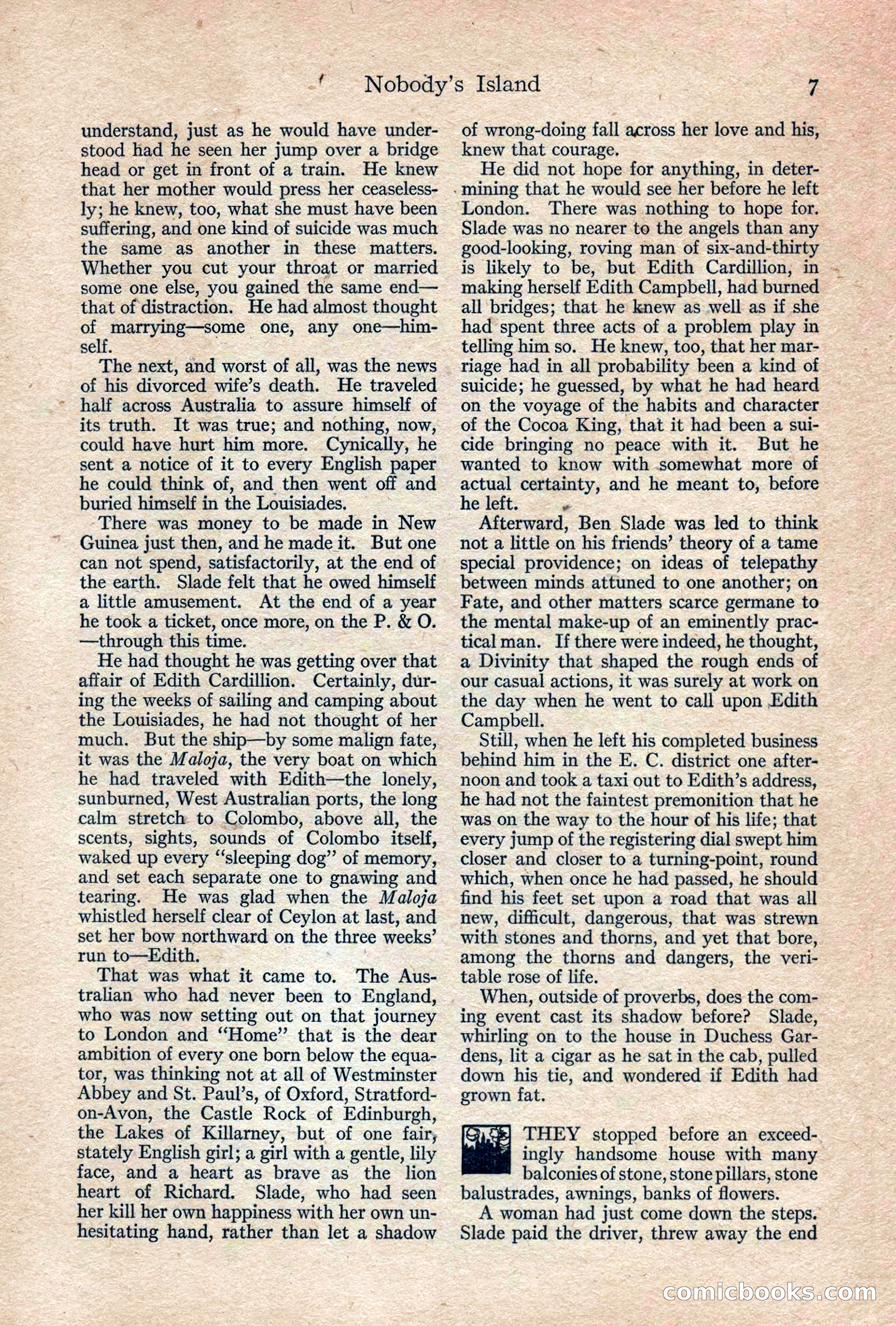
A restored page from Pulp Fiction, 1917. Page through the whole issue in the reader above.
📄 Transcribed text from this page (OCR, searchable)
Machine-transcribed from the original scan — historical spelling and the odd misread are preserved.
t — Nobody’s Island : 7 understand, just as he would have under- stood had he seen her jump over a bridge head or get in front of a train. He knew that her mother would press her ceaseless- ly; he knew, too, what she must have been suffering, and one kind of suicide was much the same as another in these matters. Whether you cut your throat or married some one else, you gained the same end— that of distraction. He had almost thought of marrying—some one, any one—him- self. The next, and worst of all, was the news of his divorced wife’s death. He traveled half across Australia to assure himself of its truth. It was true; and nothing, now, could have hurt him more. Cynically, he sent a notice of it to every English paper he could think of, and then went off and buried himself in the Louisiades. There was money to be made in New — Guinea just then, and he made it. But one can not spend, satisfactorily, at the end of the earth. Slade felt that he owed himself a little amusement. At the end of a year he took a ticket, once more, on the P. & O. —through this time. He had thought he was getting over that affair of Edith Cardillion. Certainly, dur- ing the weeks of sailing and camping about the Louisiades, he had not thought of her much. But the ship—by some malign fate, it was the Maloja, the very boat on which he had traveled with Edith—the lonely, sunburned, West Australian ports, the long calm stretch to Colombo, above all, the scents, sights, sounds of Colombo itself, waked up every “sleeping dog” of memory, and set each separate one to gnawing and tearing. He was glad when the Maloja whistled herself clear of Ceylon at last, and set her bow northward on the three weeks’ run to—Edith. That was what it came to. The Aus- tralian who had never been to England, who was now setting out on that journey to London and “Home” that is the dear ambition of every one born below the equa- tor, was thinking not at all of Westminster Abbey and St. Paul’s, of Oxford, Stratford- on-Avon, the Castle Rock of Edinburgh, the Lakes of Killarney, but of one fair, stately English girl; a girl with a gentle, lily face, and a heart as brave as the lion heart of Richard. Slade, who had seen her kill her own happiness with her own un- hesitating hand, rather than let a shadow of wrong-doing fall across her love and his, knew that courage. He did not hope for anything, in deter- -mining that he would see her before he left London. There was nothing to hope for. Slade was no nearer to the angels than any good-looking, roving man of six-and-thirty is likely to be, but Edith Cardillion, in - making herself Edith Campbell, had burned all bridges; that he knew as well as if she had spent three acts of a problem play in telling him so. He knew, too, that her mar- riage had in all probability been a kind of suicide; he guessed, by what he had heard on the voyage of the habits and character of the Cocoa King, that it had been a sui- cide bringing no peace with it. But he wanted to know with somewhat more of actual certainty, and he meant to, before he left. . Afterward, Ben Slade was led to think not a little on his friends’ theory of a tame special providence; on ideas of telepathy between minds attuned to one another; on Fate, and other matters scarce germane to the mental make-up of an eminently prac- tical man. If there were indeed, he thought, a Divinity that shaped the rough ends of our casual actions, it was surely at work on the day when he went to call upon Edith Campbell. Still, when he left his completed business behind him in the E, C. district one after- noon and took a taxi out to Edith’s address, he had not the faintest premonition that he was on the way to the hour of his life; that every jump of the registering dial swept him closer and closer to a turning-point, round which, when once he had passed, he should find his feet. set upon a road that was all new, difficult, dangerous, that was strewn with stones and thorns, and yet that bore, among the thorns and dangers, the veri- table rose of life. When, outside of proverbs, does the com- ing event cast its shadow before? Slade, whirling on to the house in Duchess Gar- dens, lit a cigar as he sat in the cab, pulled down his tie, and wondered if Edith had grown fat. ingly handsome house with many balconies of stone, stone pillars, stone balustrades, awnings, banks of flowers. A woman had just come down the steps. Slade paid the driver, threw away the end EMOPMNIE LOOKS Sue THEY stopped before an exceed-. (E@)