
Pulp Fiction, 1919 · page 160 of 208
Adventure Magazine Cover, December 18, 1919 — page 160: what you’re looking at
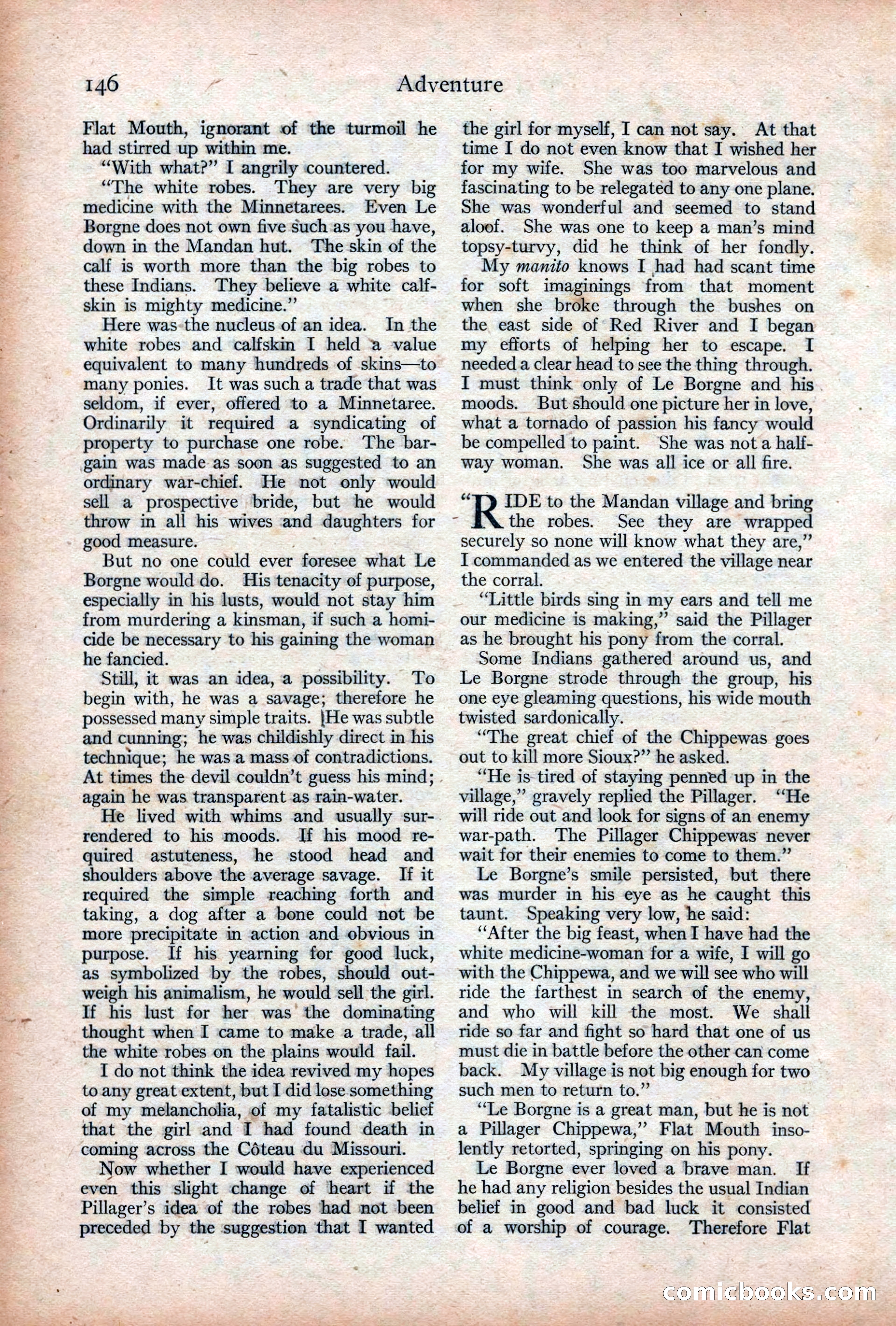
A restored page from Pulp Fiction, 1919. Page through the whole issue in the reader above.
📄 Transcribed text from this page (OCR, searchable)
Machine-transcribed from the original scan — historical spelling and the odd misread are preserved.
eat ee ASE IRS eee Pee ae 146 Flat Mouth, ignorant of the turmoil he had stirred up within me. “With what?” I angrily countered. “The white robes. They are very big medicine with the Minnetarees. Even Le Borgne does not own five such as you have, down in the Mandan hut. The skin of the calf is worth more than the big robes to these Indians. They believe a white calf- skin is mighty medicine.” Here was-the nucleus of an idea. In the white robes and calfskin I held ‘a value equivalent to many hundreds of skins—to many ponies. It was such a trade that was seldom, if ever, offered to a Minnetaree. Ordinarily it required a syndicating of property to purchase one robe. The bar- gain was made as soon as suggested to an ordinary war-chief. He not only would sell a prospective bride, but he would throw in all his wives and daughters for good measure. But no one could ever foresee what Le Borgne would do. His tenacity of purpose, especially in his lusts, would not stay him from murdering a kinsman, if such a homi- cide be necessary to his gaining the woman he fancied. Still, it was an idea, a possibility. To begin with, he was a savage; therefore he possessed many simple traits. |He was subtle and cunning; he was childishly direct in his technique; he was a mass of contradictions. At times the devil couldn’t guess his mind; . again he was transparent as rain-water. He lived with whims and usually sur-. rendered to his moods. If his mood re- quired astuteness, he stood head and shoulders above the average savage. If it required the simple reaching forth and taking, a dog after a bone could not be more precipitate in action and obvious in purpose. If his yearning for good luck, as symbolized by the robes, should out- weigh his animalism, he would sell the girl. If his lust for her was the dominating thought when I came to make a trade, all the white robes on the plains would fail. - I do not think the idea revived my hopes to any great extent, but I did lose something of my melancholia, of my fatalistic belief that the girl and I had found death in coming across the Céteau du Missouri. Now whether I would have experienced even this slight change of heart if the Pillager’s idea of the robes had mot been preceded by the suggestion that I wanted Adventure the girl for myself, I can not say. At that time I do not even know that I wished her for my wife. She was too marvelous and fascinating to be relegated to any one plane. She was wonderful and seemed to stand aloof. She was one to keep a man’s mind topsy-turvy, did he think of her fondly. My manito knows I had had scant time for soft imaginings from that moment when she broke through the bushes on the east side of Red River and I began my efforts of helping her to escape. I needed a clear head to see the thing through. I must think only of Le Borgne and his. moods. But-should one picture her in love, what a tornado of passion his fancy would be compelled to paint. She was not a half- way woman. She was all ice or all fire. IDE to the Mandan village and bring the robes. See they are wrapped securely so none will know what they are,” I commanded as we entered the village near the corral. “Little birds sing in my ears and tell me our medicine is making,” said the Pillager as he brought his pony from the corral. Some Indians gathered around us, and Le Borgne strode through the group, his one eye gleaming questions, his wide mouth twisted sardonically. “The great chief of the Chippewas goes out to kill more Sioux?”’ he asked. “He is tired of staying penned up in the village,” gravely replied the Pillager. “He will ride out and look for signs of an enemy war-path. The Pillager Chippewas never wait for their enemies to come to them.” Le Borgne’s smile persisted, but there was murder in his eye as he caught this taunt. Speaking very low, he said: “After the big feast, when I have had the white medicine-woman for a wife, I will go with the Chippewa, and we will see who will ride the farthest in search of the enemy, and who will kill the most. We shall ride so far and fight so hard that one of us must die in battle before the other can come | back. My village is not big enough for two such men to return to.” “Le Borgne is a great man, but he is not a Pillager Chippewa,” Flat Mouth inso- lently retorted, springing on his pony. Le Borgne ever loved a brave man. If he had any religion besides the usual Indian belief in good and bad luck it consisted of a worship of courage. Therefore Flat Eomicbooks GOI