
Pulp Fiction, 1919 · page 27 of 208
Adventure Magazine Cover, December 18, 1919 — page 27: what you’re looking at
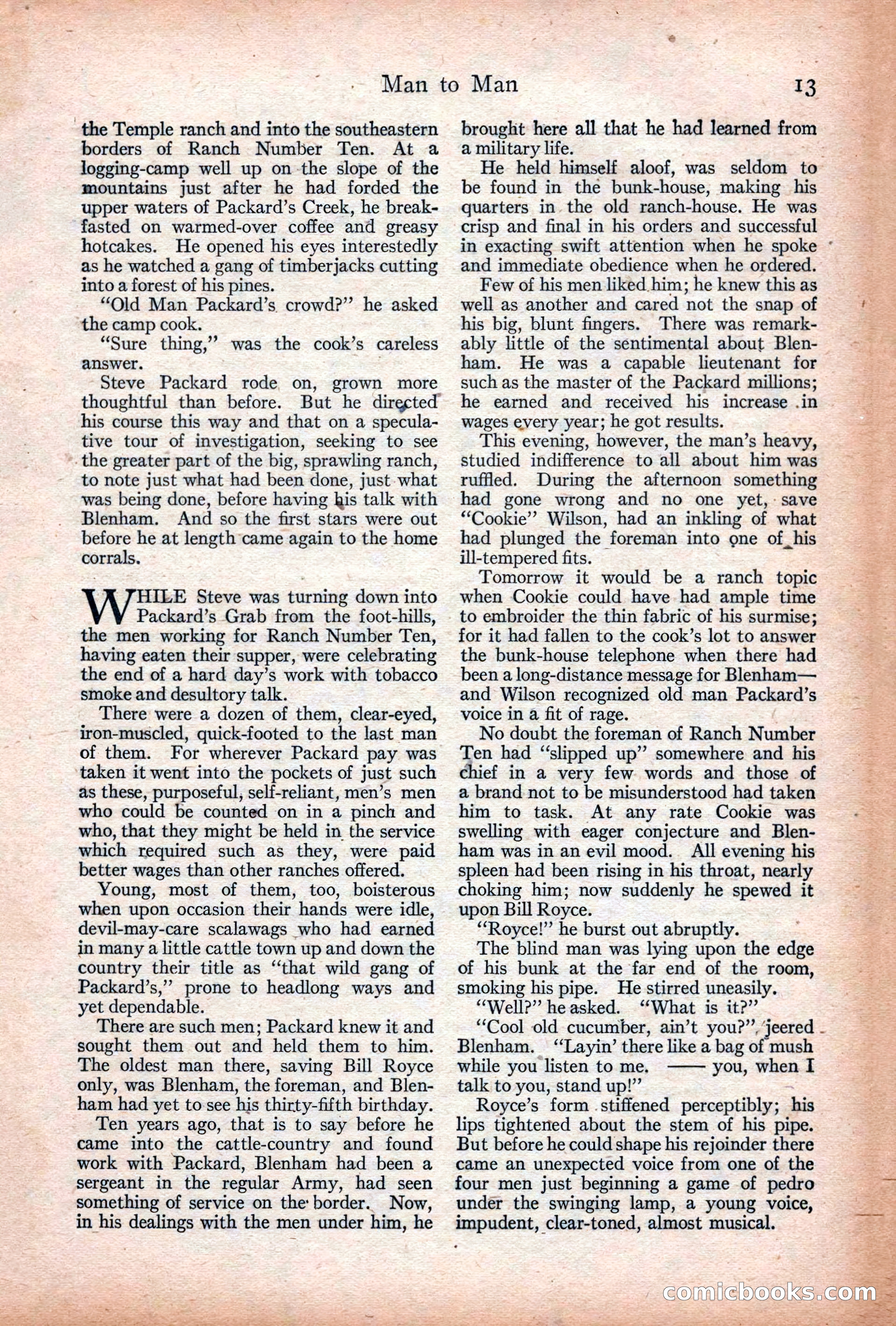
A restored page from Pulp Fiction, 1919. Page through the whole issue in the reader above.
📄 Transcribed text from this page (OCR, searchable)
Machine-transcribed from the original scan — historical spelling and the odd misread are preserved.
- st “> ~ S ae 4 : — t oe > ~~ es et ee See gis _ ” “ ie ow 2 - 5 “ee fo — © ee Pe ng no ee a a ee Man to Man 3 13 the Temple ranch and into the southeastern borders of Ranch Number Ten. At a logging-camp well up on-the slope of the mountains just after he had forded the upper waters of Packard’s Creek, he break- fasted on warmed-over coffee and greasy hotcakes. He opened his eyes interestedly as he watched a gang of timberjacks cutting into a forest of his pines. “Old Man Packard’s crowd?” he asked the camp cook. “Sure thing,’ was the cook’s careless answer. . Steve Packard rode on, grown more thoughtful than before. his course this way and that on a specula- tive tour of investigation, seeking to see the greater part of the big, sprawling ranch, to note just what had been done, just what was being done, before having his talk with Blenham. And so the first stars were out before he at length came again to the home sian ILE Steve was turning down into Packard’s Grab from the foot-hills, the men working for Ranch Number Ten, having eaten their supper, were celebrating the end of a hard day’s work with tobacco smoke and desultory talk. There were a dozen of them, clear-eyed, iron-muscled, quick-footed to the last man of them. For wherever Packard pay was taken it went into the pockets of just such as these, purposeful, self-reliant, men’s men who could be counted on in a pinch and who, that they might be held in the service which required such as they, were paid better wages than other ranches offered. Young, most of them, too, boisterous when upon occasion their hands were idle, devil-may-care scalawags who had earned in many a little cattle town up and down the country their title as “that wild gang of Packard’s,”’ prone to headlong ways and yet dependable. There are such men; Packard knew it and sought them out and held them to him. The oldest man there, saving Bill Royce only, was Blenham, the foreman, and Blen- ham had yet to see his thirty-fifth birthday. Ten years ago, that is to say before he came into the cattle-country and found work with Packard, Blenham had been a sergeant in the regular Army, had seen something of service on the: border. Now, in his dealings with the men under him, he OO rn ee . , oe. Sy i - ~ “. But he directed impudent, clear-toned, almost musical. brought here all that he had learned from a military life. He held himself aloof, was seldom te be found in the bunk- house, making his quarters in the old ranch-house. He was crisp and final in his orders and successful in exacting swift attention when he spoke * and immediate obedience when he ordered. Few of his men liked him; he knew this as well as another and cared not the snap of his big, blunt fingers. There was remark- ably little of the sentimental about Blen- ham. He was a capable lieutenant for such as the master of the Packard millions; he earned and received his increase .in — wages every year; he got results. This evening, however, the man’s heavy, studied indifference to all about him was ruffed. During the afternoon something had gone wrong and no one yet,-save “Cookie”? Wilson, had an inkling of what had plunged the foreman into one of_his ill-tempered fits. Tomorrow it would be a ranch topic when Cookie could have had ample time to embroider the thin fabric of his surmise; for it had fallen to the cook’s lot to answer the bunk-house telephone when there had been a long-distance message for Blenham— and Wilson recognized old man Packard’s voice in a fit of rage. No doubt the foreman of Ranch Number Ten had “‘slipped up”? somewhere and his chief in a very few words and those of a brand not to be misunderstood had taken him to task. At any rate Cookie was swelling with eager conjecture and Blen- ham was in an evil mood. All evening his spleen had been rising in his throat, nearly choking him; now suddenly he spewed it upon Bill Royce. “Royce!” he burst out abruptly. The blind man was lying upon the edge of his bunk at the far end of the room, smoking his pipe. He stirred uneasily. “Well?” heasked. ‘What is it?” “Cool old cucumber, ain’t you?”’, jeered - Blenham. while you listen to me. talk to you, stand up!” Royce’s form stiffened perceptibly; his lips tightened about the stem of his pipe. But before he could shape his rejoinder there came an unexpected voice from one of the four men just beginning a game of pedro under the swinging lamp, a young voice, “Layin’ there like a bag of mush —— you, when I cComichbook