
Pulp Fiction, 1919 · page 47 of 208
Adventure Magazine Cover, December 18, 1919 — page 47: what you’re looking at
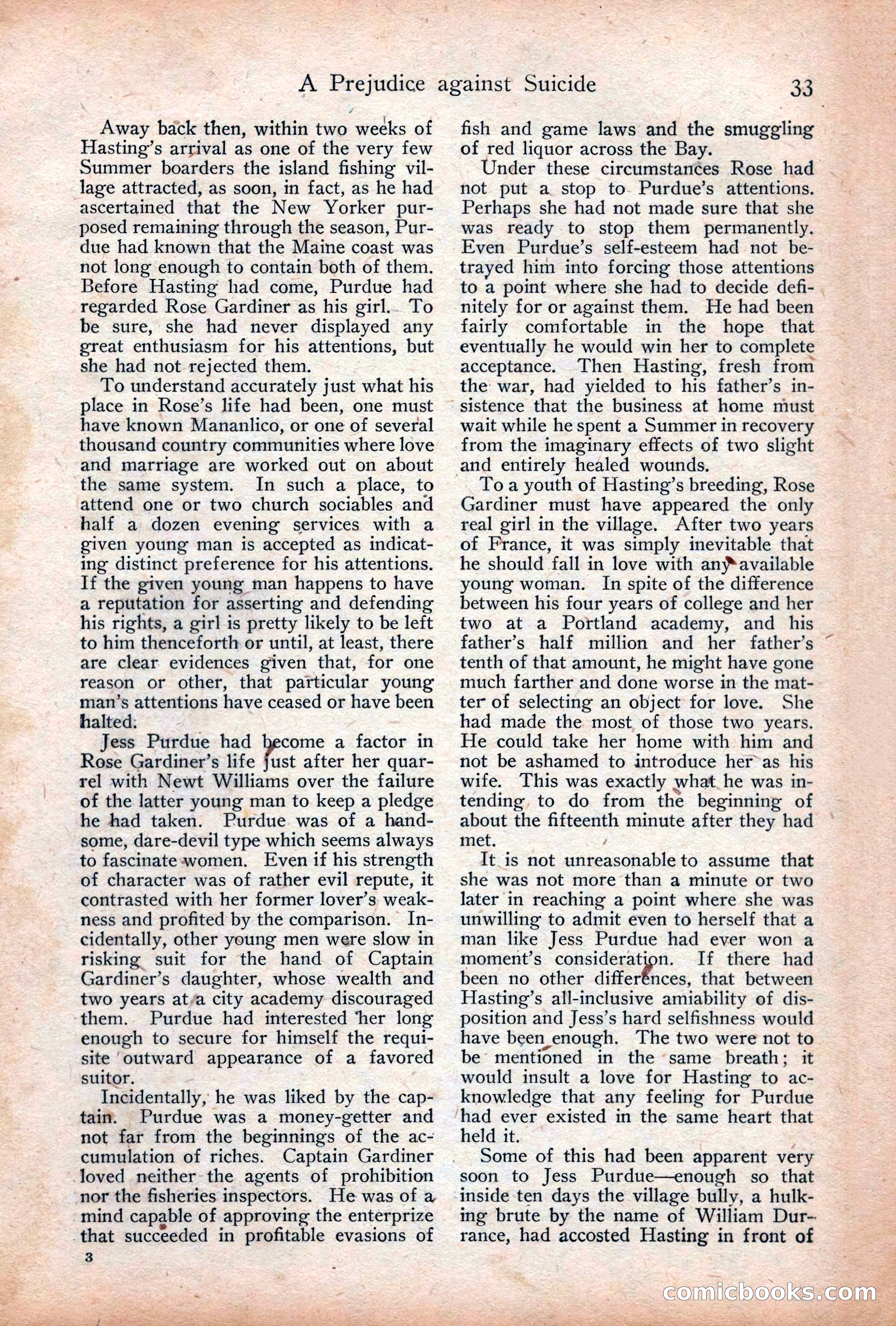
A restored page from Pulp Fiction, 1919. Page through the whole issue in the reader above.
📄 Transcribed text from this page (OCR, searchable)
Machine-transcribed from the original scan — historical spelling and the odd misread are preserved.
A Prejudice against Suicide Away back then, within two weeks of Hasting’s arrival as one of the very few Summer boarders the island fishing vil- lage attracted, as soon, in fact, as he had ascertained that the New Yorker pur- posed remaining through the season, Pur- due had known that the Maine coast was not long enough to contain both of them. Before Hasting had come, Purdue had regarded Rose Gardiner as his girl.. To be sure, she had never displayed any great enthusiasm for his attentions, but she had not rejected them. To understand accurately just what his place in Rose’s life had been, one must have known Mananlico, or one of several thousand country communities where love and marriage are worked out on about the same system. In such a place, to attend one or two church sociables and half a dozen evening services with a given young man is accepted as indicat- ing distinct preference for his attentions. If the given young man happens to have a reputation for asserting and defending his rights, a girl is pretty likely to be left to him thenceforth or until, at least, there are clear evidences given that, for one reason or other, that particular young man’s attentions have ceased or have been halted: | Jess Purdue had become a factor in Rose Gardiner’s life just after her quar- rel with Newt Williams over the failure of the latter young man to keep a pledge he had taken. Purdue was of a hand- some, dare-devil type which seems always to fascinate women. Even if his strength of character was of rather evil repute, it contrasted with her former lover’s weak- ness and profited by the comparison. In- cidentally, other young men were slow in risking suit for the hand of Captain Gardiner’s daughter, whose wealth and two years at/a city academy discouraged ‘them. Purdue had interested ‘her long enough to secure for himself the requi- site ‘outward appearance of a favored suitor. Incidentally, he was liked by the cap- tain. Purdue was a money-getter and not far from the beginnings of the ac- cumulation of riches. Captain Gardiner loved neither the agents of prohibition nor the fisheries inspectors. He was of a mind capable of approving the enterprize that succeeded in profitable evasions of fish and game laws and the smuggling of red liquor across the Bay. Under these circumstances Rose had not put a stop to. Purdue’s attentions. Perhaps she had not made sure that she was ready to stop them permanently. Even Purdue’s self-esteem had not be- trayed him into forcing those attentions to a point where she had to decide defi- nitely for or against them. He had been fairly comfortable in the hope that eventually he would win her to complete acceptance. Then Hasting, fresh from the war, had yielded to his father’s in- ~gistence that the business at home must wait while he spent a Summer in recovery from the imaginary effects of two slight and entirely healed wounds. Toa youth of Hasting’s breeding, Rose Gardiner must have appeared the only real girl in the village. After two years of France, it was simply inevitable that he should fall in love with any*available young woman. In spite of the difference between his four years of college and her two at a Portland academy, and his father’s half million and her father’s tenth of that amount, he might have gone much farther and done worse in the mat- ter of selecting an object for love. She had made the most of those two years. He could take her home with him and not be ashamed to introduce her as his wife. This was exactly what he was in- tending. to do from the beginning of about the fifteenth minute after they had met. It_is not iepasseudde to assume that she was not more than a minute or two later in reaching a point where she was unwilling to admit even to herself that a man like Jess Purdue had ever won a moment’s consideration. If there had been no other differtnces, that between Hasting’s all-inclusive amiability of dis- position and Jess’s hard selfishness would have been enough. The two were not to be mentioned in the same breath; it would insult a love for Hasting to ac- knowledge that any feeling for Purdue had ever existed in the same heart that held it. Some of this had been apparent very soon to Jess Purdue—enough so that inside ten days the village bully, a hulk- ing brute by the name of William Dur-- rance, had accosted Hasting in front of GOmicboo <S i P —— Oe eS eee 35. Eom —