
Pulp Fiction, 1920 · page 115 of 208
Adventure Magazine Cover — page 115: what you’re looking at
A restored page from Pulp Fiction, 1920. Page through the whole issue in the reader above.
📄 Transcribed text from this page (OCR, searchable)
Machine-transcribed from the original scan — historical spelling and the odd misread are preserved.
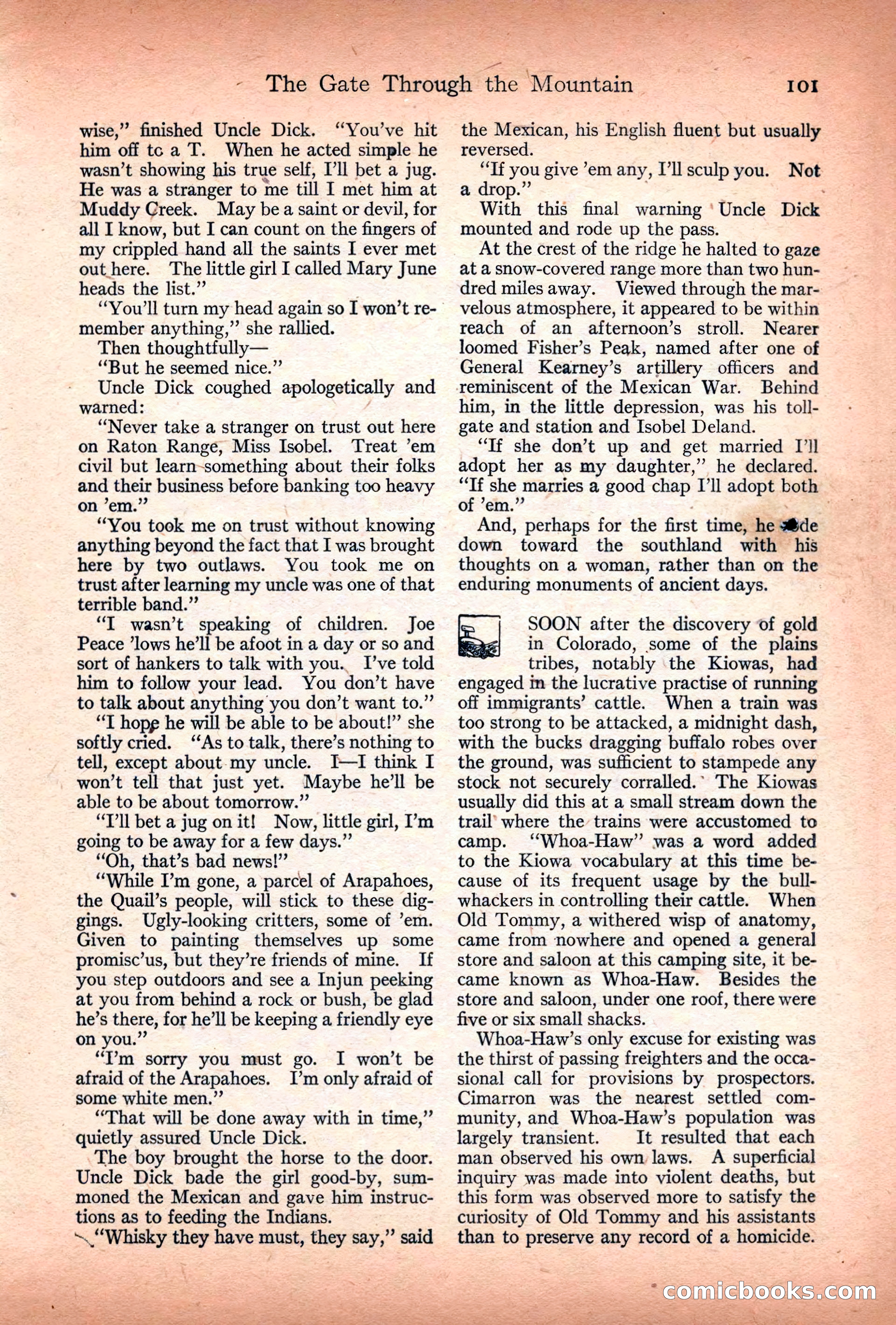
- The Gate e Through t de Sociiain : IOr wise,” finished Uncle Dick. “You’ve hit him off tc a T. When he acted simple he wasn’t showing his true self, I'll bet a jug. He was a stranger to me till I met him at Muddy Greek. May bea saint or devil, for all I know, but I can count on the fingers of my crippled hand all the saints I ever met out.here. The little girl I called Mary June heads the list.” “You'll turn my head again so I won’t re- member anything,” she rallied. Then thoughtfully— “But he seemed nice.” Uncle Dick coughed apologetically and warned: “Never take a stranger on trust out here on Raton Range, Miss Isobel. Treat ’em civil but learn-something about their folks and their business before banking too heavy on ’em.” “You took me on trust without knowing anything beyond the fact that I was brought here by two outlaws. You took me on trust after learning my uncle was one of that terrible band.” “IT wasn’t speaking of children. Joe Peace ‘lows he’ll be afoot in a day or so and sort of hankers to talk with you. I’ve told him to follow your lead. You don’t have to talk about anything you don’t want to.” “‘T hopg he will be able to be about!” she softly cried. ‘‘As to talk, there’s nothing to tell, except about my uncle. [I-—I think I _ won’t tell that just yet. Maybe he’ll be able to be about tomorrow.” “T’ll bet a jug on it! Now, little girl, I’m going to be away for a few days.” “Oh, that’s bad news!’ “While I’m gone, a parcel of Arapahoes, the Quail’s people, will stick to these dig- gings. Ugly-looking critters, some of ’em. Given to painting themselves up some promisc’us, but they’re friends of mine. If you step outdoors and see a Injun peeking at you from behind a rock or bush, be glad he’s there, for he’ll be keeping a friendly eye on you.’ “I’m sorry you must go. I won’t be afraid of the Arapahoes. I’m only afraid of some white men.” _ ©“That will be done away with in time,” quietly assured Uncle Dick. The boy brought the horse to the door. Uncle Dick bade the girl good-by, sum- moned the Mexican and gave him instruc- tions as to feeding the Indians. “Whisky they nave must, eat say,” said reminiscent of the Mexican War. the Mexican, his Piialey fluent but usually reversed. ae you give em any, I’llsculp you. Not a drop. mounted and rode up the pass. At the crest of the ridge he halted to gaze at a snow-covered range more than two hun- dred milesaway. Viewed through the mar- velous atmosphere, it appeared to be within reach of an afternoon’s stroll. Nearer loomed Fisher’s Peak, named after one of General Kearney’s artillery officers and Behind him, in the little depression, was his toll- gate and station and Isobel Deland. “Tf she don’t up and get married I'l adopt her as my daughter,” he declared. ge she marries a good chap I’ll adopt both of ’em.’ And, perhaps for the first time, he stde down toward the southland with his thoughts on a woman, rather than on the enduring monuments of ancient days. = in Colorado, some of the plains tribes, notably the Kiowas, had engaged im the lucrative practise of running off immigrants’ cattle. When a train was too strong to be attacked, a midnight dash, with the bucks dragging buffalo robes over the ground, was sufficient to stampede any stock not securely corralled.. The Kiowas usually did this at a small stream down the trail’ where the trains were accustomed to camp. ‘“Whoa-Haw” was a word added to the Kiowa vocabulary at this time be- cause of its frequent usage by the bull- whackers in controlling their cattle. When Old Tommy, a withered wisp of anatomy, came from nowhere and opened a general store and saloon at this camping site, it be- came known as Whoa-Haw. Besides the store and saloon, under one roof, there were five or six small shacks. Whoa-Haw’s only excuse for existing was the thirst of passing freighters and the occa- sional call for provisions by prospectors. Cimarron was the nearest settled com- munity, and Whoa-Haw’s population was largely transient. It resulted that each man observed his own laws. A superficial inquiry was made into violent deaths, but this form was observed more to satisfy the curiosity of Old Tommy and his assistants than to preserve any record of a homicide. SOON after the discovery of gold With this final warning ‘Uncle Dick