
Pulp Fiction, 1920 · page 163 of 208
Adventure Magazine Cover — page 163: what you’re looking at
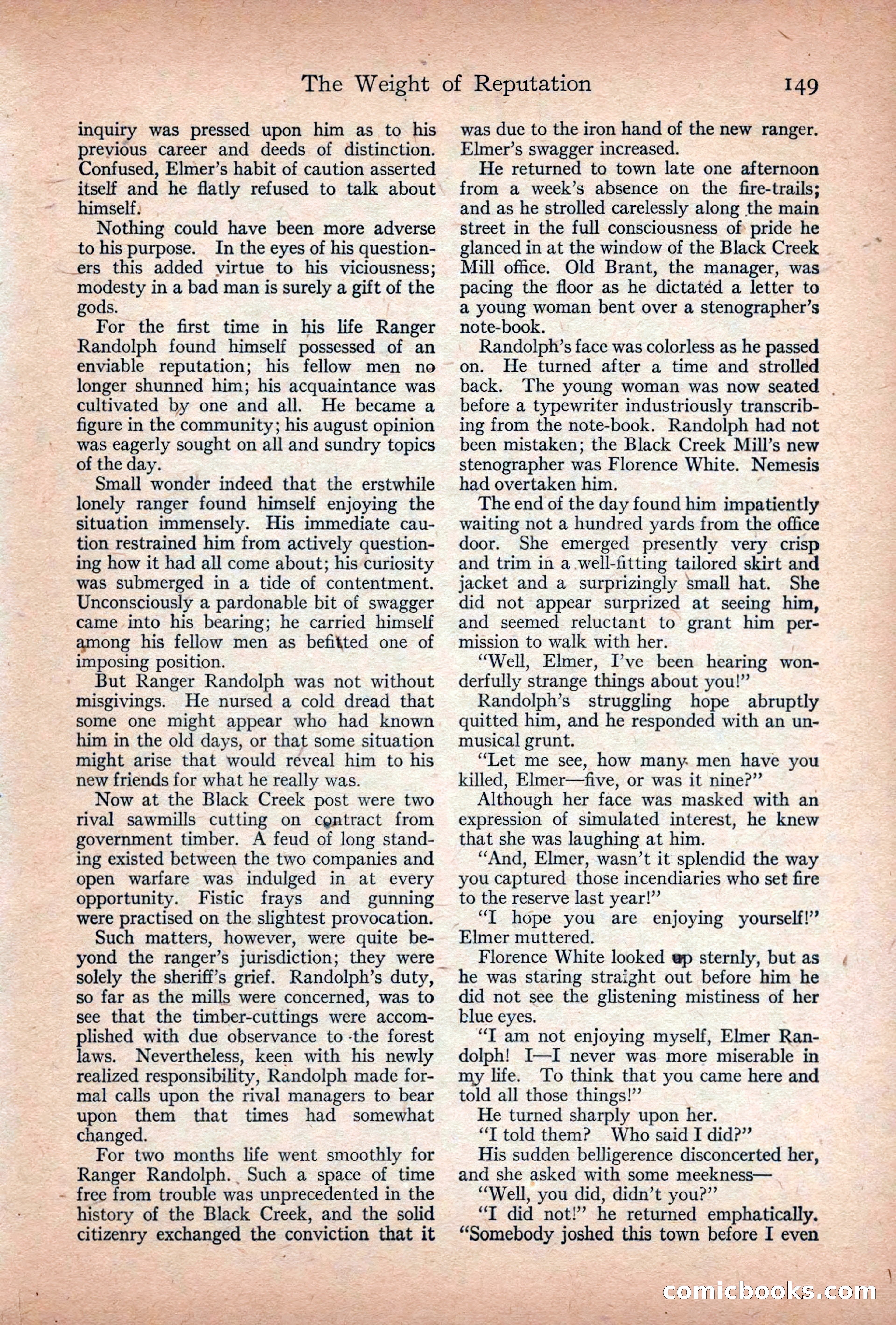
A restored page from Pulp Fiction, 1920. Page through the whole issue in the reader above.
📄 Transcribed text from this page (OCR, searchable)
Machine-transcribed from the original scan — historical spelling and the odd misread are preserved.
— a < Aa eS ‘ The Weight of Reputation inquiry was pressed upon him as to his previous career and deeds of distinction. Confused, Elmer’s habit of caution asserted itself and he flatly refused to talk about himself, Nothing could have been more adverse to his purpose. In the eyes of his question- -ers this added virtue to his viciousness; modesty in a bad man is surely a gift of the gods. For the first time in his life Ranger Randolph found himself possessed of an enviable reputation; his fellow men no longer shunned him; his acquaintance was cultivated by one and all. He became a figure in the community; his august opinion was eagerly sought on all and sundry topics of the day. Small wonder indeed that the erstwhile lonely ranger found himself enjoying the situation immensely. His immediate cau- tion restrained him from actively question- ing how it had all come about; his curiosity was submerged in a tide of contentment. Unconsciously a pardonable bit of swagger came into his bearing; he carried himself among his fellow men as befitted one of imposing position. But Ranger Randolph was not without misgivings. He nursed a cold dread that some one might appear who had known him in the old days, or that some situation might arise that would reveal him to his new friends for what he really was. Now at the Black Creek post were two rival sawmills cutting on cgntract from government timber. A feud of long stand- ing existed between the two companies and open warfare was indulged in at every opportunity. Fistic frays and gunning were practised on the slightest provocation. Such matters, however, were quite be- yond the ranger’s jurisdiction; they were solely the sheriff’s grief. Randolph’s duty, © so far as the mills were concerned, was to see that the timber-cuttings were accom- plished with due observance to -the forest laws. Nevertheless, keen with his newly realized responsibility, Randolph made for- mal calls upon the rival managers to bear upon them that times had somewhat changed. For two months life went smoothly for Ranger Randolph. Such a space of time free from trouble was unprecedented in the history of the Black Creek, and the solid citizenry exchanged the conviction that it was due to the iron hand of the new ranger. Elmer’s swagger increased. He returned to town late one afternoon from a week’s absence on the fire-trails; and as he strolled carelessly along the main street in the full consciousness of pride he glanced in at the window of the Black Creek Mill office. Old Brant, the manager, was pacing the floor as he dictatéd a letter to a young woman bent over a stenographer’s note-book. Randolph’s face was colorless as he passed on. He turned after a time and strolled 149 back. The young woman was now seated | before a typewriter industriously transcrib- ing from the note-book. Randolph had not been mistaken; the Black Creek Mill’s new stenographer was Florence White. Nemesis had overtaken him. The end of the day found him impatiently waiting not a hundred yards from the office door. She emerged presently very crisp and trim in a.well-fitting tailored skirt and jacket and a surprizingly small hat. She did not appear surprized at seeing him, and seemed reluctant to grant him per- mission to walk with her. “Well, Elmer, I’ve been hearing won- derfully strange things about you!” Randolph’s_ struggling hope abruptly quitted him, and he responded with an un- musical grunt. “Let me see, how many. men have you killed, Elmer—five, or was it nine?” Although her face was masked with an expression of simulated interest, he knew that she was laughing at him. “And, Elmer, wasn’t it splendid the way you captured those incendiaries who set fire to the reserve last year!” “T hope you are enjoying yourself!’ Elmer muttered. Florence White looked ep sternly, but as he was staring straight out before him he did not see the glistening mistiness of her blue eyes. “T am not enjoying myself, Elmer Ran- dolph! I—I never was more miserable in my life. To think that you came here and told all those things!” : He turned sharply upon her. “T told them? Who said I did?” His sudden belligerence disconcerted her, and she asked with some meekness— “Well, you did, didn’t you?” “T did not!” he returned emphatically. “Somebody joshed this town before I even Eomichbooks ee 7 - . é (E(0)