
Pulp Fiction, 1920 · page 18 of 208
Adventure Magazine Cover — page 18: what you’re looking at
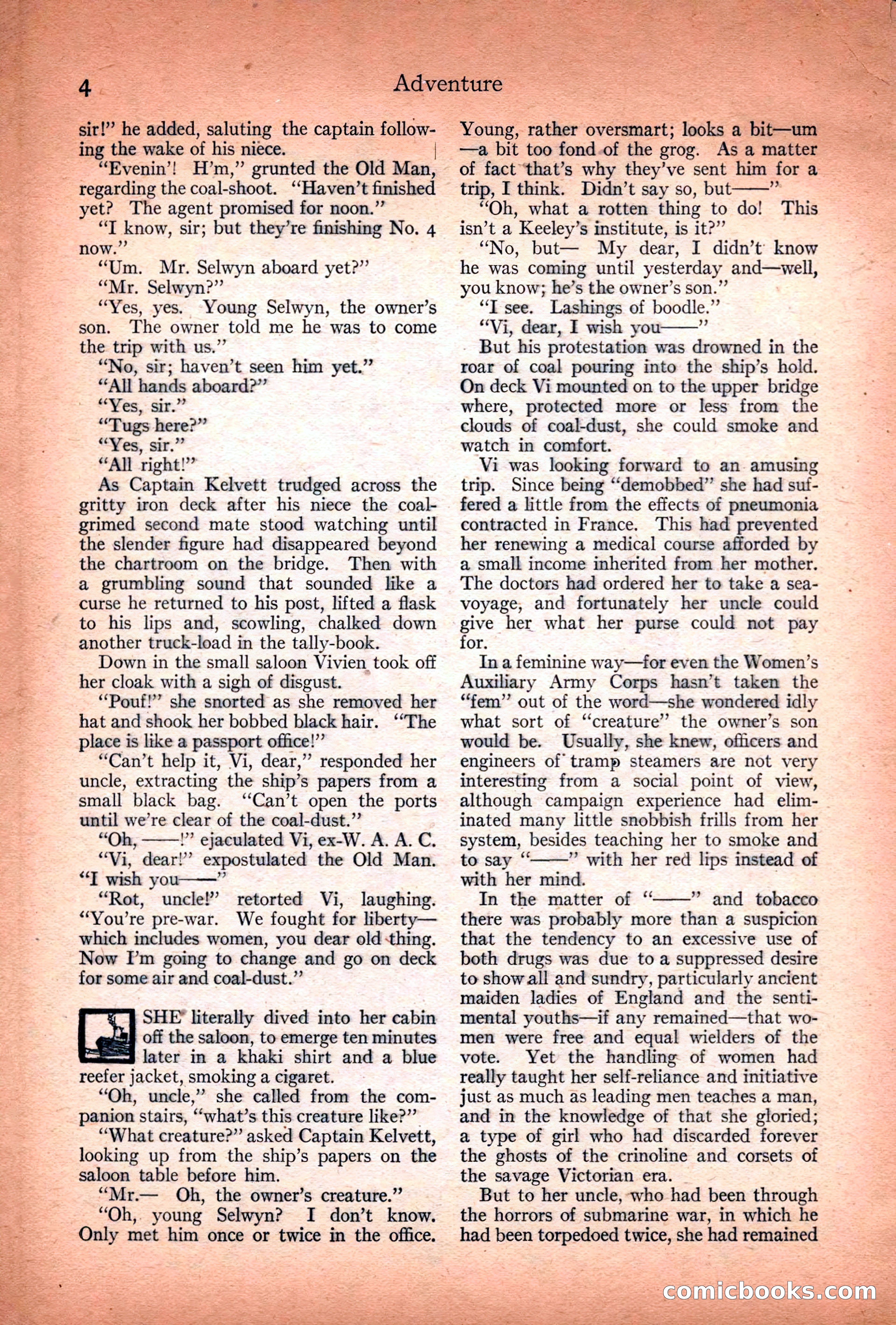
A restored page from Pulp Fiction, 1920. Page through the whole issue in the reader above.
📄 Transcribed text from this page (OCR, searchable)
Machine-transcribed from the original scan — historical spelling and the odd misread are preserved.
= sit!” he added, saluting the captain follow- _ ing the wake of his niece. | “Evenin’! H’m,” grunted the Old Man, ~ regarding the coal-shoot. ‘Haven’t finished yet? The agent promised for noon.” “T know, sir; but they’re finishing No. 4 now.” “Um. Mr. Selwyn aboard yet?” “Mr. Selwyn?” “Yes, yes. Young Selwyn, the owner’s son. The owner told me he was to come the trip with us.” “No, sir; haven’t seen him yet.” “All hands aboard?” *¥es,: sir.” “Tugs here?” “Yes, sir.” “All right!” As Captain Kelvett trudged across the gritty iron deck after his niece the coal- grimed second mate stood watching until the slender figure had disappeared beyond the chartroom on the bridge. Then with a grumbling sound that sounded like a curse he returned to his post, lifted a flask to his lips and, scowling, chalked down another truck-load in the tally-book. Down in the small saloon Vivien took off her cloak with a sigh of disgust. “Pouf!”” she snorted as she removed her hat and shook her bobbed black hair. ‘““The place is like a passport office!”’ “Can’t help it, Vi, dear,”’ responded her uncle, extracting the ship’ Ss papers from a small black bag. “Can’t open the ports until we’re clear of the coal-dust.” “Oh, !” ejaculated Vi, ex-W. A. A. C. “Vi, dear!’ expostulated the Old Man. “T wish you——” “Rot, uncle!’ retorted Vi, laughing. “You’re pre-war. We fought for liberty— which includes women, you dear old thing. Now I’m going to change and go on deck for some air and coal-dust.” \ SHE’ literally dived into her cabin el off the saloon, to emerge ten minutes === later in a khaki shirt and a blue reefer jacket, smoking a cigaret. “Oh, uncle,” she called from the com- panion stairs, ‘“what’s this creature like?” “What creature?” asked Captain Kelvett, looking up from the ship’s papers on the saloon table before him. “Mr.— Oh, the owner’s creature.” “Oh,. young Selwyn? I don’t know. - Only met him once or twice in the office. _—a bit too fond.of the grog. Asa matte Voting’ railiee oversnart: eke a a: of fact ‘that’s why they’ve sent him for a a trip, I think. Didn’t say so, but——” “Oh, what a rotten thing to do! This isn’t a Keeley’s institute, is it?” “No, but— My dear, I didn’t know he was coming until yesterday and—well, you know; he’s the owner’s son.” “IT see. Lashings of boodle.” “Vi, dear, I wish you But his protestation was drowned in the roar of coal pouring into the ship’s hold. On deck Vi mounted on to the upper bridge where, protected more or less from the clouds of coal-dust, she could smoke and watch in comfort. Vi was looking forward to an. amusing trip. Since being “demobbed” she had suf- fered a little from the effects of pneumonia contracted in France. This had prevented her renewing a medical course afforded by a small income inherited from her mother. The doctors had ordered her to take a sea- voyage, and fortunately her uncle could give her what her purse could not pay for. In a feminine way—for even the Women’s Auxiliary Army Corps hasn’t taken the “fem” out of the word—she wondered idly what sort of “creature’’ the owner’s son would be. Usually, she knew, officers and engineers of tramp steamers are not very interesting from a social point of view, although campaign experience had elim- inated many little snobbish frills from her system, besides teaching her to smoke and to say “ ” with her red lips instead of with her mind. In the matter of ‘——” and tobacco there was probably more than a suspicion that the tendency to an excessive use of both drugs was due to a suppressed desire to show all and sundry, particularly ancient maiden ladies of England and the senti- mental youths—if any remained—that wo- men were free and equal wielders of the vote. Yet the handling of women had really taught her self-reliance and initiative just as much as leading men teaches a man, and in the knowledge of that she gloried; a type of girl who had discarded forever the ghosts of the crinoline and corsets of the savage Victorian era. - But to her uncle, who had been through the horrors of submarine war, in which he had been torpedoed twice, she had remained