
Pulp Fiction, 1920 · page 180 of 208
Adventure Magazine Cover — page 180: what you’re looking at
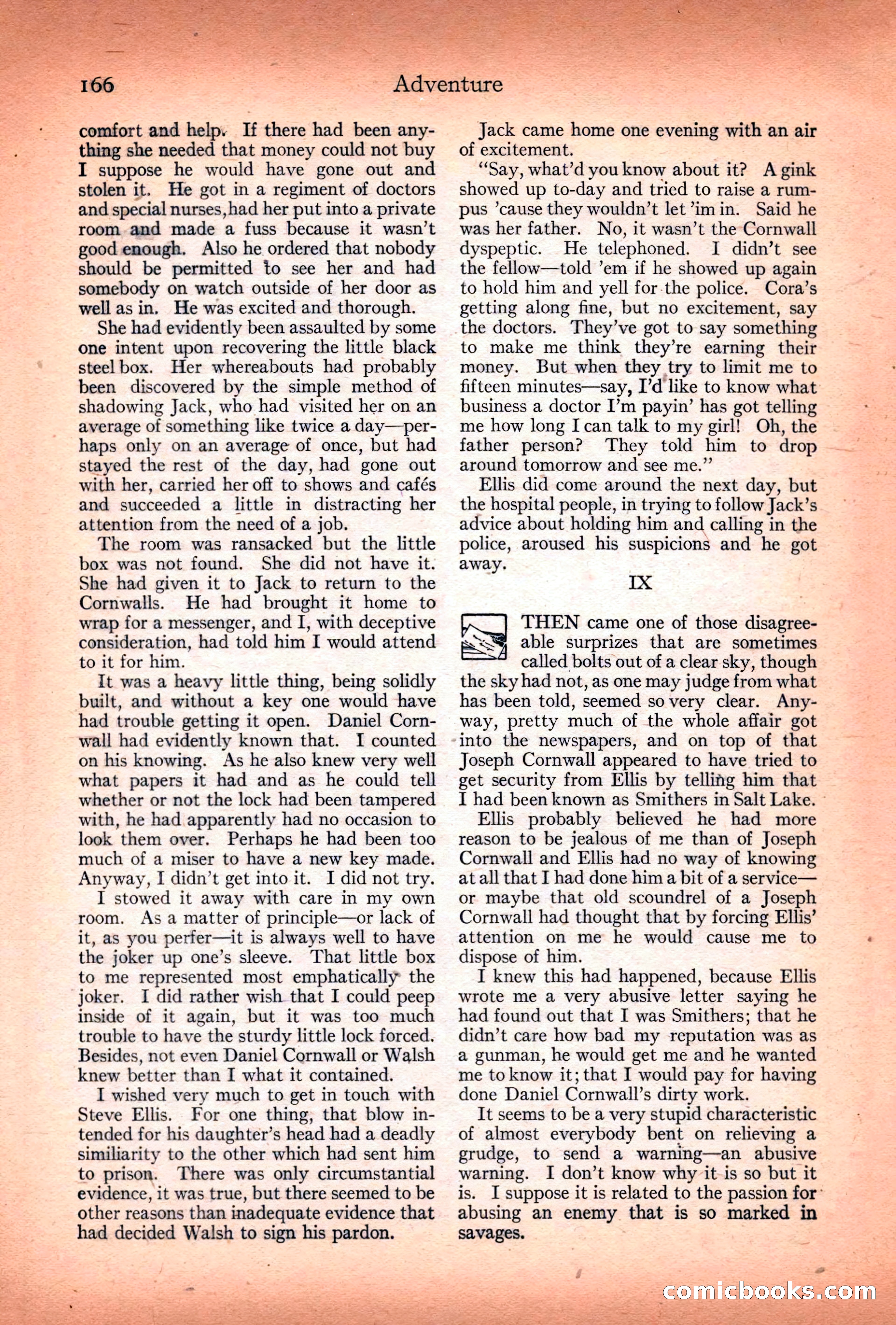
A restored page from Pulp Fiction, 1920. Page through the whole issue in the reader above.
📄 Transcribed text from this page (OCR, searchable)
Machine-transcribed from the original scan — historical spelling and the odd misread are preserved.
nme 5” ~d joker. = fomsioct and help. lf there bad been any- thing she needed that money could not buy ce suppose he would have gone out and stolen it. He got in a regiment of doctors and special nurses,had her put into a private room and made a fuss because it wasn’t good enough. Also he ordered that nobody should be permitted to see her and had somebody on watch outside of her door as well as in. He was excited and thorough. She had evidently been assaulted by some one intent upon recovering the little black steel box. Her whereabouts had probably been discovered by the simple method of shadowing Jack, who had visited her on an average of something like twice a day—per- haps only on an average of once, but had stayed the rest of the day, had gone out with her, carried her off to shows and cafés and succeeded a little in distracting her attention from the need of a job. The room was ransacked but the little box was not found. She did not have it. She had given it to Jack to return to the Cornwalls. He had brought it home to wrap for a messenger, and I, with deceptive consideration, had told him I would attend to it for him. It was a heavy little thing, being solidly built, and without a key one would have had trouble getting it open. Daniel Corn- wall had evidently known that. I counted on his knowing. As he also knew very well what papers it had and as he could tell whether or not the lock had been tampered with, he had apparently had no occasion to look them over. Perhaps he had been too much of a miser to have a new key made. Anyway, I didn’t get into it. I did not try. I stowed it away with care in my own room. Asa matter of principle—or lack of it, as you perfer—it is always well to have the joker up one’s sleeve. That little box to me represented most emphatically the I did rather wish that I could peep inside of it again, but it was too much trouble to have the sturdy little lock forced. Besides, not even Daniel Cornwall or Walsh knew better than I what it contained. I wished very much to get in touch with Steve Ellis. For one thing, that blow in- tended for his daughter’s head had a deadly similiarity to the other which had sent him to prison. There was only circumstantial evidence, it was true, but there seemed to be other reasons than inadequate evidence that had decided Walsh to sign his pardon. ee ws Be ee he i So Senet. Vee ed Jack came home one evening with an air — of excitement. “Say, what’d you know about it? A gink showed up to-day and tried to raise a rum- pus ’cause they wouldn’t let ’imin. Said he was her father. No, it wasn’t the Cornwall dyspeptic. He telephoned. I didn’t see the fellow—told ’em if he showed up again to hold him and yell for-the police. Cora’s getting along fine, but no excitement, say the doctors. They’ve got to say something to make me think they’re earning their money. But when they try to limit me to fifteen minutes—say, I’d’ like to know what business a doctor I’m payin’ has got telling me how long I can talk to my girl! Oh, the father person? around tomorrow and see me.’ Ellis did come around the next day, but the hospital people, in trying to follow Jack’s advice about holding him and calling in the police, aroused his suspicions and he got away. TX bh THEN came one of those disagree- BSS | able surprizes that are sometimes called bolts out of a clear sky, though the sky had not, as one may judge from what has been told, seemed so very clear. Any- way, pretty much of the whole affair got ‘into the newspapers, and on top of that Joseph Cornwall appeared to have tried to get security from Ellis by telling him that I had been known as Smithers in Salt Lake. © Ellis probably believed he had more reason to be jealous of me than of Joseph Cornwall and Ellis had no way of knowing at all that I had done him a bit of a service— or maybe that old scoundrel of a Joseph Cornwall had thought that by forcing Ellis’ attention on me he would cause me to dispose of him. I knew this had happened, because Ellis wrote me a very abusive letter saying he had found out that I was Smithers; that he didn’t care how bad my reputation was as a gunman, he would get me and he wanted me to know it; that I would pay for having done Daniel Cornwall’s dirty work. It seems to be a very stupid characteristic of almost everybody bent on relieving a grudge, to send a warning—an abusive warning. I don’t know why it is so but it is. I suppose it is related to the passion for’ abusing an enemy that is so marked in savages. aa “== SF, eS ee rere eee) 1S Bee 3 i eats nak ER ee (0) ro O'@ k They told him to drop .