
Pulp Fiction, 1920 · page 187 of 208
Adventure Magazine Cover — page 187: what you’re looking at
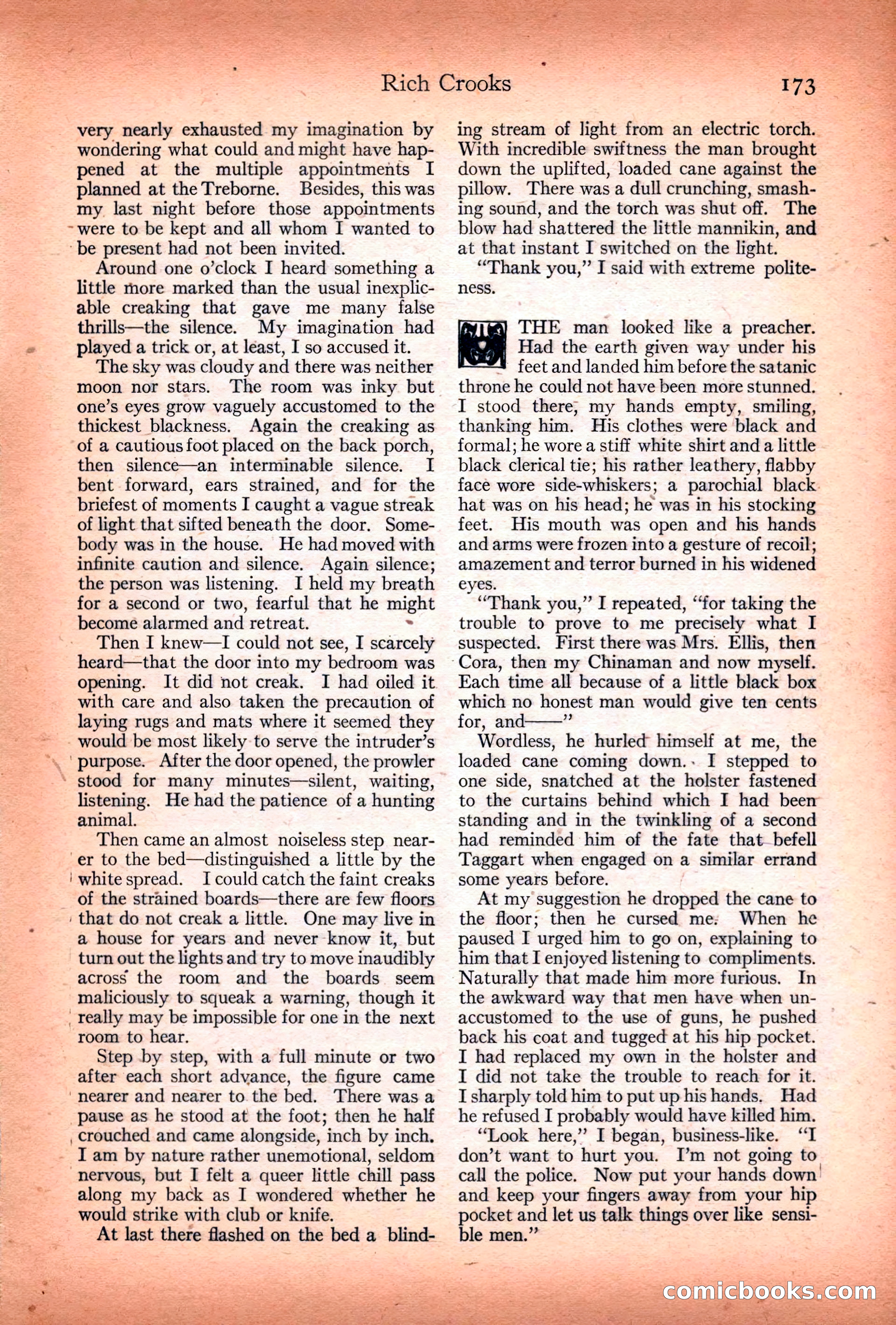
A restored page from Pulp Fiction, 1920. Page through the whole issue in the reader above.
📄 Transcribed text from this page (OCR, searchable)
Machine-transcribed from the original scan — historical spelling and the odd misread are preserved.
3S very nearly exhausted my imagination by wondering what could and might have hap- pened at the multiple appointments I = planned at the Treborne. Besides, this was my last night before those appointments = were to be kept and all whom I wanted to ‘be present had not been invited. Around one o’clock I heard something a little more marked than the usual inexplic- able creaking that gave me many false thrills—the silence. My imagination had played a trick or, at least, I so accused it. The sky was cloudy and there was neither moon nor stars. The room was inky but one’s eyes grow vaguely accustomed to the thickest blackness. Again the creaking as ‘of a cautious foot placed on the back porch, then silence—an interminable silence. I bent forward, ears strained, and for the briefest of moments I caught a vague streak of light that sifted beneath the door. Some- body was in the house. He had moved with infinite caution and silence. Again silence; the person was listening. I held my breath for a second or two, fearful that he might become alarmed and retreat. - Then I knew—I could not see, I scarcely heard—that the door into my bedroom was ---—~—s opening. It did not creak. I had oiled it ___ with care and also taken the precaution of --__ laying rugs and mats where it seemed they = ae - would be most likely to serve the intruder’s ae a purpose. After the door opened, the prowler __ * stood for many minutes—silent, waiting, -_____ listening. He had the patience of a hunting 3 animal. Lae oe Then came an almost noiseless step near- ‘er to the bed—distinguished a little by the | white spread. I could catch the faint creaks ____ of the strained boards—there are few floors + that do not creak a little. One may live in a house for years and never know it, but ei turn out the lights and try to move inaudibly across the room and the boards seem ~ Step by step, with a full minute or two after each short advance, the figure came ‘nearer and nearer to the bed. There was a pause as he stood at the foot; then he half __, crouched and came alongside, inch by inch. qe 7 am by nature rather unemotional, seldom nervous, but I felt a queer little chill pass re: _along my back as I wondered whether he _ would strike with club or knife. Ce Be . . ae maliciously to squeak a warning, though it ce. ___, really may be impossible for one in the next ea: room to hear. set At es there flashed on a the bed a blind-. ing stream of light from an electric torch. ae With incredible swiftness the man brought — down the uplifted, loaded cane against the pillow. There was a dull crunching, smash- ing sound, and the torch was shut off. The blow had shattered the little mannikin, and at that instant I switched on the light. “Thank you,” I said with extreme polite- ness. m) THE man looked like a preacher. Had the earth given way under his NAM" feet and landed him before the satanic throne he could not have been more stunned. I stood there, my hands empty, smiling, thanking him. His clothes were black and formal; he wore a stiff white shirt and a little | black clerical tie; his rather leathery, flabby face wore side-whiskers: a parochial black. hat was on his head; he was in his stocking feet. His mouth was open and his hands and arms were frozen into a gesture of recoil; amazement and terror burned in his widened eyes. “Thank you,” I repeated, “for taking the trouble to prove to me precisely what I suspected. First there was Mrs. Ellis, then ‘Cora, then my Chinaman and now myself. Each time all because of a little black box which no honest man would give ten cents for, and Wordless, he hurled himself at me, the loaded cane coming down.- I stepped to one side, snatched at the holster fastened to the curtains behind which I had been standing and in the twinkling of a second had reminded him of the fate that befell Taggart when engaged on a similar errand some years before. At my suggestion he dropped the cane to the floor; then he cursed me: When he paused I ‘urged him to go on, explaining to him that I enjoyed listening to compliments. Naturally that made him more furious. In the awkward way that men have when un- accustomed to the use of guns, he pushed back his coat and tugged at his hip pocket. I had replaced my own in the holster and I did not take the trouble to reach for it. I sharply told him to put up his hands. Had he refused I probably would have killed him. “Look here,’ I began, business-like. “T don’t want to hurt you. I’m not going to call the police. Now put your hands down! and keep your fingers away from your hip pocket and let us talk things over like sensi- ble men.” 9 vey 4% aye lhe hoe (hes ee) ee Te f 4 ’ NWA ‘is , >, CeCe aera ee Pe