
Pulp Fiction, 1920 · page 189 of 208
Adventure Magazine Cover — page 189: what you’re looking at
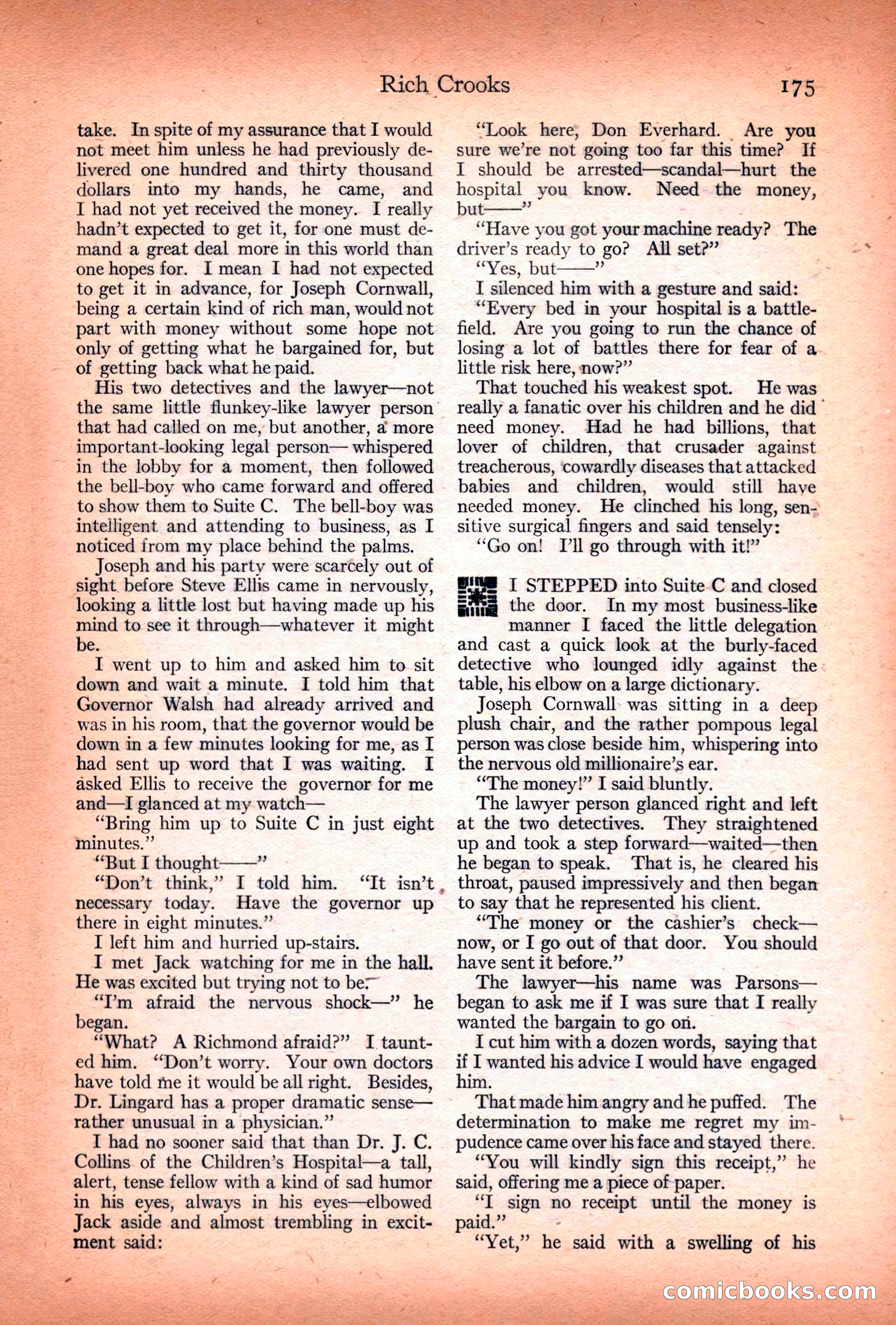
A restored page from Pulp Fiction, 1920. Page through the whole issue in the reader above.
📄 Transcribed text from this page (OCR, searchable)
Machine-transcribed from the original scan — historical spelling and the odd misread are preserved.
hn Rich Crooks 175_ take. In spite of my assurance that I would not meet him unless he had previously de- livered one hundred and thirty thousand dollars into my hands, he came, and I had not yet received the money. I really hadn’t expected to get it, for one must de- mand a great deal more in this world than one hopes for. I mean I had not expected to get it in advance, for Joseph Cornwall, being a certain kind of rich man, would not part with money without some hope not only of getting what he bargained for, but of getting back what he paid. His two detectives and the lawyer—not the same little flunkey-like lawyer person that had called on me, but another, a more important-looking legal person— whispered in the lobby for a moment, then followed the bell-boy who came forward and offered to show them to Suite C. The bell-boy was intelligent and attending to business, as I noticed from my place behind the palms. Joseph and his party were scarcely out of sight. before Steve Ellis came in nervously, looking a little lost but having made up his mind to see it through—whatever it might be. I went up to him and asked him to sit down and wait a minute. I told him that Governor Walsh had already arrived and was in his room, that the governor would be down in a few minutes looking for me, as I had sent up word that I was waiting. I asked Ellis to receive the governor for me and—I glanced at my watch— “Bring him up to Suite C in just eight minutes.” “But I thought——” “Don’t think,” I told him. necessary today. Have the governor up there in eight minutes.” I left him and hurried up-stairs. I met Jack watching for me in the hall. He was excited but trying not to bes “T’m afraid the nervous shock—” he began. “What? A Richmond afraid?” I taunt- ed him. “Don’t worry. Your own doctors have told me it would be all right. Besides, Dr. Lingard has a proper dramatic sense— rather unusual in a physician.” I had no sooner said that than Dr. J. C. Collins of the Children’s Hospital—a tall, alert, tense fellow with a kind of sad humor in his eyes, always in his eyes—elbowed Jack aside and almost trembling in excit- ment said: we = a . ae a a. ee eS SSS PS —— ae a me : — a eT a ae ae yp ES * ee EO i ee ne gd ep nee ae: aeaee “Tt isn’t , “Look here, Don Everhard. Are you sure we're not going too far this time? If I should be arrested—scandal—hurt the hospital you know. Need the money, but “Have you got your machine ready? The driver’s ready to go? All set?” “Yes, but se I silenced him with a gesture and said: “Every bed in your hospital is a battle- field. Are you going to run the chance of losing a lot of battles there for fear of a little risk here, now?” That touched his weakest spot. He was really a fanatic over his children and he did’ need money. Had he had billions, that lover of children, that crusader against treacherous, ‘cowardly diseases that attacked babies and children, would still have needed money. He clinched his long, sen- sitive surgical fingers and said tensely: “Go on! Ill go through with it!” 2 I STEPPED into Suite C and closed sau the door. In my most business-like manner I faced the little delegation and cast a quick look at the burly-faced detective who lounged idly against the: table, his elbow on a large dictionary. Joseph Cornwall was sitting in a deep plush chair, and the rather pompous legal person was close beside him, whispering into the nervous old millionaire’s ear. “The money!” I said bluntly. The lawyer person glanced right and left at the two detectives. They straightened up and took a step forward—waited—then he began to speak. That is, he cleared his throat, paused impressively and then began to say that he represented his client. “The money or the cashier’s check— now, or I go out of that door. You should have sent it before.” The lawyer—his name was Parsons— began to ask me if I was sure that I really wanted the bargain to go ori. I cut him with a dozen words, saying that if I wanted his advice I would have engaged him That made him angry and he puffed. The determination to make me regret my im- pudence came over his face and stayed there. “You will kindly sign this receipt,’ he said, offering me a piece of paper. “T sign no receipt until the money is paid.” “Vet,” he said with a swelling of his