
Pulp Fiction, 1920 · page 194 of 208
Adventure Magazine Cover — page 194: what you’re looking at
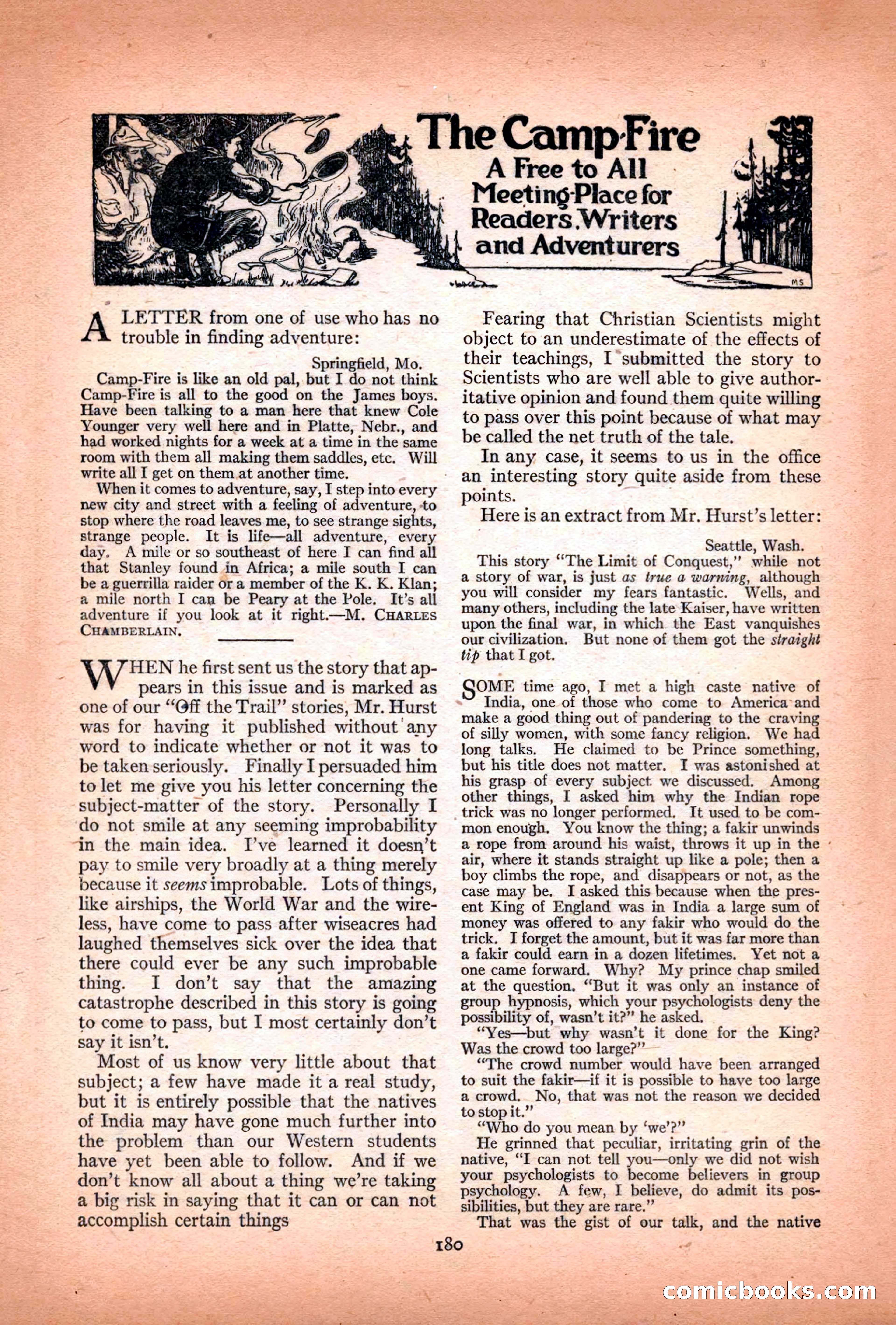
A restored page from Pulp Fiction, 1920. Page through the whole issue in the reader above.
📄 Transcribed text from this page (OCR, searchable)
Machine-transcribed from the original scan — historical spelling and the odd misread are preserved.
3 LETTER from one of use who has no trouble in finding adventure: Springfield, Mo. Camp-Fire is like an old pal, but I do not think Camp-Fire is all to the good on the James boys. Have been talking to a man here that knew Cole Younger very well here and in Platte, Nebr., and had worked nights for a week at a time in the same room with them all making them saddles, etc. Will write all I get on them at another time. When it comes to adventure, say, I step into every new city and street with a feeling of adventure, -to stop where the road leaves me, to see strange sights, strange people. It is life—all adventure, every day. A mile or so southeast of here I can find all that Stanley found in Africa; a mile south I can be a guerrilla raider or a member of the K. K. Klan; a mile north I cam be Peary at the Pole. It’s all adventure if you look at it right—M. CHARLES CHAMBERLAIN, WHEN he first sent us the story that ap- pears in this issue and is marked as one of our “‘@ff the Trail” stories, Mr. Hurst was for having it published without any word to indicate whether or not it was to be taken seriously. Finally I persuaded him to let me give you his letter concerning the ‘subject-matter of the story. Personally I do not smile at any seeming improbability “in the main idea. I’ve learned it doesn’t pay to smile very broadly at a thing merely because it seems improbable. Lots of things, like airships, the World War and the wire- less, have come to pass after wiseacres had laughed themselves sick over the idea that there could ever be any such improbable thing. I don’t say that the amazing catastrophe described in this story is going to come to pass, but I most certainly don’t say it isn’t. Most of us know very little about that subject; a few have made it a real study, but it is entirely possible that the natives of India may have gone much further into the problem than our Western students have yet been able to follow. And if we don’t know all about a thing we’re taking a big risk in saying that it can or can not accomplish certain things A Free to All ng-Place for Meeti Readers Writers and Adventurers Fearing that Christian Scientists might object to an underestimate of the effects of their teachings, I submitted the story to Scientists who are well able to give author- itative opinion and found them quite willing to pass over this point because of what may ~ be called the net truth of the tale. In any case, it seems to us in the office an interesting story quite aside from these points. Here is an extract from Mr. Hurst’s letter: Seattle, Wash. This story ‘““The Limit of Conquest,’’ while not a story of war, is just as true a warning, although you will consider my fears fantastic. Wells, and many others, including the late Kaiser, have written upon the final war, in which the East vanquishes our civilization. But none of them got the straight tip that I got. SOME time ago, I met a high caste native of India, one of those who come to America°and make a good thing out of pandering to the craving of silly women, with some fancy religion. We had long talks. He claimed to be Prince something, but his title does not matter. I was astonished at his grasp of every subject: we discussed. Among other things, I asked him why the Indian rope trick was no longer performed. It used to be com- mon enough, You know the thing; a fakir unwinds a rope from around his waist, throws it up in the - air, where it stands straight up like a pole; then a boy climbs the rope, and disappears or not, as the case may be. I asked this because when the pres- ent King of England was in India a large sum of money was offered to any fakir who would do the trick. I forget the amount, but it was far more than a fakir could earn in a dozen lifetimes. Yet not a one came forward. Why? My prince chap smiled at the question. “But it was only an instance of group hypnosis, which your psychologists deny the possibility of, wasn’t it?” he asked. “Yes—but why wasn’t it done for the King? Was the crowd too large?” “The crowd number would have been arranged to suit the fakir—if it is possible to have too large a crowd. No, that was not the reason we decided to stop it.” “Who do you mean by ‘we’?” He grinned that peculiar, irritating grin of the native, “I can not tell you—only we did not wish your psychologists to become believers in group psychology. A few, I believe, do admit its pos- sibilities, but they are rare.” That was the gist of our j 180 of << = - *. 4 cs — x es a ane : rR Se Ey — i try aie ep A le cee ae ee aa eae eae as ye - y vi Aww | Va > oo < > Se. pen as GO ee Do " aE Sg ee — ~~ << tee T= oe — : ct eos (Ga i ai G GG =a SE pare Fae Othe ea Se ae re Sera eee a ae eee re, Dinicy Q) : ao re Son: fia eee, ae a te Seen ~ a= af = =. an Nn ins ates = oa Cee oe = J | aS ym ‘ C = - : >, te SS talk, and the native — # pRy se’ ree ;\ CA wR te ; vs