
Pulp Fiction, 1920 · page 56 of 208
Adventure Magazine Cover — page 56: what you’re looking at
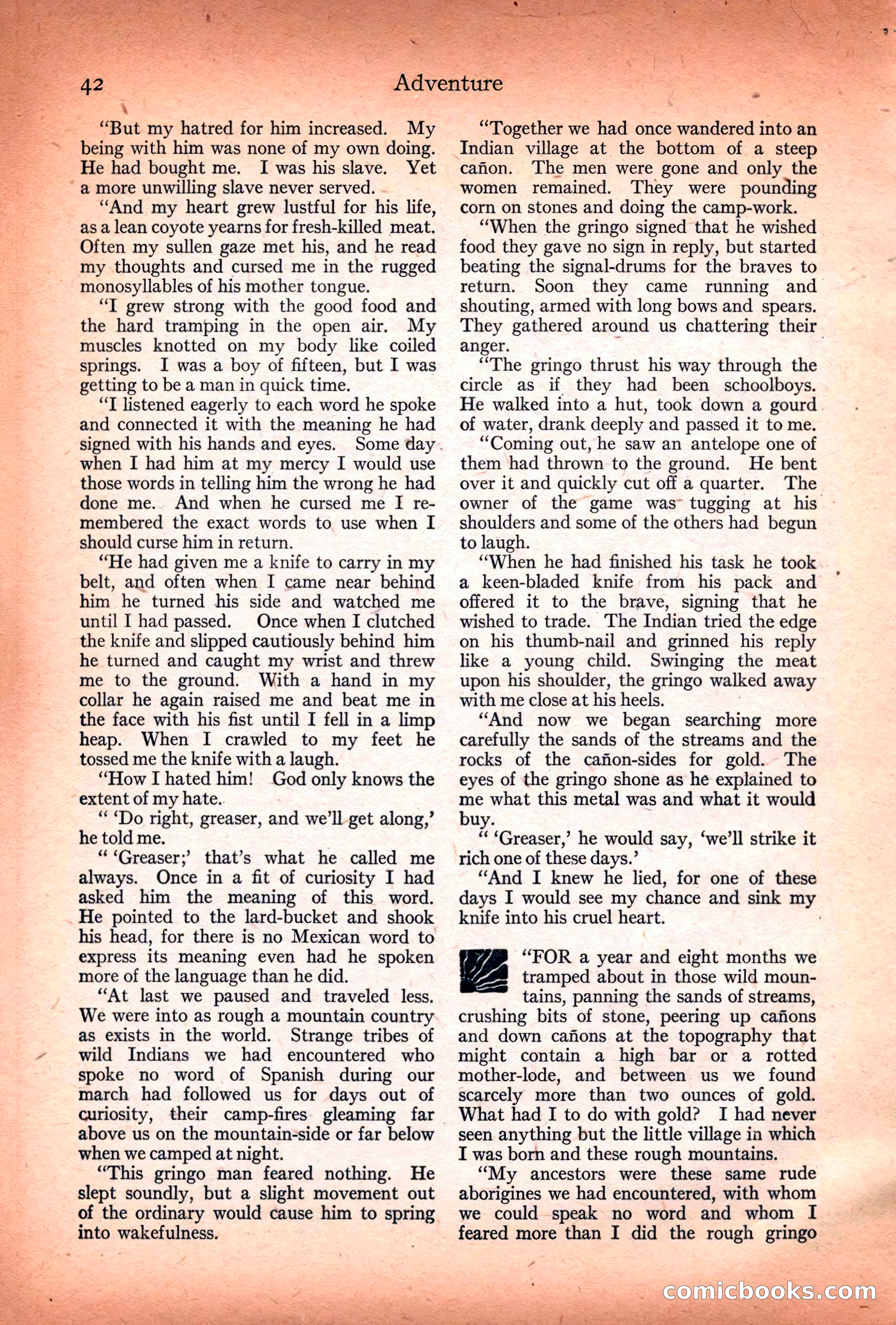
A restored page from Pulp Fiction, 1920. Page through the whole issue in the reader above.
📄 Transcribed text from this page (OCR, searchable)
Machine-transcribed from the original scan — historical spelling and the odd misread are preserved.
_ signed with his hands and eyes. 3 “But. my hatred for him eaiaged. My : Sse with him was none of my own doing. He had bought me. I was his slave. Yet “amore unwilling slave never served. - “And my heart grew lustful for his life, asa lean coyote yearns for fresh-killed meat. Often my sullen gaze met his, and he read my thoughts and cursed me in the rugged =. monosyllables of his mother tongue. “T grew strong with the good food and the hard tramping in the open air. My muscles knotted on my body like coiled springs. I was a boy of fifteen, but I was getting to be a man in quick time. “T listened eagerly to each word he spoke and connected it with the meaning he had when I had him at my mercy I would use those words in telling him the wrong he had done me. And when he cursed me [f re- membered the exact words to use when I should curse him in return. “He had given me a knife to carry in my belt, and often when I came near behind him he turned his side and watched me until I had passed. Once when I clutched the knife and slipped cautiously behind him he turned and caught my wrist and threw me to the ground. With a hand in my collar he again raised me and beat me in the face with his fist until I fell in a limp heap. When I crawled to my feet he tossed me the knife with a laugh. “How I hated him! God only knows the extent of my hate.. “ “Do right, greaser, and we’ll get along,’ he told me. “‘ “Greaser;’ that’s what he called me always. Once in a fit of curiosity I had asked him the meaning of this word. _He pointed to the lard-bucket and shook his head, for there is no Mexican word to express its meaning even had he spoken more of the language than he did. “At last we paused and traveled less. We were into as rough a mountain country as exists in the world. Strange tribes of wild Indians we had encountered who spoke no word of Spanish during our march had followed us for days out of curiosity, their camp-fires gleaming far above us on the mountain-side or far below when we camped at night. “This gringo man feared nothing. He slept soundly, but a slight movement out of the ordinary would cause him to spring into ele: Some day . “Together we are once bel into a Indian village at the bottom of a steep © cafion. The men were gone and only the women remained. They were pounding corn on stones and doing the camp-work. “When the gringo signed that he wished food they gave no sign in reply, but started beating the signal-drums for the braves to return. Soon they came running and shouting, armed with long bows and spears. They gathered around us chattering their anger. “The gringo thrust his way through the circle as if they had been schoolboys. He walked into a hut, took down a gourd. of water, drank deeply and passed it to me. “Coming out, he saw an antelope one of them had thrown to the ground. He bent over it and quickly cut off a quarter. The owner of the game was tugging at his shoulders and some of the others had begun to laugh. “‘When he had finished his task he took a keen-bladed knife from his pack and offered it to the brave, signing that he wished to trade. The Indian tried the edge on his thumb-nail and grinned his reply like a young child. Swinging the meat upon his shoulder, the gringo walked away with me close at his heels. “And now we began searching more carefully the sands of the streams and the rocks of the cafion-sides for gold. The eyes of the gringo shone as he explained to me what this metal was and what it would buy. “ ‘Greaser,’ he would say, ‘we’ll strike it rich one of these days.’ “And I knew he lied, for one of these days I would see my chance and sink my knife into his cruel heart. ym “FOR a year and eight months we wefe tramped about in those wild moun- tains, panning the sands of streams, crushing bits of stone, peering up cafions and down cajions at the topography that might contain a high bar or a rotted mother-lode, and between us we found scarcely more than two ounces of gold. What had I to do with gold? I had never seen anything but the little village in which I was born and these rough mountains. “My ancestors were these same rude aborigines we had encountered, with whom we could speak no word and whom I_ _ feared more than I did the es gringo . < se z