
Pulp Fiction, 1920 · page 76 of 208
Adventure Magazine Cover — page 76: what you’re looking at
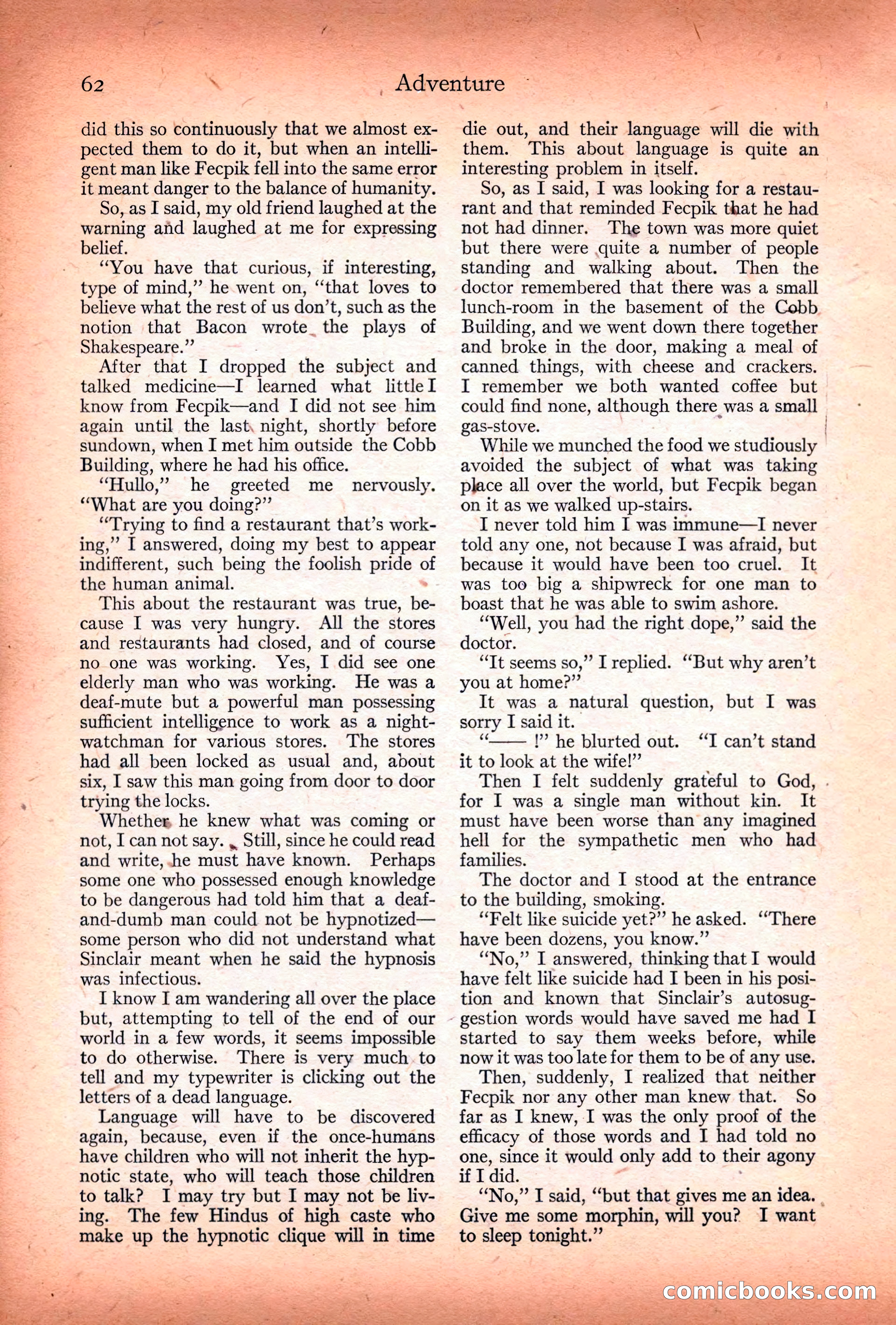
A restored page from Pulp Fiction, 1920. Page through the whole issue in the reader above.
📄 Transcribed text from this page (OCR, searchable)
Machine-transcribed from the original scan — historical spelling and the odd misread are preserved.
5 2 did this SO continuously that we almost ex- es Be: pected them to do it, but when an intelli- _ gent man like Fecpik fell into the same error it meant danger to the balance of humanity. So, as I said, my old friend laughed at the warning and laughed at me for expressing belief. “You have that curious, if interesting, type of mind,” he went on, “that loves to believe what the rest of us don’t, such as the notion that Bacon wrote_the plays of Shakespeare.” After that I dropped the subject and talked medicine—I learned what littleI know from Fecpik—and I did not see him again until the last, night, shortly before sundown, when I met him outside the Cobb Building, where he had his office. “Hullo,” he greeted me_ nervously. “What are you doing?” “Trying to find a restaurant that’s work- ing,” I answered, doing my best to appear indifferent, such being the foolish pride of the human animal. > This about the restaurant was true, be- cause I was very hungry. All the stores and restaurants had closed, and of course no one was working. Yes, I did see one elderly man who was working. He was a deaf-mute but a powerful man possessing sufficient intelligence to work as a night- watchman for various stores. The stores had all been locked as usual and, about six, I saw this man going from door to door trying the locks. Whether he knew what was coming or not, I can not say. , Still, since he could read and write,.he must have known. Perhaps some one who possessed enough knowledge to be dangerous had told him that a deaf- and-dumb man could not be hypnotized— some person who did not understand what Sinclair meant when he said the hypnosis was infectious. I know I am wandering all over the place but, attempting to tell of the end of our world in a few words, it seems impossible to do otherwise. There is very much to tell and my typewriter is clicking out the letters of a dead language. Language will have to be discovered again, because, even if the once-humans have children who will not inherit the hyp- notic state, who will teach those children to talk? I may try but I may not be liv- ing. The few Hindus of high caste who make up the hypnotic clique will in time — a be * = - ee ts . - . — ~ < <*e x a =i ie Ba Pre PB ~2> - = ae x r * me ete s <2 ff : ike ye ee ee a >< a a ee Ee ~- 5 z SH _ oe —— = a man . aan et a die out, and their language will die with them. This about language is quite an interesting problem in itself. So, as I said, I was looking for a restau- rant and that reminded Fecpik that he had not had dinner. The town was more quiet but there were quite a number of people standing and walking about. Then the doctor remembered that there was a small lunch-room in the basement of the Cobb Building, and we went down there together and broke in the door, making a meal of canned things, with cheese and crackers. I remember we both wanted coffee but could find none, although there was a small gas-stove. | While we munched the food we studiously avoided the subject of what was taking place all over the world, but Fecpik began on it as we walked up-stairs. I never told him I was immune—TI never told any one, not because I was afraid, but because it would have been too cruel. It was too big a shipwreck for one man to boast that he was able to swim ashore. “Well, you had the right dope,” said the doctor. “Tt seems so,” I replied. ‘“But why aren’t you at home?” It was a natural question, but I was sorry I said it. ““_ |” he blurted out. it to look at the wife!” Then I felt suddenly grateful to God, for I was a single man without kin. It must have been worse than any imagined hell for the sympathetic men who had families. The doctor and I stood at the entrance to the building, smoking. “Felt like suicide yet?”’ he asked. “There have been dozens, you know.” “No,” I answered, thinking that I would have felt like suicide had I been in his posi- tion and known that Sinclair’s autosug- “T can’t stand - gestion words would have saved me had I started to say them weeks before, while now it was too late for them to be of any use. Then, suddenly, I realized that neither Fecpik nor any other man knew that. So far as I knew, I was the only proof of the efficacy of those words and I had told no one, since it would only add to their agony if I did. “No,” I said, “but that gives me an idea. | Give me some morphin, will you? I want to sleep tonight.” Peis ole ae at eee ee eee Co FS ay See a ae = ae ——— a a