
Pulp Fiction, 1920 · page 78 of 208
Adventure Magazine Cover — page 78: what you’re looking at
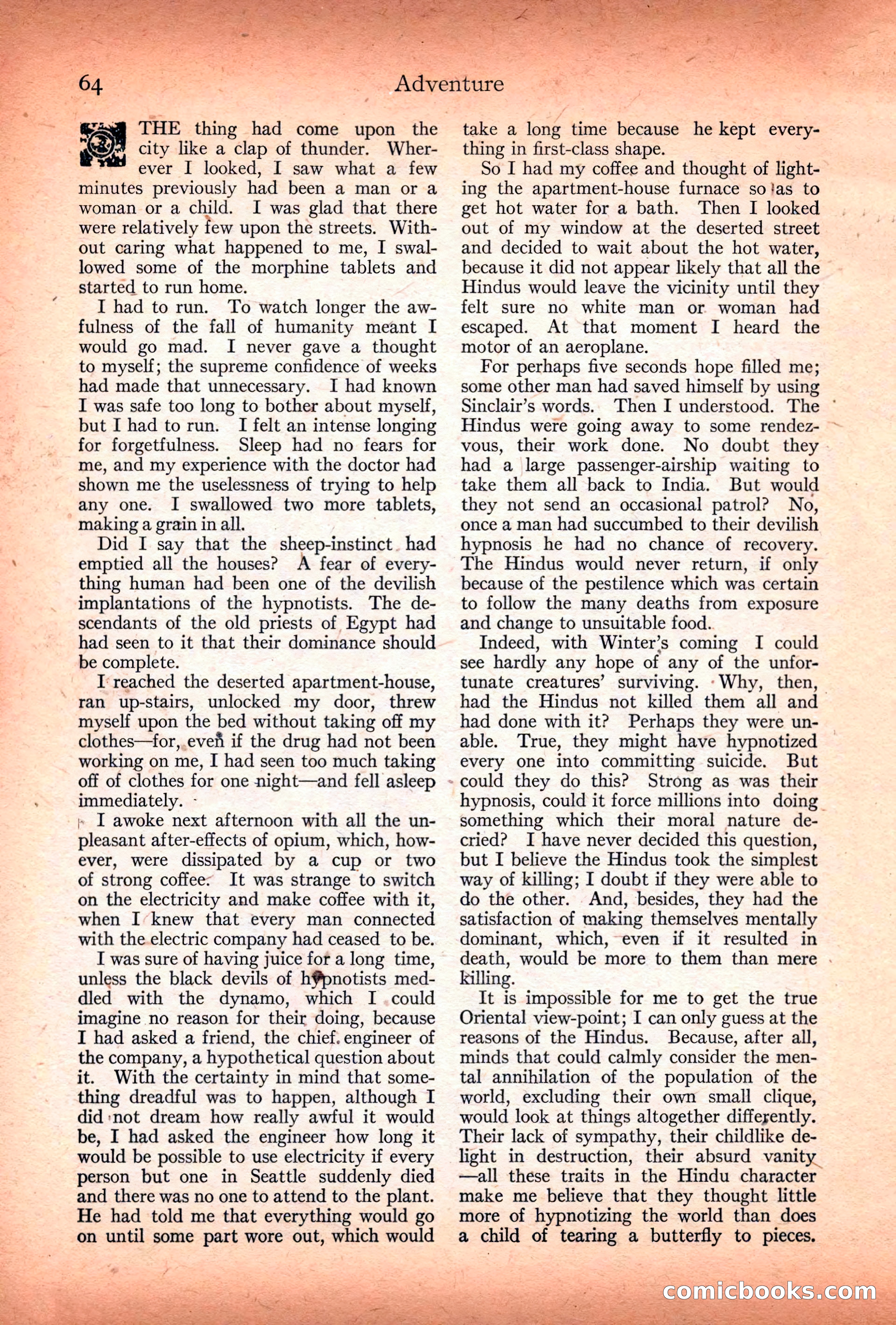
A restored page from Pulp Fiction, 1920. Page through the whole issue in the reader above.
📄 Transcribed text from this page (OCR, searchable)
Machine-transcribed from the original scan — historical spelling and the odd misread are preserved.
city like a clap of thunder. Wher- ever I looked, I saw what a few minutes previously had been a man or a woman or a child. I was glad that there were relatively few upon the streets. With- out caring what happened to me, I swal- lowed some of the morphine tablets and started to run home. I had to run. To watch longer the aw- fulness of the fall of humanity meant I would go mad. I never gave a thought to myself; the supreme confidence of weeks had made that unnecessary. I had known I was safe too long to bother about myself, but I had torun. I felt an intense longing for forgetfulness. Sleep had no fears for me, and my experience with the doctor had shown me the uselessness of trying to help or ee, THE thing had come upon the _any one. I swallowed two more tablets, making a grain in all. Did I say that the sheep-instinct. had emptied all the houses? fear of every- thing human had been one of the devilish implantations of the hypnotists. The de- scendants of the old priests of Egypt had had seen to it that their dominance should be complete. I'reached the deserted apartment-house, ran up-stairs, unlocked my door, threw myself upon the bed without taking off my clothes—for,.even if the drug had not been working on me, I had seen too much taking off of clothes for one night—and fell asleep immediately. - » I awoke next afternoon with all the un- pleasant after-effects of opium, which, how- ever, were dissipated by a cup or two of strong coffee: It was strange to switch on the electricity and make coffee with it, when I knew that every man connected with the electric company had ceased to be. I was sure of having juice for a long time, unless the black devils of h¥pnotists med- dled with the dynamo, which I . could imagine no reason for their doing, because I had asked a friend, the chief. engineer of the company, a hypothetical question about it. With the certainty in mind that some- thing dreadful was to happen, although I did not dream how really awful it would be, I had asked the engineer how long it would be possible to use electricity if every person but one in Seattle suddenly died and there was no one to attend to the plant. He had told me that everything would go on until some part wore out, which would oh a Re ee = #4 i> “act + he SP OT” _—— ~ a gellte oag, —— < = ™ 2 oS) <= iP ee —< s ake ef A ‘> . aes take a long time because he kept every-— thing in first-class shape. So I had my coffee and thought of light-— ing the apartment-house furnace so!tas to get hot water for a bath. Then I looked out of my window at the deserted street and decided to wait about the hot water, because it did not appear likely that all the | Hindus would leave the vicinity until they felt sure no white man or woman had escaped. At that moment I heard the motor of an aeroplane. For perhaps five seconds hope filled me; some other man had saved himself by using Sinclair’s words. ‘Then I understood. The ~* Hindus were going away to some rendez-— vous, their work done. No doubt they - had a large passenger-airship waiting to take them all back to India. But would they not send an occasional patrol? No, once a man had succumbed to their devilish hypnosis he had no chance of recovery. The Hindus would never return, if only because of the pestilence which was certain to follow the many deaths from exposure and change to unsuitable food. Indeed, with Winter’s coming I could see hardly any hope of any of the unfor- tunate creatures’ surviving. ‘Why, then, had the Hindus not killed them all and had done with it? Perhaps they were un- able. True, they might have hypnotized © every one into committing suicide. But - could they do this? Strong as was their hypnosis, could it force millions into doing something which their moral nature de- cried? I have never decided this question, but I believe the Hindus took the simplest way of killing; I doubt if they were able to do the other. And, besides, they had the satisfaction of making themselves mentally dominant, which, even if it resulted in death, would be more to them than mere . killing. It is impossible for me to get the true Oriental view-point; I can only guess at the reasons of the Hindus. Because, after all, minds that could calmly consider the men- tal annihilation of the population of the world, excluding their own small clique, would look at things altogether differently. Their lack of sympathy, their childlike de- light in destruction, their absurd vanity —all these traits in the Hindu character make me believe that they thought little more of hypnotizing the world than does a child of tearing a butterfly to pieces <=. : op ~ Se Se en eS ee gee pe Coe Rae We ee 4 ; = — hn | ee = a m ) books.c ee