
Pulp Fiction, 1920 · page 87 of 208
Adventure Magazine Cover — page 87: what you’re looking at
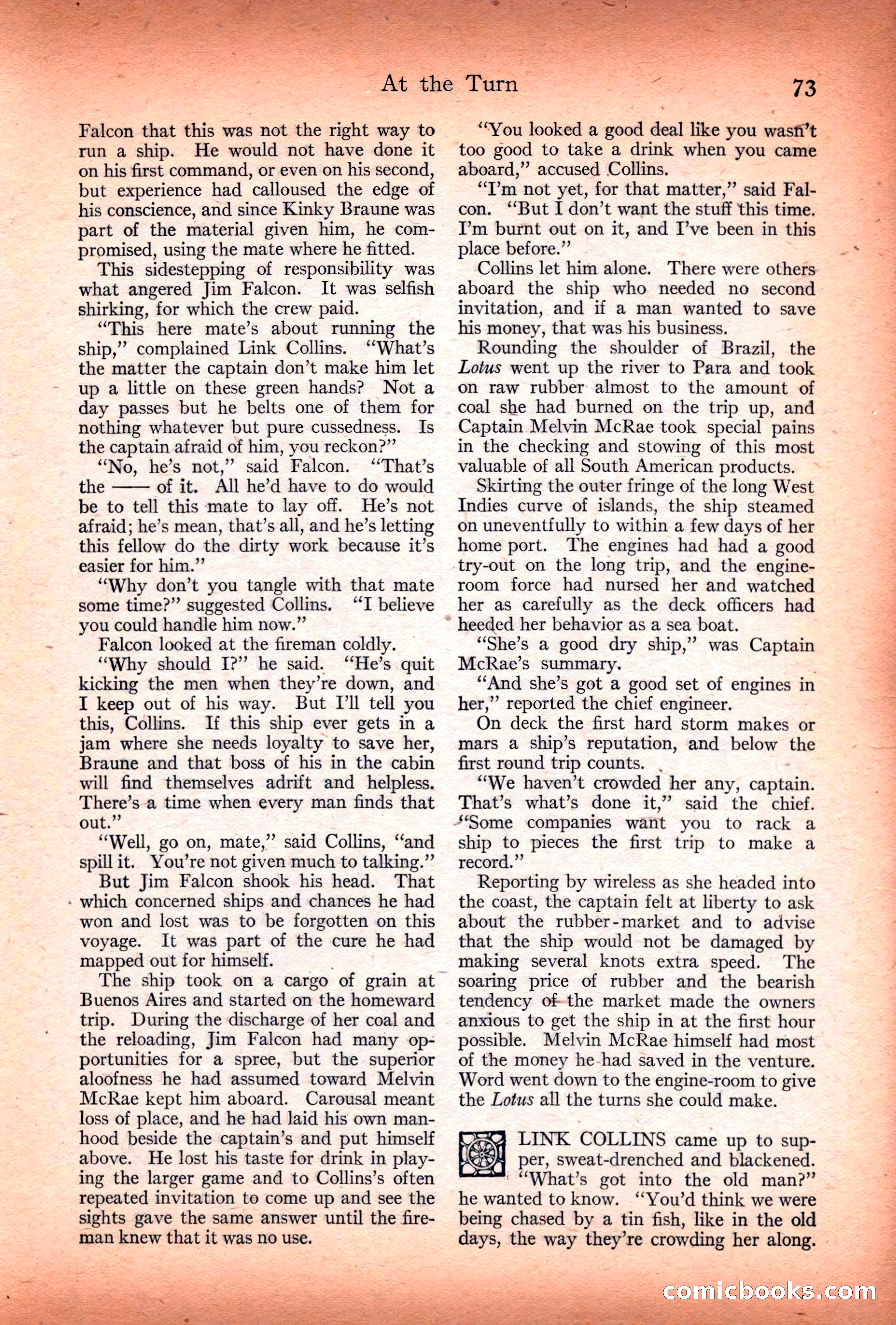
A restored page from Pulp Fiction, 1920. Page through the whole issue in the reader above.
📄 Transcribed text from this page (OCR, searchable)
Machine-transcribed from the original scan — historical spelling and the odd misread are preserved.
Falcon that this was not the right way to run a ship. He would not have done it on his first command, or even on his second, but experience had ‘calloused the edge of his conscience, and since Kinky Braune was part of the material given him, he com- promised, using the mate where he fitted. This sidestepping of responsibility was what angered Jim Falcon. It was selfish shirking, for which the crew paid. “This here mate’s about running the ship,” complained Link Collins. “What’s the matter the captain don’t make him let up a little on these green hands? Not a day passes but he belts one of them for nothing whatever but pure cussedness. Is the captain afraid of him, you reckon?” “No, he’s not,” said Falcon. “That’s the of it. All he’d have to do would be to tell this mate to lay off. He’s not afraid; he’s mean, that’s all, and he’s letting this fellow do the dirty work because it’s easier for him.”’ “Why don’t you tangle with that mate some time?” suggested Collins. “TI believe you could handle him now.” Falcon looked at the fireman coldly. “Why should I?” he said. “He’s quit kicking the men when they’re down, and I keep out of his way. But Ill tell you this, Collins. If this ship ever gets in a jam where she needs loyalty to save her, Braune and that boss of his in the cabin will find themselves adrift and helpless. There’s-a time when every man finds that out.” “Well, go on, mate,” said Collins, “and spill it. You’re not given much to talking.” But Jim Falcon shook his head. That - which concerned ships and chances he had won and lost was to be forgotten on this voyage. It was part of the cure he had mapped out for himself. The ship took on a cargo of grain at Buenos Aires and started on the homeward trip. During the discharge of her coal and the reloading, Jim Falcon had many op- portunities for a spree, but the superior aloofness he had assumed toward Melvin McRae kept him aboard. Carousal meant loss of place, and he had laid his own man- _ hood beside the captain’s and put himself above. He lost his taste for drink in play- ing the larger game and to Collins’s often repeated invitation to come up and see the sights gave the same answer until the fire- man out that it was No use. Pe ER 4 C= oe" —— a ig eee ® == >. “You locked a good hea like you nes too good to take a drink when you came aboard,” accused Collins. “Pm not yet, for that matter, ’ said ra con. ‘‘But I don’t want the stuff this time. I’m burnt out on it, and I’ve been in this place before.” Collins let him alone. There were others aboard the ship who needed no second invitation, and if a man wanted to save his money, that was his business. Rounding the shoulder of Brazil, the Lotus went up the river to Para and took on raw rubber almost to the amount of coal she had burned on the trip up, and Captain Melvin McRae took special pains in the checking and stowing of this most valuable of all South American products. Skirting the outer fringe of the long West Indies curve of islands, the ship steamed on uneventfully to within a few days of her home port. The engines had had a good try-out on the long trip, and the engine- room force had nursed her and watched her as carefully as the deck officers had ~ heeded her behavior as a sea boat. “She’s a good dry ship,” was Captain McRae’s summary. “And she’s got a good set of engines in her,” reported the chief engineer. On deck the first hard storm makes or mars a ship’s reputation, and below the first round trip counts. , “We haven’t crowded her any, captain. That’s what’s done it,” said the chief. 4Some companies want you to rack a ship to pieces the first trip to make a record.” Reporting by wireless as she headed into the coast, the captain felt at liberty to ask about the rubber-market and to advise that the ship would not be damaged by making several knots extra speed. The soaring price of rubber and the bearish tendency ofthe market made the owners anxious to get the ship in at the first hour possible. Melvin McRae himself had most of the money he-had saved in the venture. Word went down to the engine-room to give the Lotus all the turns she could make. LINK COLLINS came up to sup- ) per, sweat-drenched and blackened. ‘ —e he wanted to know. ‘“‘You’d think we were being chased by a tin fish, like in the old days, the ar at re cromding her ot sie: a — = ei, ° oe ‘“What’s got into the old man?” — a “- = . 7 44h! © ‘ ah ide At ‘ ‘ : ‘ . te all tT le A 4 x * bs. . + Sal) ; , ty pital ' Cy " - ; : ’ “i” sys y 4 . ty »f YT ay, a Pei 3 . j % ye Ab i V4 ‘ * A _* eile . SOA HOA ete COU En, MMe een ee NS OC MMIREE IA TAT ae Pere eS ; “ANAS, PLE eee ae aH bs ' - = <a