
Pulp Fiction, 1920 · page 124 of 172
Adventure Magazine Cover — page 124: what you’re looking at
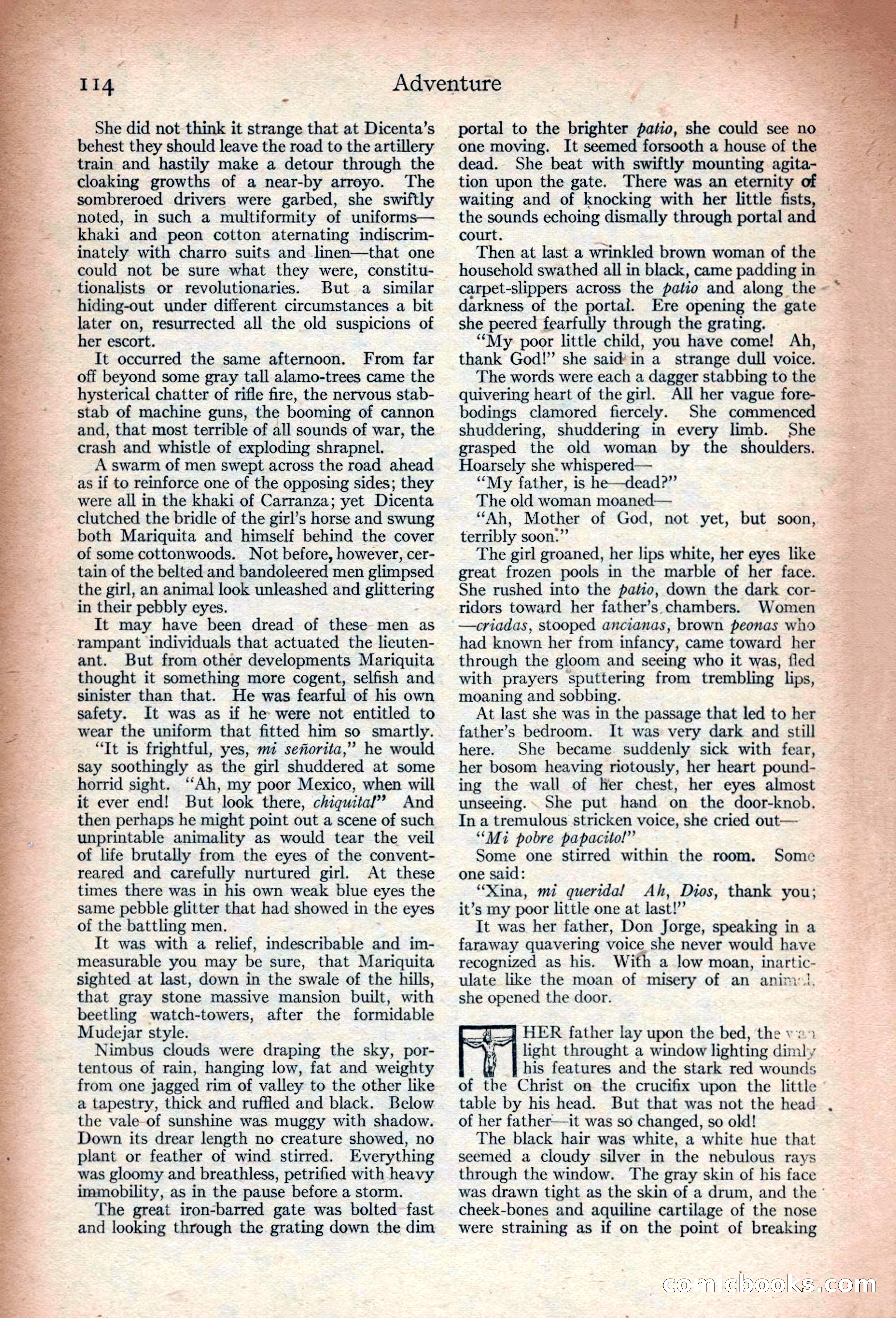
A restored page from Pulp Fiction, 1920. Page through the whole issue in the reader above.
📄 Transcribed text from this page (OCR, searchable)
Machine-transcribed from the original scan — historical spelling and the odd misread are preserved.
She did not think it strange that at Dicenta’s behest they should leave the road to the artillery train and hastily make a detour through the cloaking growths of a near-by arroyo. The sombreroed drivers were garbed, she swiftly noted, in such a multiformity of uniforms— khaki and peon cotton aternating indiscrim- inately with charro suits and linen—that one could not be sure what they were, constitu- tionalists or revolutionaries. But a similar hiding-out under different circumstances a bit later on, resurrected all the old suspicions of her escort. It occurred the same afternoon. From far off beyond some gray tall alamo-trees came the hysterical chatter of rifle fire, the nervous stab- stab of machine guns, the booming of cannon and, that most terrible of all sounds of war, the crash and whistle of exploding shrapnel. A swarm of men swept across the road ahead as if to reinforce one of the opposing sides; they were all in the khaki of Carranza; yet Dicenta clutched the bridle of the girl’s horse and swung both Mariquita and himself behind the cover of some cottonwoods. Not before, however, cer- tain of the belted and bandoleered men glimpsed the girl, an animal look unleashed and eattering in their pebbly eyes. It may have been dread of these men as rampant individuals that actuated the lieuten- ant. But from other developments Mariquita thought it something more cogent, selfish and sinister than that. He was fearful of his own safety. It was as if he were not entitled to wear the uniform that fitted him so smartly. “Tt is frightful, yes, mz sevorita,” he would say soothingly as the girl shuddered at some horrid sight. “Ah, my poor Mexico, when will it ever end! But look there, chiquital’? And then perhaps he might point out a scene of such unprintable animality as would tear the veil of life brutally from the eyes of the convent- reared and carefully nurtured girl. At these times there was in his own weak blue eyes the same pebble glitter that had showed in the eyes of the battling men. It was with a relief, indescribable and im- measurable you may be sure, that Mariquita sighted at last, down in the swale of the hills, that gray stone massive mansion built, with beetling watch-towers, after the formidable Mudejar style. Nimbus clouds were draping the sky, por- tentous of rain, hanging low, fat and weighty from one jagged rim of valley to the other like a tapestry, thick and ruffled and black. Below the vale-of sunshine was muggy with shadow. Down its drear length no creature showed, no plant or feather of wind stirred. Everything was gloomy and breathless, petrified with heavy immobility, as in the pause before a storm. The great iron-barred gate was bolted fast and looking through the grating down the dim Adventure portal to the brighter patio, she could see no = forsooth a house of the © one moving. It seemed dead. She beat with swiftly mounting agita- tion upon the gate. There was an eternity of waiting and of knocking with her little fists, — the sounds echoing dismally through portal and court. Then at last a wrinkled brown woman of the household swathed all in black, came padding in carpet-slippers across the patio and along the darkness of the portal. Ere opening the gate “My poor little child, you have come! Ah, thank God!” she said’in a strange dull voice. The words were each a dagger stabbing to the quivering heart of the girl. All her vague fore- bodings clamored fiercely. She commenced shuddering, shuddering in every limb. She grasped the old woman by the shoulders. Hoarsely she whispered— “My father, is he—dead?”’ The old woman moaned— “Ah, Mother of God, not yet, but soon, terribly soon.’ The girl groaned, her lips white, her eyes like great frozen pools in the marble of her face. She rushed into the patio, down the dark cor- ridors toward her father’s chambers. Women —criadas, stooped ancianas, brown peonas who had known her from infancy, came toward her through the gloom and seeing who it was, fled with prayers sputtering from trembling lips, moaning and sobbing. At last she was in the passage that led to her | father’s bedroom. It was very dark and still here. She became suddenly sick with fear, her bosom heaving riotously, her heart pound- ing the wall of Her chest, her eyes almost unseeing.. She put hand on the door-knob. In a tremulous stricken voice, she cried out— “Mi pobre papacitol”’ Some one stirred within the room. Some one said: “Xina, mi queridal Ah, Dios, thank you; it’s my poor little one at last!” It was her father, Don Jorge, speaking in a faraway quavering voice she never would have recognized as his. With a low moan, inartic- ulate like the moan of misery of an anim:! she opened the door. ~-4 HER father lay upon the bed, the v9 4+ § light throught a window lighting dimly his features and the stark red wounds of the Christ on the crucifix upon the little © table by his head. But that was not the head of her father—it was so changed, so old! The black hair was white, a white hue that seeméd a cloudy silver in the nebulous rays through the window. The gray skin of his face was drawn tight as the skin of a drum, and the ° cheek-bones and aquiline cartilage of the nose were straining as if on the point of breaking comicbooks (C@