
Pulp Fiction, 1920 · page 131 of 172
Adventure Magazine Cover — page 131: what you’re looking at
A restored page from Pulp Fiction, 1920. Page through the whole issue in the reader above.
📄 Transcribed text from this page (OCR, searchable)
Machine-transcribed from the original scan — historical spelling and the odd misread are preserved.
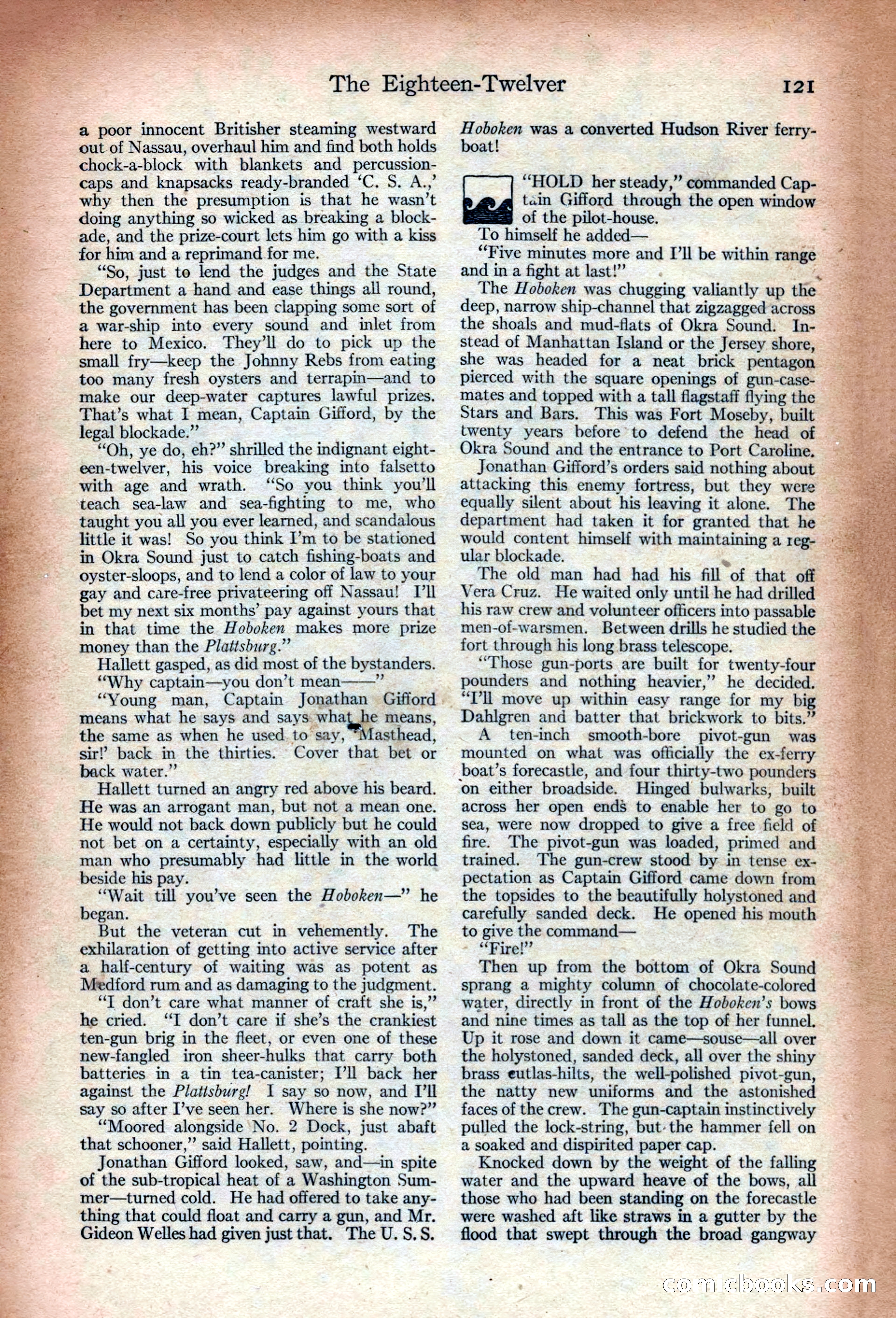
% et a poor innocent Britisher steaming westward out of Nassau, overhaul him and find both holds chock-a-block with blankets and percussion- caps and knapsacks ready-branded ‘C. S. A.,’ why then the presumption is that he wasn’t doing anything so wicked as breaking a block- ade, and the prize-court lets him go with a kiss for him and a reprimand for me. “So, just to lend the judges and the State Department a hand and ease things all round, the government has been clapping some sort of a war-ship into every sound and inlet from here to Mexico. They’ll do to pick up the small fry—keep the Johnny Rebs from eating too many fresh oysters and terrapm—and to make our deep-water captures lawful prizes. That’s what I mean, Captain Gifford, by the legal blockade.” “Oh, ye do, eh?” shrilled the indignant eight- een-twelver, his voice breaking into falsetto with age and wrath. “So you think you'll teach sea-law and sea-fighting to me, who taught you all you ever learned, and scandalous little it was! So you think I’m to be stationed in Okra Sound just to catch fishing-boats and oyster-sloops, and to lend a color of law to your gay and care-free privateering off Nassau! ll bet my next six months’ pay against yours that in that time the Hoboken makes more prize money than the Plattsburg.” Hallett gasped, as did most of the bystanders. “Why captain—you don’t mean——” “Young man, Captain Jonathan Gifford means what he says and says: what ae means, the same as when he used. to say, “Masthead, sir! back in the thirties. back water.” Hallett turned an angry red above his beard. He was an arrogant man, but not a mean one. He would not back down publicly but he could not bet on a certainty, especially with an old man who presumably had little in the world beside his pay. “Wait till you’ve seen the Hoboken—” he began. But the veteran cut in vehemently. The exhilaration of getting into active service after a half-century of waiting was as potent as Medford rum and as damaging to the judgment. “T don’t care what manner of craft she is,” he cried. ‘I don’t care if she’s the crankiest ten-gun brig in the fleet, or even one of these new-fangled iron sheer-hulks that carry both batteries in a tin tea-canister; I'll back her against the Platisburg! I say so now, and ll say so after I’ve seen her. Where is she now?” “Moored alongside No. 2 Dock, just abaft that schooner,”’ said Hallett, pointing. Jonathan Gifford looked, saw, and—in spite of the sub-tropical heat of a Washington Sum- mer—turned cold. He had offered to take any- thing that could float and carry a gun, and Mr. Gideon Welles had given just that. The U.S. S. Cover that bet or The Eighteen-Twelver “es otoken was a converted Hudson River ferry- at! “HOLD her steady,” commanded Cap- 3 ee Saas tain Gifford through the open window of the pilot-house. To himself he added— “Five minutes more and I’ll be within range and inafight at last!” a The Hoboken was chugging valiantly up the deep, narrow ship-channel that zigzagged across the shoals and mud-flats of Okra Sound. In- stead of Manhattan Island or the Jersey shore, she was headed for a neat brick pentagon pierced with the square openings of gun-case- mates and topped with a tall flagstaff flying the Stars and Bars. This was Fort Moseby, built twenty years before’to defend the head of — = : Okra Sound and the entrance to Port Caroline, Jonathan Gifford’s orders said nothing about attacking this enemy fortress, but they were equally silent about his leaving it alone. The department had taken it for granted that he would content himself with maintaining a reg- ular blockade. ts The old man had had his fill of that off Vera Cruz. He waited only until he had drilled his raw crew and volunteer officers into passable men-of-warsmen. Between drills he studied the ~ = ‘ fort through his long brass telescope. “Those gun-ports are built for twenty-four ‘ pounders and nothing heavier,” he decided. “T’ll move up within easy range for my big Dahlgren and batter that brickwork to bits.” A ten-inch smooth-bore pivot-gun was mounted on what was officially the ex-ferry boat’s forecastle, and four thirty-two pounders on either broadside. Hinged bulwarks, built across her open end to enable her to go to © <<“ > sea, were now dropped to give a free field of fire. The pivot-gun was loaded, primed and trained. The gun-crew stood by in tense ex- pectation as Captain Gifford came down from the topsides to the beautifully holystoned and carefully sanded deck. He opened his mouth to give the command— “Pirel’’ Then up from the bottom of Okra Sound sprang a mighty column of chocolate-colored water, directly in front of the Hoboken’s bows and nine times as tall as the top of her funnel. Up it rose and down it came—souse—all over the holystoned, sanded deck, all over the shiny brass eutlas-hilts, the well-polished pivot-gun, the natty new uniforms and the astonished faces of the crew. The gun-captain instinctively pulled the lock-string, but-the hammer fell on a soaked and dispirited paper cap. Knocked down by the weight of the falling water and the upward heave of the bows, all those who had been standing on the forecastle were washed aft like straws in a gutter by the flood that swept through the broad gangway GoOmIiIGbooks