
Pulp Fiction, 1920 · page 14 of 172
Adventure Magazine Cover — page 14: what you’re looking at
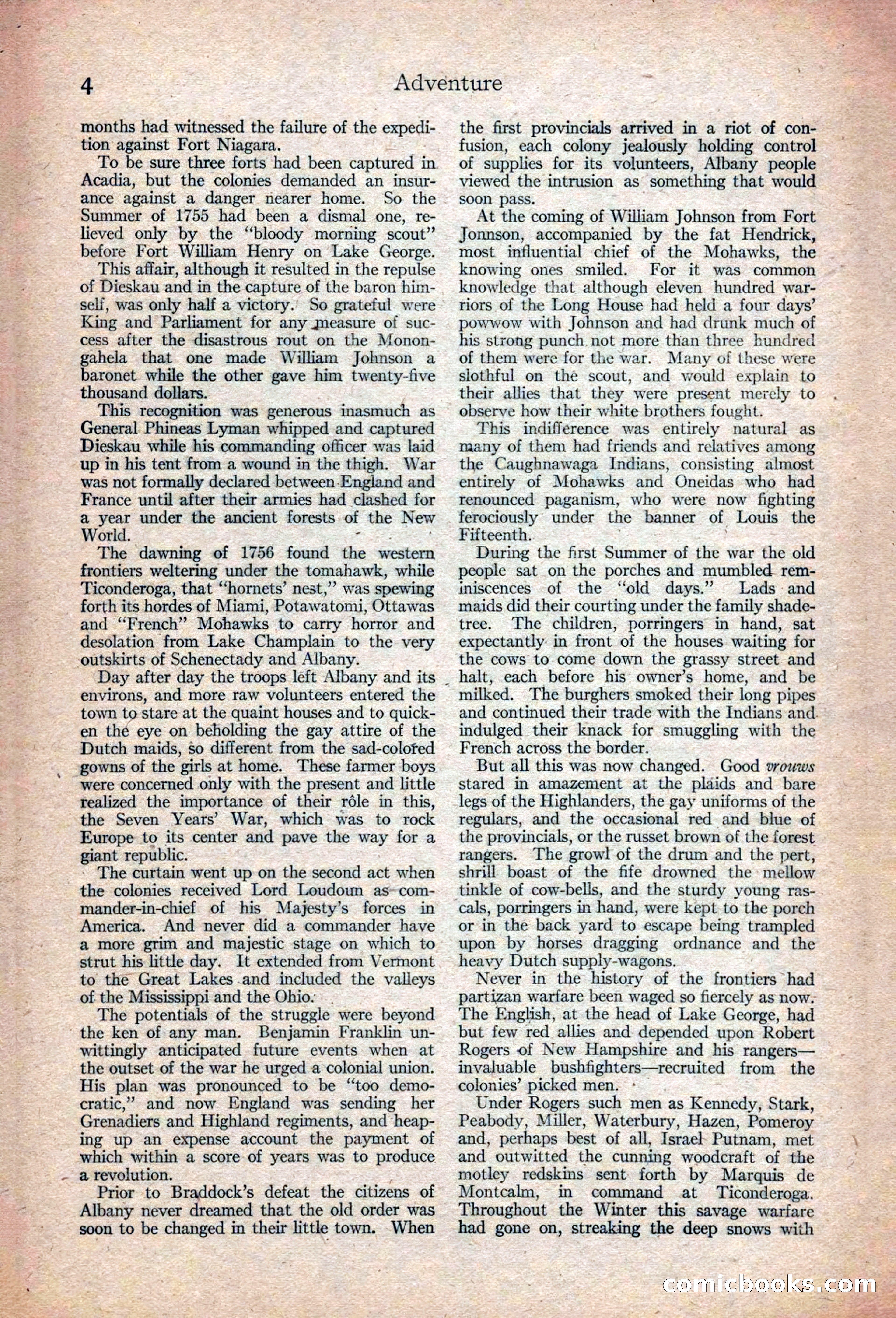
A restored page from Pulp Fiction, 1920. Page through the whole issue in the reader above.
📄 Transcribed text from this page (OCR, searchable)
Machine-transcribed from the original scan — historical spelling and the odd misread are preserved.
S aes — > Soe one p > a ay Rt cals eG ‘ the ken of any man. 4. | Adventure months had witnessed the failure of the expedi- tion against Fort Niagara. To be sure three forts had been captured in. Acadia, but the colonies demanded an insur- ance against a danger nearer home. So the Summer of 1755 had been a dismal one, re- lieved only by the “bloody morning scout” before Fort William Henry on Lake George. This affair, although it resulted in the repulse of Dieskau and in the capture of the baron him- self, was only half a victory.’ So grateful were King and Parliament for any measure of suc- cess after the disastrous rout on the Monon- gahela that one made William Johnson a baronet while the other gave him twenty-five thousand dollars. | This recognition was generous inasmuch as General Phineas Lyman whipped and captured Dieskau while his commanding officer was laid -up in his tent from a wound in the thigh. War was not formally declared between-England and France until after their armies had clashed for a year under the ancient forests of the New World. 2 The dawning of 1756 found the western frontiers weltering under the tomahawk, while Ticonderoga, that “hornets’ nest,” was spewing - forth its hordes of Miami, Potawatomi, Ottawas and “French” Mohawks to carry horror and desolation from Lake Champlain to the very outskirts of Schenectady and Albany. Day after day the troops left Albany and its _ environs, and more raw volunteers entered the town to stare at the quaint houses and to quick- en thé eye on beholding the gay attire of the Dutch maids, so different from the sad-colofed gowns of the girls at home. These farmer boys were concerned only with the present and little realized the importance of their réle in this, the Seven Years’ War, which was to rock Europe to its center and pave the way for a giant republic. - The curtain went up on the second act when the colonies received Lord Loudoun as~com- mander-in-chief of his Majesty’s forces in America. And never did a commander have a more grim and majestic stage on which to strut his little day. It extended from Vermont to the Great Lakes and included the valleys of the Mississippi and the Ohio. . The potentials of the struggle were beyond Benjamin Franklin un- wittingly anticipated future events when at the outset of the war he urged a colonial union. His plan was pronounced to be “too demo- cratic,” and now England was sending her Grenadiers and Highland regiments, and heap- ing up an expense account the payment of which within a score of years was to produce a revolution. Prior to Braddock’s defeat the citizens of Albany never dreamed that the old order was soon to be changed in their little town. When the first provincials arrived in a riot of con- fusion, each colony jealously holding control of supplies for its volunteers, Albany people viewed the intrusion as something that would soon pass. At the coming of William Johnson from Fort Jonnson, accompanied by the fat Hendrick, most influential chief of the Mohawks, the knowing ones smiled. For it was common knowledge that although eleven hundred war- riors of the Long House had held a four days’ powwow with Johnson and had drunk much of his strong punch not more than three hundred of them were for the war. Many of these were slothful on thé scout, and would explain to their allies that they were present merely to observe how their white brothers fought. This indifference was entirely natural as many of them had friends and relatives among the Caughnawaga Indians, consisting almost entirely of Mohawks and Oneidas who had renounced paganism, who were now fighting ferociously under the banner of Louis the Fifteenth. During the first Summer of the war the old people sat on the porches and mumbled rem- iniscences of the ‘old days.” Lads and maids did their courting under the family shade- tree. The children, porringers in hand, sat expectantly in front of the houses waiting for the cows to come down the grassy street and halt, each before his owner’s home, and be milked. The burghers smoked their long pipes and continued their trade with the Indians and. indulged their knack for smuggling with the French across the border. But all this was now changed. Good vrouws stared in amazement at the plaids and bare legs of the Highlanders, the gay uniforms of the regulars, and the occasional red and blue of the provincials, or the russet brown of the forest rangers. The growl of the drum and the pert, shrill boast of the fife drowned the mellow tinkle of cow-bells, and the sturdy young ras- . cals, porringers in hand, were kept to the porch or in the back yard to escape being trampled upon by horses dragging ordnance and the heavy Dutch supply-wagons. Never in the history of the frontiers had partizan warfare been waged so fiercely as now- The English, at the head of Lake George, had but few red allies and depended upon Robert | Rogers of New Hampshire and his rangers— invaluable bushfighters—recruited from the colonies’ picked men. : Under Rogers such men as Kennedy, Stark, Peabody, Miller, Waterbury, Hazen, Pomeroy and, perhaps best of all, Israel Putnam, met and outwitted the cunning woodcraft of the motley redskins sent forth by Marquis de Montcalm, in command at Ticonderoga. Throughout the Winter this savage warfare had gone on, streaking the deep snows wiih COLMIC OOS 4