
Pulp Fiction, 1920 · page 144 of 172
Adventure Magazine Cover — page 144: what you’re looking at
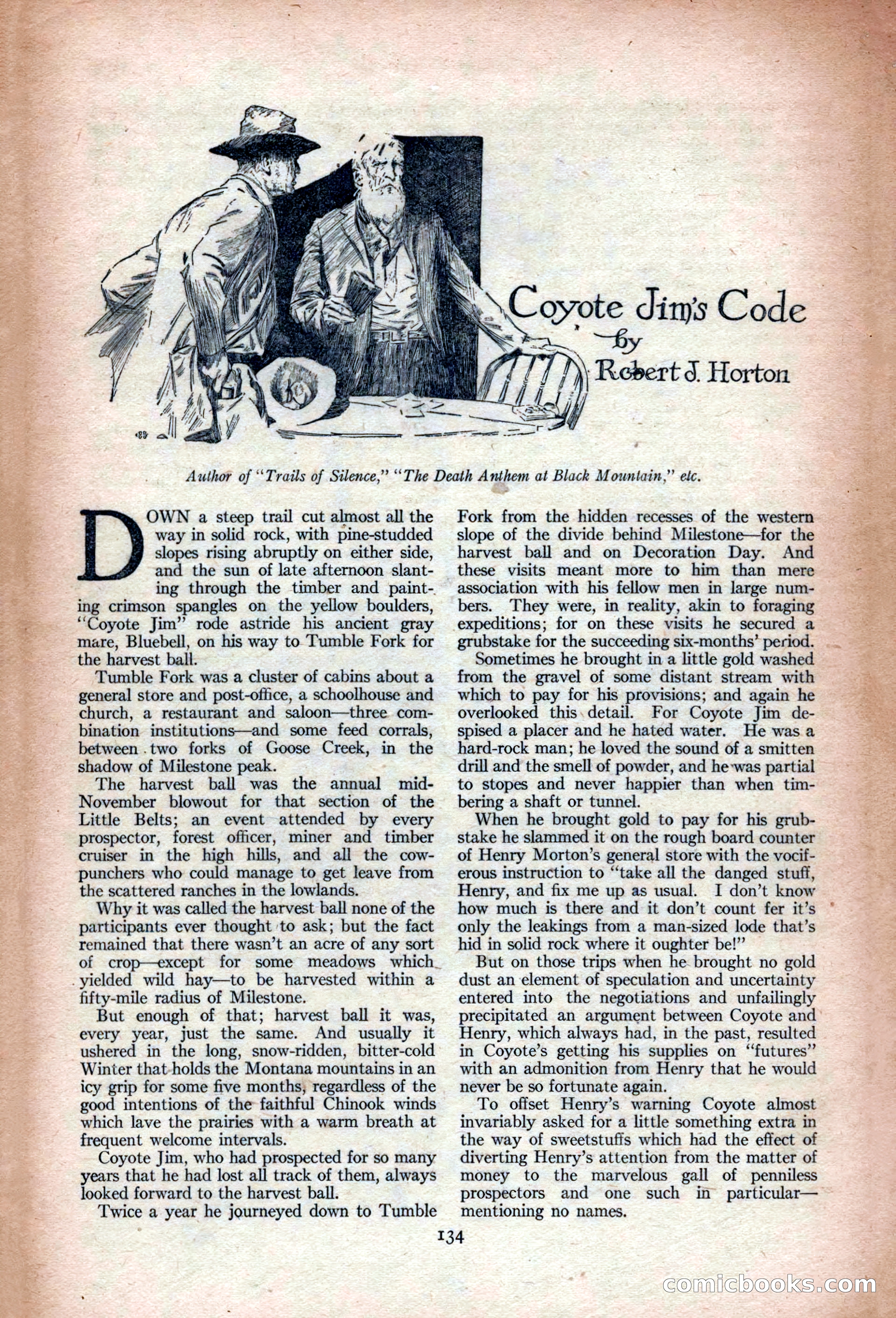
A restored page from Pulp Fiction, 1920. Page through the whole issue in the reader above.
📄 Transcribed text from this page (OCR, searchable)
Machine-transcribed from the original scan — historical spelling and the odd misread are preserved.
ward = ct ~ —_— —- = = ae % - as “a fie oi > ~¥ OWN a steep trail cut almost all the way in solid rock, with pine-studded slopes rising abruptly on either side, and the sun of late afternoon slant- ing crimson spangles on the yellow boulders, “Coyote Jim” rode astride his ancient gray mare, Bluebell, on his way to Tumble Fork for the harvest ball. Tumble Fork was a cluster of cabins about a general store and post-office, a schoolhouse and church, a restaurant and saloon—three com- bination institutions—and some feed corrals, between .two forks of Goose Creek, in the shadow of Milestone peak. The harvest ball was the annual mid- November blowout for that section of the Little Belts; an event attended by every prospector, forest officer, miner and timber cruiser in the high hills, and all the cow- punchers who could manage to get leave from the scattered ranches in the lowlands. Why it was called the harvest ball none of the participants ever thought to ask; but the fact remained that there wasn’t an acre of any sort _yielded wild hay—to be harvested within a fifty-mile radius of Milestone. But enough of that; harvest ball it was, every year, just the same. And usually it ushered in the long, snow-ridden, bitter-cold Winter that-holds the Montana mountains in an icy grip for some five months, regardless of the good intentions of the faithful Chinook winds which lave the prairies with a warm breath at frequent welcome intervals. Coyote Jim, who had prospected for so many years that he had lost all track of them, always looked forward to the harvest ball. Twice a year he journeyed down to Tumble ing through the timber and paint-. of crop—except for some meadows which_ 134 a Te te ee go ee =ae*, oe a ee oe x a ee . nal ar — = Ps Author of ‘‘Trails of Silence,” “The Death Anthem at Black Mountain,” etc. 2 va Fork from the hidden recesses of the western slope of the divide behind Milestone—for the harvest ball and on Decoration Day. And these visits meant more to him than mere ~~ association with his fellow men in large num- bers. They were, in reality, akin to foraging expeditions; for on these visits he secured a> grubstake for the succeeding six-months’ period. Sometimes he brought in a little gold washed _ from the gravel of some distant stream with which to pay for his provisions; and again he overlooked this. detail. For Coyote Jim de-— 4 spised a placer and he hated water. He was a hard-rock man; he loved the sound of a smitten drill and the smell of powder, and he-was partial to stopes and never happier than when tim- bering a shaft or tunnel. When he brought gold to pay for his grub- stake he slammed it on the rough board counter of Henry Morton’s general store with the vocif- erous instruction to “take all the danged stuff, Henry, and fix me up as usual. how much is there and it don’t count fer it’s only the leakings from a man-sized lode that’s hid in solid rock where it oughter be!” | But on those trips when he brought no gold dust an element of speculation and uncertainty entered into the negotiations and unfailingly precipitated an argument between Coyote and Henry, which always had, in the past, resulted in Coyote’s getting his supplies on “futures” with an admonition from Henry that he would never be so fortunate again. To offset Henry’s warning Coyote almost invariably asked for a little something extra in the way of sweetstufis which had the effect of diverting Henry’s attention from the matter of money to the marvelous gall of penniless prospectors and one such in particular— ~ mentioning no names. I don’t know CONNICLOO©