
Pulp Fiction, 1920 · page 38 of 172
Adventure Magazine Cover — page 38: what you’re looking at
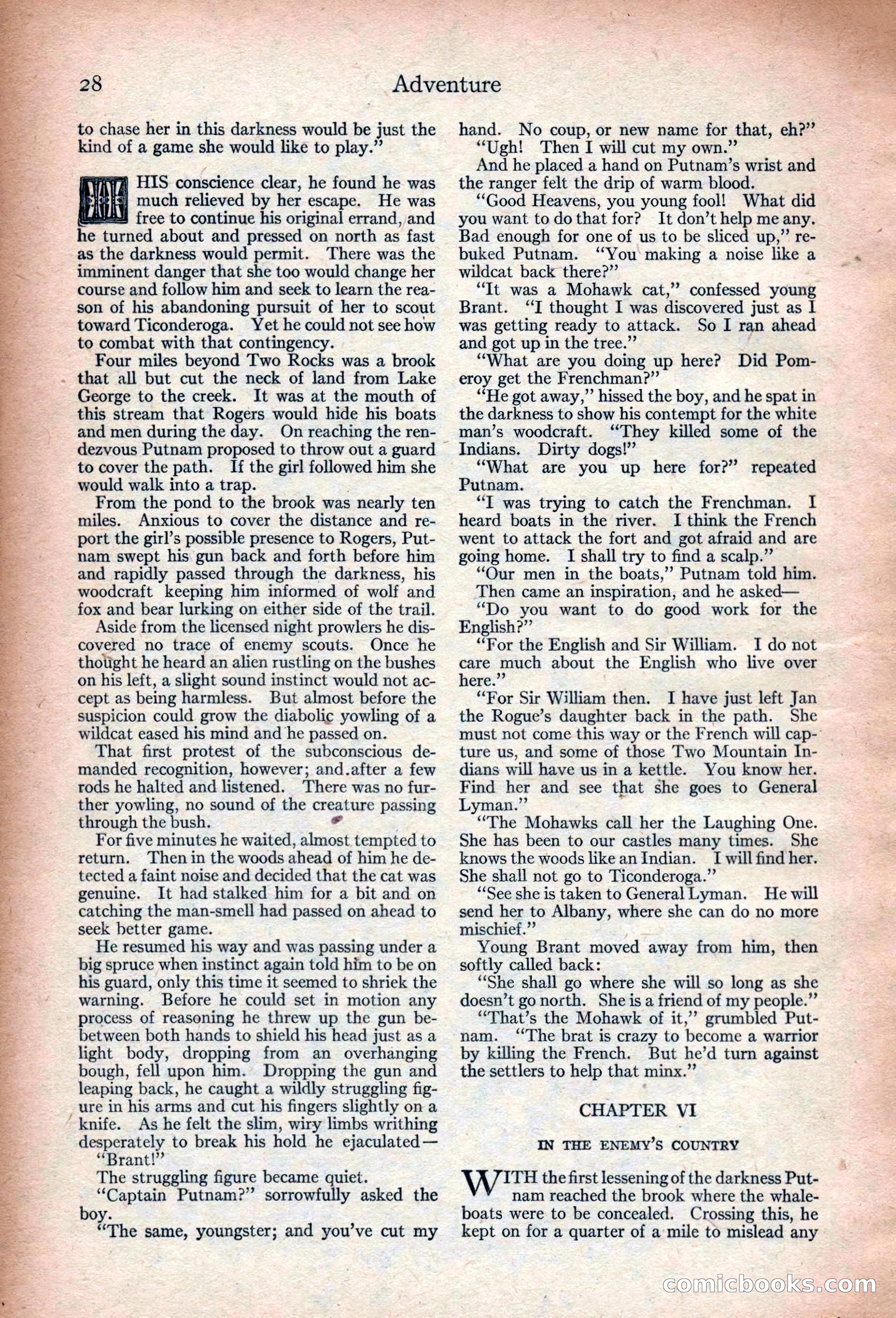
A restored page from Pulp Fiction, 1920. Page through the whole issue in the reader above.
📄 Transcribed text from this page (OCR, searchable)
Machine-transcribed from the original scan — historical spelling and the odd misread are preserved.
Must he aa io ; ey a ' knife. 28 to chase her in this darkness would be just the kind of a a she would like to play.” Me HIS conscience clear, he found he was / much relieved by her escape. He was . free to continue his original errand, and he whe about and pressed on north as fast as the darkness would permit. There was the imminent danger that she too would change her course and follow him and seek to learn the rea- son of his abandoning pursuit of her to scout toward Ticonderoga. Yet he could not see how to combat with that contingency. Four miles beyond Two Rocks was a brook . that all but cut the neck of land from Lake George to the creek. It was at the mouth of this stream that Rogers would hide his boats and men during the day. On reaching the ren- dezvous Putnam proposed to throw out a guard to cover the path. If the girl followed him she would walk into a trap. From the pond to the brook was nearly ten miles. Anxious to cover the distance and re- port the girl’s possible presence to Rogers, Put- nam swept his gun back and forth before him and rapidly passed through the darkness, his woodcraft keeping him informed of wolf and fox and bear lurking on either side of the trail. Aside from the licensed night prowlers he dis- covered no trace of enemy scouts. Once he thoiight he heard an alien rustling on the bushes on his left, a slight sound instinct would not ac- cept as being harmless. But almost before the suspicion could grow the diabolic yowling of a wildcat eased his mind and he passed on. That first protest of the subconscious de- manded recognition, however; and.after a few rods he halted and listened. There was no fur- ther yowling, no sound of the creature passing through the bush. For five minutes he waited, ee tempted to return. Then in the woods ahead of him he de- tected a faint noise and decided that the cat was genuine. It had stalked him for a bit and on catching the man-smell had passed on ahead to seek better game. He resumed his way and was passing under a big spruce when instinct again told him to be on his guard, only this time it seemed to shriek the warning. Before he could set in motion any process of reasoning he threw up the gun be- between both hands to shield his head just as a light body, dropping from an overhanging bough, fell upon him. Dropping the gun and leaping back, he caught a wildly struggling fig- ure in his arms and cut his fingers slightly on a As he felt the slim, wiry limbs writhing desperately to break his hold he ejaculated — “Brant!” The struggling figure became quiet. “Captain Putnam?” sorrowfully asked the boy. “The same, youngster; and you’ve cut my Adventure hand. No coup, or new name for that, eh?” “Ugh! Then I will cut my own.” And he placed a hand on Putnam’s wrist and the ranger felt the drip of warm blood. ““Good Heavens, you young fool! What did you want to dothat for? It don’t help me any. Bad enough for one of us to be sliced up,” re- buked Putnam. “You making a noise like a wildcat back there?”’ “Tt was a Mohawk cat,” confessed young Brant. “TI thought I was discovered just as 1 was getting ready to attack. So I ran ahead and got up in the tree.”’ “What are you doing up here? Did Pom- eroy get the Frenchman?” “He got away,” hissed the boy, and he spat in the darkness to show his contempt for the white man’s woodcraft. “They killed some of the - Indians. Dirty dogs!” “What are you up here for?” repeated Putnam. “TI was trying to catch the Frenchman. I heard boats in the river. I think the French went to attack the fort and got afraid and are going home. I shall try to find a scalp.” “Our men in the boats,” Putnam told him. Then came an inspiration, and he asked— “Do you want to do good work for the English?” “For the English and Sir William. I do not care much about the English who live over here.” “For Sir William then. I have just left Jan the Rogue’s daughter back in the path. She must not come this way or the French will cap-° ture us, and some of those Two Mountain In- dians will have us in a kettle. You know her. Find her and see that she goes to General Lyman.” “The Mohawks call her the Laughing One. She has been to our castles many times. She knows the weods like an Indian. I will find her. She shall not go to Ticonderoga.” “See she is taken to General Lyman. He will send her to Albany, where she can do no more mischief.” Young Brant moved away from him, then softly called back: “She shall go where she will so long as she doesn’t go north. She is a friend of my people.” “That’s the Mohawk of it,’’ grumbled Put- nam. “The brat is crazy to become a warrior by killing the French. But he’d turn against the settlers to help that minx.” CHAPTER VI IN THE ENEMY’S COUNTRY With the first lessening of the darkness Put- nam reached the brook where the whale- boats were to be concealed. Crossing this, he kept on for a quarter of a mile to mislead any COMMICMOOoOkKsS Eom —