
Pulp Fiction, 1920 · page 40 of 172
Adventure Magazine Cover — page 40: what you’re looking at
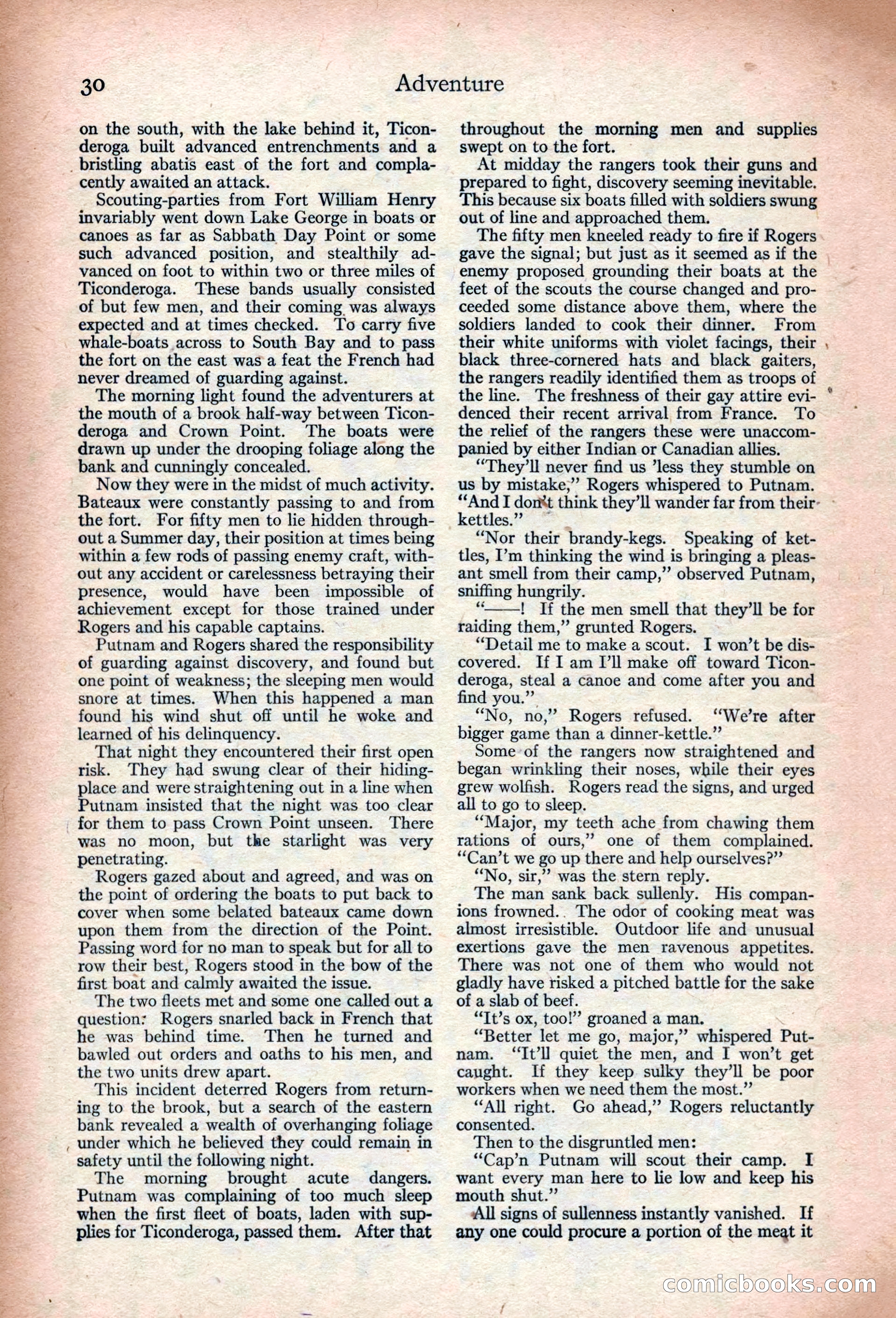
A restored page from Pulp Fiction, 1920. Page through the whole issue in the reader above.
📄 Transcribed text from this page (OCR, searchable)
Machine-transcribed from the original scan — historical spelling and the odd misread are preserved.
nah Bre ey Mns ars. ep hte matin We NT Ln Ra 2 ee pi AS aye oles bah CATA) | i ' Ar Hi) . a Y \ A See BSI) Pine NTS > br » sehieraet (ile of: LY, Foie j * ’ . } ; 4 ie At Ra Ae GY 30 Adventure on the south, with the lake behind it, Ticon- deroga built advanced entrenchments and a _bristling abatis east of the fort and compla- cently awaited an attack. Scouting-parties from Fort William Henry invariably went down Lake George in boats or canoes as far as Sabbath Day Point or some such advanced position, and stealthily ad- vanced on foot to within two or three miles of Ticonderoga. These bands usually consisted of but few men, and their coming was always expected and at times checked. To carry five whale-boats across to South Bay and to pass the fort on the east was a feat the French had never dreamed of guarding against. The morning light found the adventurers at the mouth of a brook half-way between Ticon- deroga and Crown Point. The boats were drawn up under the drooping foliage along the bank and cunningly concealed. Now they were in the midst of much activity. Bateaux were constantly passing to and from the fort. For fifty men to lie hidden through- out a Summer day, their position at times being within a few rods of passing enemy craft, with- out any accident or carelessness betraying their presence, would have been impossible of achievement except for those trained under Rogers and his capable captains. Putnam and Rogers shared the responsibility of guarding against discovery, and found but one point of weakness; the sleeping men would snore at times. When this happened a man found his wind shut off until he woke and learned of his delinquency. That night they encountered their first open risk. They had swung clear of their hiding- place and were straightening out in a line when Putnam insisted that the night was too clear for them to pass Crown Point unseen. There was no moon, but the starlight was very penetrating. Rogers gazed about and agreed, and was on the point of ordering the boats to put back to cover when some belated bateaux came down upon them from the direction of the Point. Passing word for no man to speak but for all to row their best, Rogers stood in the bow of the first boat and calmly awaited the issue. The two fleets met and some one called out a question: Rogers snarled back in French that he was behind time. Then he turned and bawled out orders and oaths to his men, and the two units drew apart. This incident deterred Rogers from return- ing to the brook, but a search of the eastern bank revealed a wealth of overhanging foliage under which he believed they could remain in safety until the following night. The morning brought acute dangers. Putnam was complaining of too much sleep when the first fleet of boats, laden with sup- plies for Ticonderoga, passed them. After that throughout the morning men and supplies swept on to the fort. At midday the rangers took their guns and prepared to fight, discovery seeming inevitable. This because six boats filled with soldiers swung out of line and approached them. The fifty men kneeled ready to fire if Rogers gave the signal; but just as it seemed as if the enemy proposed grounding their boats at the — feet of the scouts the course changed and pro- ceeded some distance above them, where the soldiers landed to cook their dinner. From their white uniforms with violet facings, their black three-cornered hats and black gaiters, the rangers readily identified them as troops of the line. The freshness of their gay attire evi- denced their recent arrival from France. To the relief of the rangers these were unaccom- panied by either Indian or Canadian allies. “They’ll never find us ’less they stumble on us by mistake,” Rogers whispered to Putnam. — = : ‘And I domt think they’ll wander far from their- ~ kettles.” “Nor their brandy-kegs. Speaking of ket- tles, I’m thinking the wind is bringing a pleas- ant smell from their camp,’ observed Putnam, sniffing hungrily. “___! Tf the men smell that they’ll be for raiding them,” grunted Rogers. “Detail me to make a scout. I won’t be dis- covered. If I am I’ll make off toward Ticon- deroga, steal a canoe and come after you and find you.” “No, no,” Rogers refused. ‘We're after bigger game than a dinner-kettle.”’ Some of the rangers now straightened and began wrinkling their noses, while their eyes grew wolfish. Rogers read the signs, and urged all to go to sleep. “Major, my teeth ache from chawing them rations of ours,’ one of them complained. “‘Can’t we go up there and help ourselves?” “No, sir,” was the stern reply. The man sank back sullenly. His compan- ions frowned.. The odor of cooking meat was almost irresistible. Outdoor life and unusual exertions gave the men ravenous appetites. There was not one of them who would not gladly have risked a pitched battle for the sake of a slab of beef. “Tt’s ox, too!” groaned a man. “Better let me go, major,’ whispered Put- nam. “It'll quiet the men, and I won’t get caught. If they keep sulky they’ll be poor workers when we need them the most.” “All right. Go ahead,” Rogers reluctantly consented. Then to the disgruntled men: “Cap’n Putnam will scout their camp. I want every man here to lie low and keep his mouth shut.” “All signs of sullenness instantly vanished. If any one could procure a portion of the meat it COMMICLOOOKS