
Pulp Fiction, 1920 · page 62 of 172
Adventure Magazine Cover — page 62: what you’re looking at
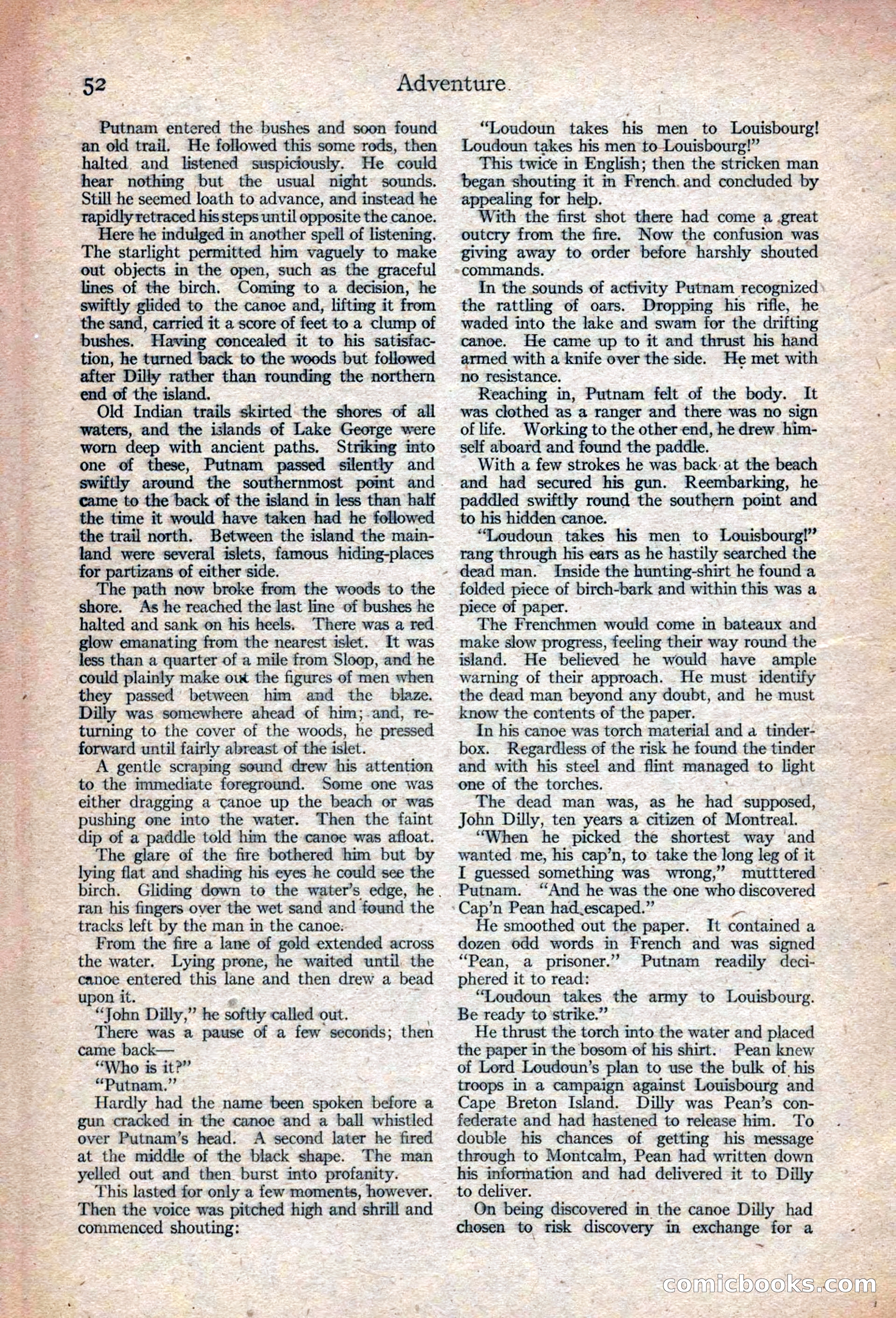
A restored page from Pulp Fiction, 1920. Page through the whole issue in the reader above.
📄 Transcribed text from this page (OCR, searchable)
Machine-transcribed from the original scan — historical spelling and the odd misread are preserved.
52 Putnam entered the bushes and soon found an old trail, He followed this some rods, then -halted. and listened suspiciously. He could hear nothing but the usual night sounds. Still he seemed loath to advance, and instead he tapidly retraced his steps until opposite the canoe. Here he indulged in another spell of listening. The starlight permitted him vaguely to make out objects in the open, such as the graceful lines of the birch. Coming to a decision, he swiftly glided to the canoe and, lifting it from the sand, carried it a score of feet to a clump of bushes. Having concealed it to his satisfac- tion, he turned back to the woods but followed after Dilly rather than rounding the northern end of the island. ' Old Indian trails skirted the shores of all waters, and the islands of Lake George were worn deep with ancient paths. Striking into one of these, Putnam passed silently and swiftly around the southernmost pomt and . came to the back of the island in less than half the time it would have taken had he followed the trail north. Between the island the main- land were several islets, famous hiding-places for partizans of either side. The path now broke from the woods to the shore. As he reached the last lime of bushes he halted and sank on his heels. There was a red. - glow emanating from the nearest islet. It was less than a quarter of a mile from Sloop, and he could plainly make out the figures of men when they passed between him and the blaze. Dilly was somewhere ahead of him;.and, re- turning to the cover of the woods, he pressed forward until fairly abreast of the islet. A gentle scraping sound drew his attention to the immediate foreground. Some one was either dragging a canoe up the beach or was pushing one into the water. Then the faint dip of a paddle told him the canoe was afloat. The glare of the fire bothered him but by lying flat and shading his eyes he could see the birch. Gliding down to the water’s edge, he. ran his fingers over the wet sand and found the tracks left by the man in the canoe: From the fire a lane of gold extended across the water. Lying prone, he waited until the canoe entered this lane and then drew a bead upon it. “John Dilly,” he softly called out. of a few seconds; then “Putnam.” Hardly had the name been spoken before a gun cracked in the canoe and a ball whistled over Putnam’s head. A second later he fired at the middle of the black shape. The man yelled out and then burst into profanity. This lasted for only a few moments, however. Then the voice was pitched high and ‘shrill and commenced shouting: ‘Cap’n Pean had.esca Adventure. “Loudoun takes his men to Louisbourg! Loudoun takes his men to-Louisbourg!”’ This twice in English; then the stricken man began shouting it in French. and concluded by appealing for help. With the first shot there had come a great outcry from the fire. Now the confusion was giving away to order before harshly shouted -commands. In the sounds of activity Putnam recognized the rattling of oars. Dropping his rifle, he waded into the lake and swam for the drifting canoe. He came up to it and thrust his hand armed with a knife over the side. He met with no resistance. Reaching in, Putnam felt of the body. It was clothed as a ranger and there was no sign of life. Working to the other end, he drew. him- self aboard and found the paddle. With a few strokes he was back at the beach and had secured his gun. Reembarking, he paddled swiftly round the southern poimt and to his hidden canoe. “Loudoun takes his men to Louisbourg!” rang through his ears as he hastily searched the Inside the hunting-shirt he found a folded piece of birch-bark and within this was a piece of paper. The Frenchmen would come in bateaux and make slow progress, feeling their way round the island. He believed he would have ample warning of their approach. He must identify the dead man beyond any doubt, and he must know the contents of the paper. In his canoe was torch material and a tinder- box. Regardless of the risk he found the tinder and with his steel and flint managed to light one of the torches. The dead man was, as he had supposed, John oa ten years a citizen of Montreal. “When he picked the shortest way and wanted me, his cap’n, to take the long leg of it I guessed something was wrong,” Putnam. “And he was the one who discovered He smoothed out the paper. It contained a dozen odd words in French and was signed “Pean, a prisoner.’’ Putnam readily deci- phered it to read: “Loudoun takes the army to Louisbourg. Be ready to strike.” He thrust the torch into the water and placed the paper in the bosom of his shirt. Pean knew of Lord Loudoun’s plan to use the bulk of his troops in a campaign against Louisbourg and Cape Breton Island. Dilly was Pean’s con- federate and had hastened to release him. To double his chances of getting his message through to Montcalm, Pean had written down his information and had delivered it to Dilly - to deliver. On being discovered in the canoe Dilly had chosen to risk discovery in exchange for a COMMICLOOOKS mutttered © Gon