
Pulp Fiction, 1920 · page 67 of 172
Adventure Magazine Cover — page 67: what you’re looking at
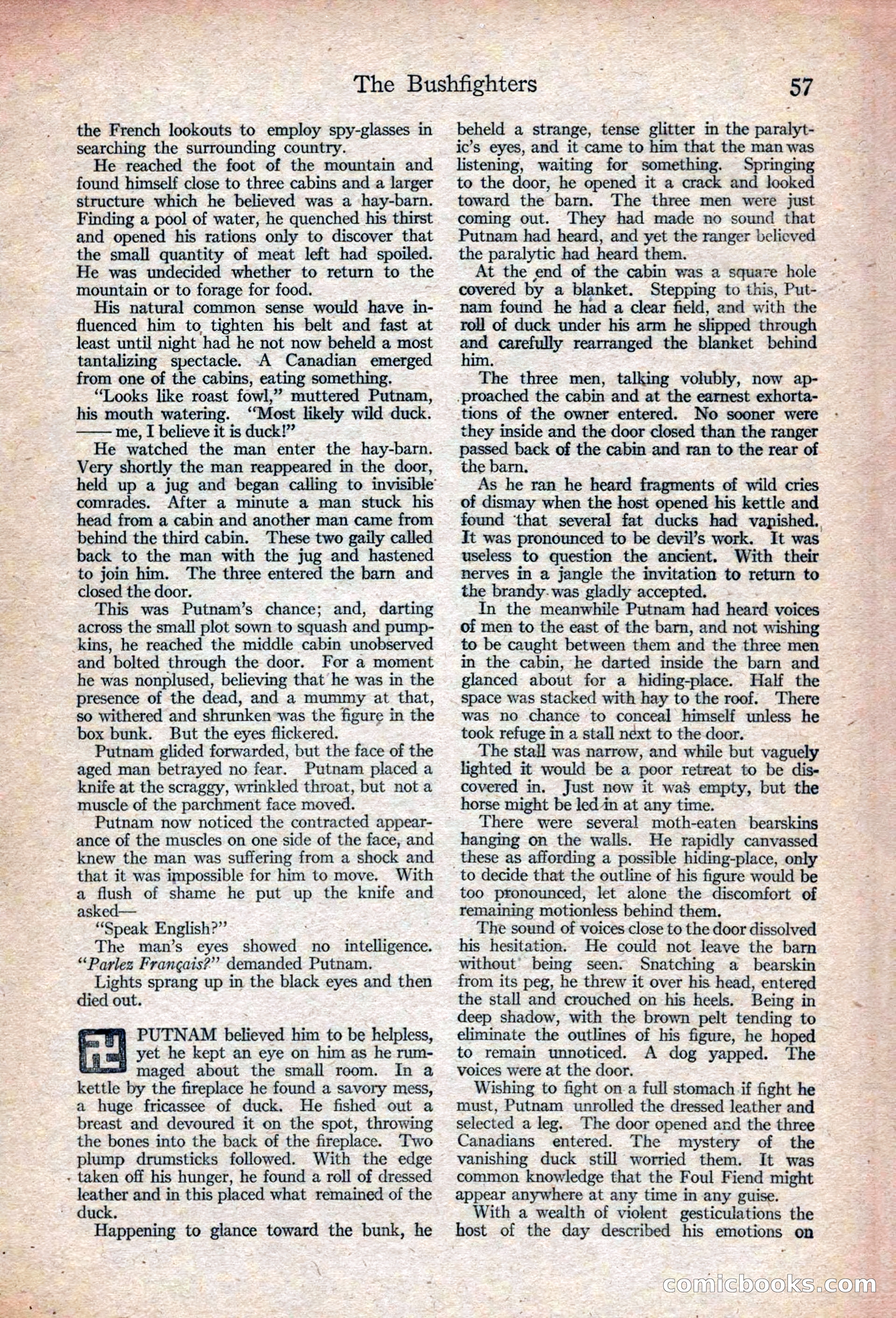
A restored page from Pulp Fiction, 1920. Page through the whole issue in the reader above.
📄 Transcribed text from this page (OCR, searchable)
Machine-transcribed from the original scan — historical spelling and the odd misread are preserved.
The Bushfighters the French lookouts to employ spy-glasses in searching the surrounding country. He reached the foot of the mountain and found himself close to three cabins and a larger structure which he believed was a hay-barn. Finding a pool of water, he quenched his thirst and opened his rations only to discover that the small quantity of meat left had spoiled. He was undecided whether to return to the mountain or to forage for food. His natural common sense would have in- fluenced him to tighten his belt and fast at least until night had he not now beheld a most tantalizing spectacle. -A Canadian emerged from one of the cabins, eating something. “Looks like roast fowl,” muttered Putnam, his mouth watering. “Most likely wild duck. —— me, I believe it is duck!” He watched the man enter the hay-barn. Very shortly the man reappeared in the door, held up a jug and began calling to invisible’ comrades. After a minute a man stuck his head from a cabin and another man came from behind the third cabin. These two gaily called back to the man with the jug and hastened _ to join him. The three entered the barn and closed the door. This was Putnam’s chance; and, darting across the small plot sown to squash and pump- -kins, he reached the middle cabin unobserved and bolted through the door. For a moment he was nonplused, believing that he was in the presence of the dead, and a mummy at that, so withered and shrunken was the figure in the box bunk. But the eyes flickered. Putnam glided forwarded, but the face of the aged man betrayed no fear. Putnam placed a knife at the scraggy, wrinkled throat, but not a muscle of the parchment face moved. Putnam now noticed the contracted appear- ance of the muscles on one side of the face, and . knew the man was suffering from a shock and that it was impossible for him to move. With a flush of shame he put up the knife and asked— “Speak English?” The man’s eyes showed no _ intelligence. “Parlez Frangais?”’ demanded Putnam. Lights sprang up in the black eyes and then died out. PUTNAM Scteved him to be Anat yet he kept an eye on him as he rum- maged about the small room. In a kettle by the fireplace he found a savory mess, a huge fricassee of duck. He fished out a breast and devoured it on the spot, throwing the bones into the back of the fireplace. Two plump drumsticks followed. With the edge - taken off his hunger, he found a roll of dressed leather and in this placed what remained of the ~ duck. Happening to glance toward the bunk, he 37 beheld a strange, tense glitter in the paralyt- ic’s eyes, and it came to him that the man was listening, waiting for something. Springing to the door, he opened it a crack and looked toward the barn. The three men were just coming out. They had made no sound that Putnam had heard, and yet the ranger believed the paralytic had heard them. At the end of the cabin was a square hole covered by a blanket. Stepping to this, Put- nam found he had a clear field, and with the roll of duck under his arm he slipped through -~ carefully rearranged the blanket behind athe three men, talking volubly, now ap- .proached the cabin and at the earnest exhorta- tions of the owner entered. No sooner were they inside and the door closed than the ranger passed back of the cabin and ran to the rear of the barn, As he ran he heard fragments of wild cries of dismay when the host opened his kettle and found ‘that several fat ducks had vapished.. It was pronounced to be devil’s work. It was useless to question the ancient. With their nerves in a jangle the invitation to return to the brandy. was gladly accepted. . In the meanwhile Putnam had heard voices of men to the east of the barn, and not wishing to be caught between them and the three men in the cabin, he darted inside the barn and glanced about for a hiding-place. Half the space was stacked with hay to the roof. There was no chance to conceal himself unless he took refuge in a stall néxt to the door. The stall was narrow, and while but vaguely lighted it would be a poor retreat to be dis- covered in. Just now it was empty, but the horse might be led in at any time. There were several moth-eaten bearskins hanging on the walls. He rapidly canvassed these as affording a possible hiding-place, only to decide that the outline of his figure would be too pronounced, let alone the discomfort of remaining motionless behind them. The sound of voices close to the door dissolved his hesitation. He could not leave the barn without’ being seen: Snatching a bearskin from its peg, he threw it over his head, entered the stall and crouched on his heels. Being i in deep shadow, with the brown pelt tending to eliminate the outlines of his figure, he hoped to remain unnoticed. A dog yapped. The voices were at the door. Wishing to fight on a full stomach if fight he must, Putnam unrolled the dressed leather and selected a leg. The door opened and the three Canadians entered. The mystery of the vanishing duck still worried them. It was common knowledge that the Foul Fiend might appear anywhere at any time in any guise. With a wealth of violent gesticulations the host of the day described his emotions on connicloolks a“ (F@) -_