
Pulp Fiction, 1920 · page 76 of 172
Adventure Magazine Cover — page 76: what you’re looking at
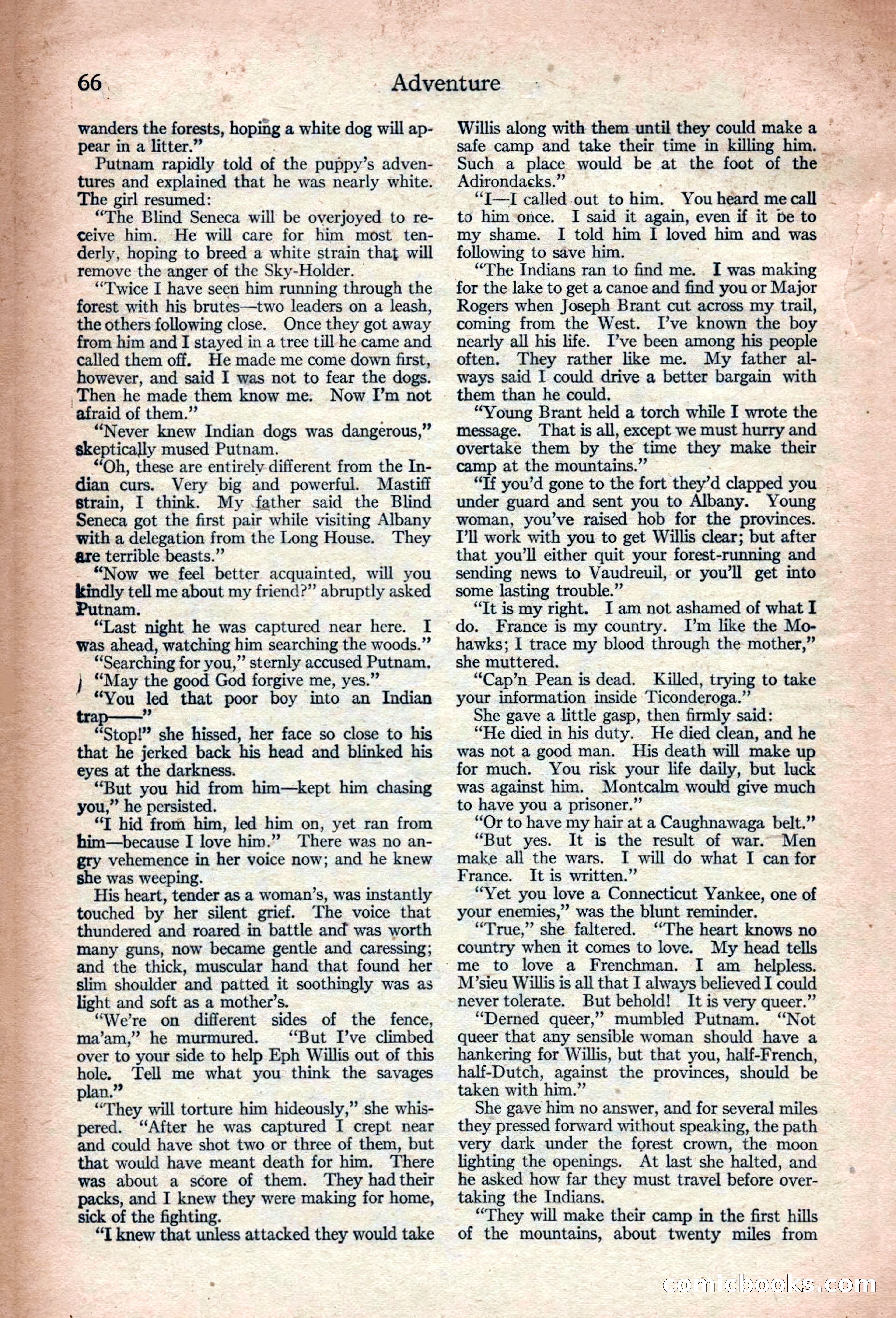
A restored page from Pulp Fiction, 1920. Page through the whole issue in the reader above.
📄 Transcribed text from this page (OCR, searchable)
Machine-transcribed from the original scan — historical spelling and the odd misread are preserved.
so - ie rte : 5: ae > — ae a : 66 ; wanders the forests, hoping a white dog will ap- pear in a litter.” Putnam rapidly told of the puppy’s adven- tures and explained that he was nearly white. The girl resumed: “The Blind Seneca will be overjoyed to re- ceive him. He will care for him most ten- derly, hoping to breed a white strain that will _ remove the anger of the Sky-Holder. | “Twice I have seen him running through the forest with his brutes—two leaders on a leash, the others following close. Once they got away from him and I stayed in a tree till he came and called them off. He made me come down first, however, and said I was not to fear the dogs. Then he made them know me. Now I’m not ‘afraid of them.” “Never knew Indian dogs was dangerous,” skeptically mused Putnam. “Oh, these are entirely different from the In- dian curs. Very big and powerful. Mastiff strain, I think. My father said the Blind Seneca got the first pair while visiting Albany with a delegation from the Long House. They are terrible beasts.” - “Now we feel better acquainted, will you _ Kindly tell me about my friend?” abruptly asked Putnam. “Last night he was captured near here. I was ahead, watching him searching the woods.” “Searching for you,” sternly accused Putnam. } “May the good God forgive me, yes.” “You Jed that poor boy into an Indian p——” “Stop!”? she hissed, her face so close to his that he jerked back his head and blinked his eyes at the darkness. “But you hid from him—kept him chasing you,” he persisted. “T hid from him, led him on, yet ran from him—because I love him.” There was no an- gry vehemence in her voice now; and he knew she was weeping. His heart, tender as a woman’s, was instantly touched by her silent grief. The voice that thundered and roared in battle and was worth many guns, now became gentle and caressing; and the thick, muscular fan that found her slim shoulder and patted it soothingly was as light and soft as a mother’s. “We're on different sides of the fence, ma’am,” he murmured. ‘But I’ve climbed over to your side to help Eph Willis out of this hole. = Tell me what you think the savages plan. “They will torture him hideously,” she whis- pered. “After he was captured I crept near a could have shot two or three of them, but that would have meant death for him. There was about a score of them. They had their , and I knew they were making for home, sick of the fighting “TI knew that unless attacked they would take Adventure ’ do. France is my country. Willis along with them until they could make a © safe camp and take their time in killing him. Such a place would be at the foot of the Adirondacks.” “T—I called out to him. You heard me call to him once. I said it again, even if it be to my shame. I told him I loved him and was following to save him. “The Indians ran to find me. . I was making for the lake to get a canoe and find you or Major Rogers when Joseph Brant cut across my trail, coming from the West. I’ve known the boy nearly all his life. I’ve been among his people often. They rather like me. My father al- ways said I could drive a better bargain with - them than he could “Young Brant held a torch while I wrote the message. That is all, except we must hurry and overtake them by the time they make their camp at the mountains.” 3 ~ “Tf you’d gone to the fort they’d clapped you — under guard and sent you to Albany. Young woman, you’ve raised hob for the provinces. T’ll work with you to get Willis clear; but after that you'll either quit your forest-running and sending news to Vaudreuil, or you'll get into some lasting trouble.” “It is my right. I am not ashamed of what I I’m like the Mo- hawks; I trace my blood through the mother,” she muttered. “Cap’n Pean is dead. Killed, trying to take your information inside Ticonderoga.” She gave a little gasp, then firmly said: “He died in his duty. He died clean, and he was not a good man. His death will make up for much. You risk your life daily, but luck was against him. Montcalm would give much to have you a prisoner.” “Or to have my hair at a Caughnawaga belt.” “But yes. It is the result of war. Men make all the wars. I will do what I can for France. It is written.” “Yet you love a Connecticut Yankee, one of your enemies,” was the blunt reminder. “True,” she faltered. ‘“The heart knows no country when it comes to love. My head tells -me to love a Frenchman. I am helpless. M’sieu Willis is all that I always believed I could never tolerate. But behold! It is very queer.” “Derned queer,” mumbled Putnam. “Not queer that any sensible woman should have a hankering for Willis, but that you, half-French, half-Dutch, against the provinces, should be taken with him.” She gave him no answer, and for several miles they pressed forward without speaking, the path very dark under the forest crown, the moon lighting the openings. At last she halted, and he asked how far they must travel before over- taking the Indians. “They will make their camp in the first hills of the mountains, about twenty miles from CORDIC OO© SS (F@