
Pulp Fiction, 1920 · page 89 of 172
Adventure Magazine Cover — page 89: what you’re looking at
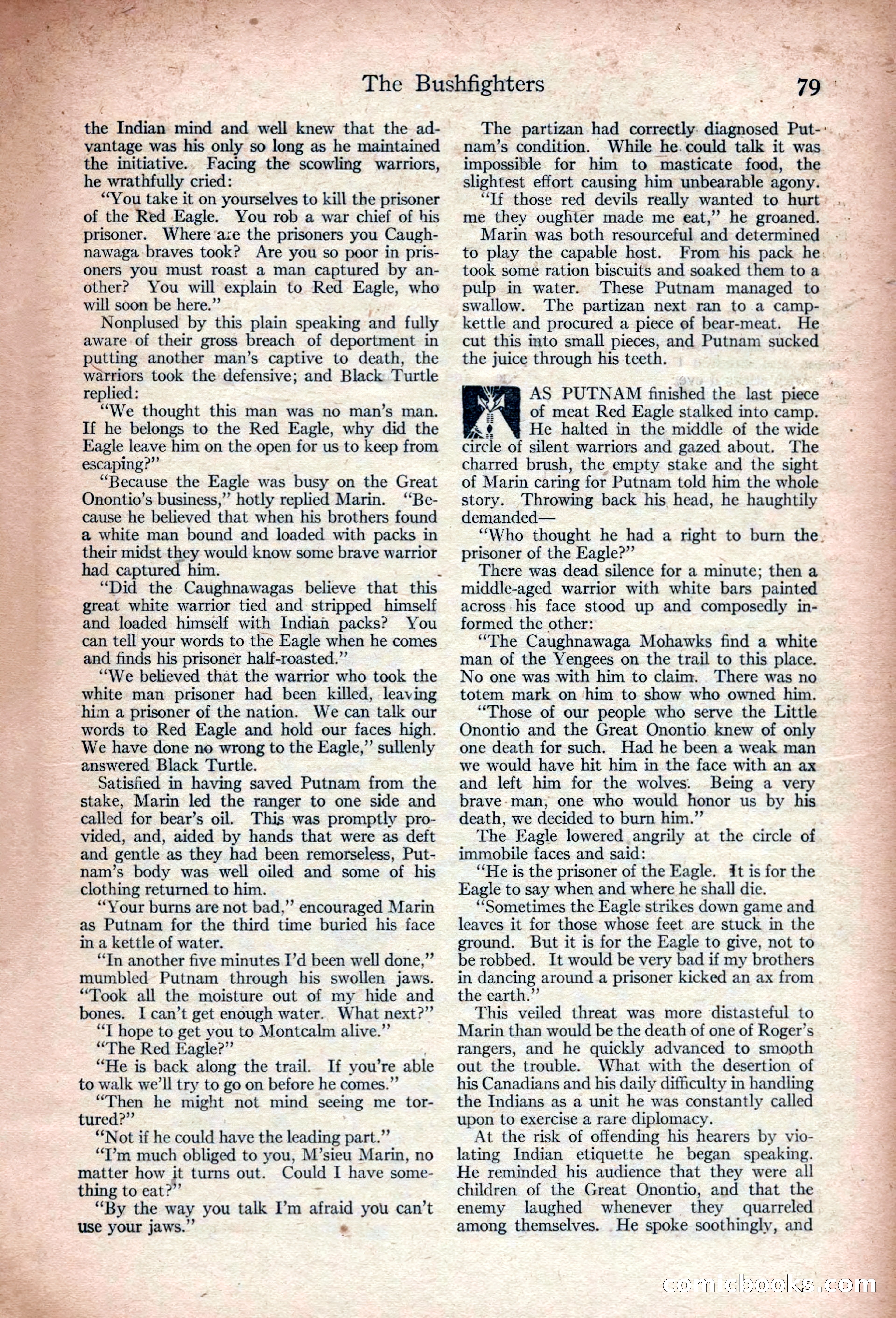
A restored page from Pulp Fiction, 1920. Page through the whole issue in the reader above.
📄 Transcribed text from this page (OCR, searchable)
Machine-transcribed from the original scan — historical spelling and the odd misread are preserved.
the Indian mind and well knew that the ad- - vantage was his only so long as he maintained the initiative.. Facing the scowling warriors, he wrathfully cried: “You take it on yourselves to kill the prisoner of the Red Eagle. You rob a war chief of his prisoner. Where are the prisoners you Caugh- nawaga braves took? Are you so poor in pris- oners you must roast a man captured by an- other? You will explain to Red Eagle, who will soon be here.” Nonplused by this plain speaking and f ully aware of their gross breach of deportment in putting another man’s captive to death, the warriors took the defensive; and Black Turtle replied: “We thought this man was no man’s man. If he belongs to the Red Eagle, why did the Eagle leave him on the open for us to keep from escaping?” “Because the Eagle was busy on the Great Onontio’s business,” hotly replied Marin. ‘“Be- cause he believed that when his brothers found a white man bound and loaded with packs in their midst they would know some brave warrior had captured him. “Did the Caughnawagas believe that this great white warrior tied and stripped himself and loaded himself with Indian packs? You can tell your words to the Eagle when he comes and finds his prisoner half-roasted.”’ “We believed that the warrior who took the white man prisoner had been killed, leaving him a prisoner of the nation. We can talk our words to Red Eagle and hold our faces high. - We have done no wrong to the Eagle,” sullenly answered Black Turtle. Satisfied in having saved Putnam from the stake, Marin led the ranger to one side and called for bear’s oil. This was promptly pro- vided, and, aided by hands that were as deft and gentle as they had been remorseless, Put- nam’s body was well oiled and some of his clothing returned to him. “Your burns are not bad,”’ encouraged Marin as Putnam for the third time buried his face in a kettle of water. “Tn another five minutes I’d been well done,” mumbled Putnam through his swollen jaws. “Took all the moisture out of my hide and bones. I can’t get enough water. What next?” “T hope to get you to Montcalm alive.”’ “The Red Eagle?” “He is back along the trail. If you’ re able to walk we’ll try to go on before he comes.’ “Then he might not mind seeing me tor- tured?” “‘Not if he could have the leading part.” “T’m much obliged to you, M’sieu Marin, no matter how it turns out. Could I have some- thing to eat?”’ “By the way you talk I’m afraid you can’t use your jaws.’ . The Bushfighters 79 The partizan had correctly: diagnosed Put-:. nam’s condition. While he.could talk it was. = impossible for him to masticate food, the slightest effort causing him unbearable agony. “If those red devils really wanted to hurt. . me they oughter made me eat,” he groaned. Marin was both resourceful and determined to play the capable host. took some ration biscuits and soaked them to a pulp in water. These Putnam managed to swallow. The partizan next ran to a camp- kettle and procured a piece of bear-meat. cut this into small pieces, and Putnam sucked the juice through his teeth. of meat Red Eagle stalked into camp. He halted in the middle of the wide circle of silent warriors and gazed about. The charred brush, the empty stake and the sight of Marin caring for Putnam told him the whole story. Throwing back his head, he haughtily - demanded— ’ “Who thought he had a right to burn the. prisoner of the Eagle?” There was dead silence for a minute; then a middle-aged warrior with white bars painted across his face stood up and composedly in- formed the other: “The Caughnawaga Mohawks find a white man of the Yengees on the trail to this place. No one was with him to claim. There was no totem mark on him to show who owned him. “Those of our people who serve the Little Onontio and the Great Onontio knew of only one death for such. Had he been a weak man we would have hit him in the face with an ax and left him for the wolves. Being a very brave-man, one who would honor us by his death, we decided to burn him.” The Eagle lowered angrily at the circle of immobile faces and said: “He is the prisoner of the Eagle. {t is for the Eagle to say when and where he shall die. “‘Sometimes the Eagle strikes down game and leaves it for those whose feet are stuck in the ground. But it is for the Eagle to give, not to be robbed. It would be very bad if my brothers in dancing around a prisoner kicked an ax from the earth.” This veiled threat was more distasteful to Marin than would be the death of one of Roger’s rangers, and he quickly advanced to smooth out the trouble. What with the desertion of his Canadians and his daily difficulty in handling the Indians as a unit he was constantly called upon to exercise a rare diplomacy. At the risk of offending his hearers by vio- lating Indian etiquette he began speaking. He reminded his audience that they were all children of the Great Onontio, and that the enemy laughed whenever they quarreled among themselves. He spoke soothingly, and COMICLMOOOKS He. From his pack he: ., AS PUTNAM finished the last piece — (C@ Pile tebhiG ee es y Pe) UPA a ee =}