
Pulp Fiction, 1920 · page 96 of 172
Adventure Magazine Cover — page 96: what you’re looking at
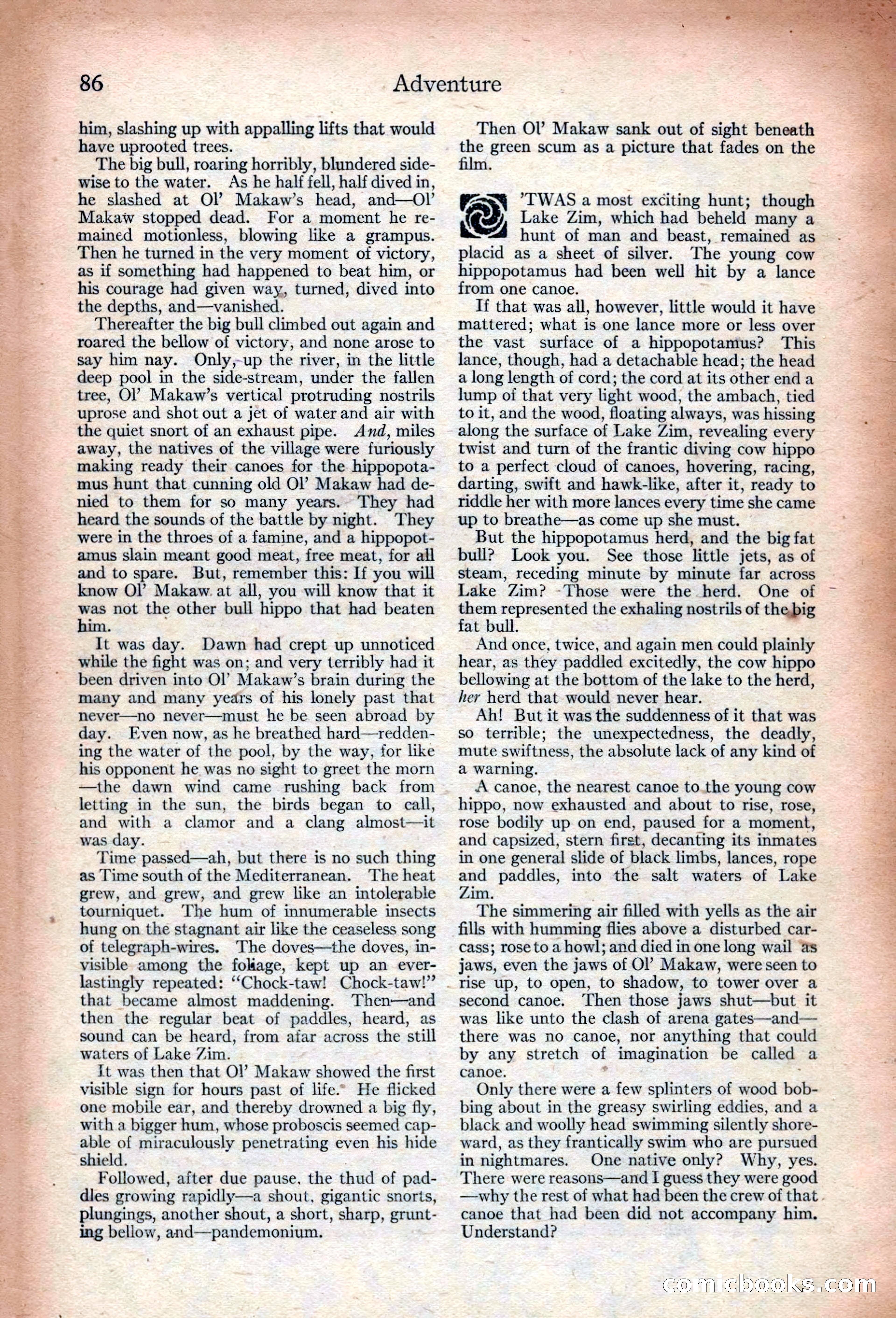
A restored page from Pulp Fiction, 1920. Page through the whole issue in the reader above.
📄 Transcribed text from this page (OCR, searchable)
Machine-transcribed from the original scan — historical spelling and the odd misread are preserved.
him, slashing up with appalling lifts that would have uprooted trees. The big bull, roaring horribly, blundered side- wise to the water. As he half fell, half dived in, he slashed at Ol’ Makaw’s head, and—Ol’ Makaw stopped dead. For a moment he re- mained motionless, blowing like a grampus. Then he turned in the very moment of victory, as if something had happened to beat him, or his courage had given way, turned, dived into the depths, and—vanished. Thereafter the big bull climbed out again and roared the bellow of victory, and none arose to say him nay. Only,-up the river, in the little deep pool in the side-stream, under the fallen tree, Ol’ Makaw’s vertical protruding nostrils uprose and shot out a jet of water and air with the quiet snort of an exhaust pipe. And, miles away, the natives of the village were furiously making ready their canoes for the hippopota- mus hunt that cunning old Ol’ Makaw had de- nied to them for so many years. They had heard the sounds of the battle by night. They were in the throes of a famine, and a hippopot- amus slain meant good meat, free meat, for all and to spare. But, remember this: If you will know OI Makaw. at all, you will know that it — not the other bull hippo that had beaten It was day. Dawn had crept up unnoticed while the fight was on; and very terribly had it been driven into Ol’ Makaw’s brain during the many and many yedrs of his lonely past that never—no never—must he be seen abroad by day. Even now, as he breathed hard—redden- ing the water of the pool, by the way, for like his opponent he was no sight to greet the morn —the dawn wind came rushing back from letting in the sun, the birds began to call, and with a clamor and a clang almost—it was day. Time passed—ah, but there is no such thing as Time south of the Mediterranean. The heat grew, and grew, and grew like an intolerable tourniquet. The hum of innumerable insects hung on the stagnant air like the ceaseless song of telegraph-wires. The doves—the doves, in- visible among the foliage, kept up an ever- lastingly repeated: “Chock-taw! Chock-taw!” that became almost maddening. Then—and then the regular beat of paddles, heard, as sound can be heard, from afar across the still waters of Lake Zim. it was then that Ol’ Makaw showed the first visible sign for hours past of life.” He flicked one mobile ear, and thereby drowned a big fly, with a bigger hum, whose proboscis seemed cap- able of miraculously penetrating even his hide shield. : Followed, after due pause, the thud of pad- dles growing rapidly—a shout, gigantic snorts, plungings, another shout, a short, sharp, grunt- ing bellow, and—pandemonium. Vy o/ a Rt wk 1 : pare des at F 4 hated <=. — Sai * » Adventure Then OV Makaw sank out of sight beneath ne green scum as a picture that fades on the *TWAS a most exciting hunt; though KO) Lake Zim, which had beheld many a placid as a sheet of silver. The young cow hippopotamus had been well hit by a lance from one canoe. If that was all, however, little would it have mattered; what is one lance more or less over the vast surface of a hippopotamus? This lance, though, had a detachable head; the head a long length of cord; the cord at its other enda lump of that very light wood, the ambach, tied to it, and the wood, floating always, was hissing along the surface of Lake Zim, revealing every twist and turn of the frantic diving cow hippo to a perfect cloud of canoes, hovering, racing, darting, swift and hawk-like, after it, ready to riddle her with more lances every time she came up to breathe—as come up she must. But the hippopotamus herd, and the big fat bull? Look you. See those little jets, as of steam, receding minute by minute far across Lake Zim? -Those were the herd. One of them represented the exhaling nostrils of the big fat bull. And once, twice, and again men could plainly hear, as they paddled excitedly, the cow hippo bellowing at the bottom of the lake to the herd, her herd that would never hear. Ah! But it was the suddenness of it that was so terrible; the unexpectedness, the deadly, mute swiftness, the absolute lack of any kind of a warning. A canoe, the nearest canoe to.the young cow hippo, now exhausted and about to rise, rose, rose bodily up on end, paused for a moment, and capsized, stern first, decanting its inmates in one general slide of black limbs, lances, rope and paddles, into the salt waters of Lake Zim. The simmering air filled with yells as the air fills with humming flies above a disturbed car- cass; rose to a howl; and died in one long wail @s jaws, even the jaws of Ol’ Makaw, were seen to _ rise up, to open, to shadow, to tower over a second canoe. Then those jaws shut—but it was like unto the clash of arena gates—and— there was no canoe, nor anything that could by any stretch of imagination be called a canoe. ” : Only there were a few splinters of wood bob- bing about in the greasy swirling eddies, and a black and woolly head swimming silently shore- ward, as they frantically swim who are pursued in nightmares. One native only? Why, yes. There were reasons—and I guess they were good hunt of man and beast, remained as - —why the rest of what had been the crew of that . canoe that had been did not accompany him. Understand? COnNICLOOOKS Lf rts Yinde a)? com