
Pulp Fiction, 1920 · page 100 of 172
Adventure, December 3, 1920 — page 100: what you’re looking at
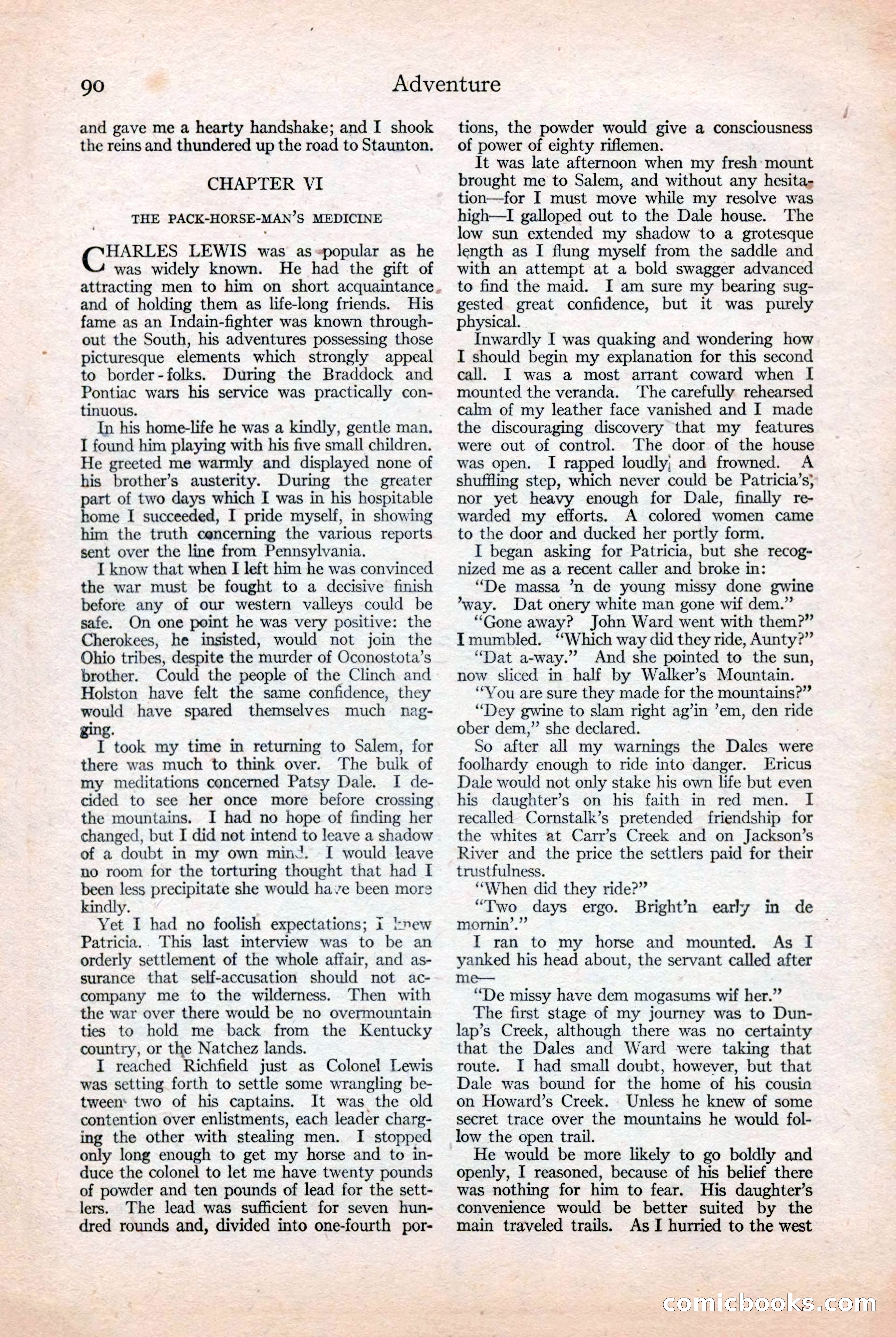
A restored page from Pulp Fiction, 1920. Page through the whole issue in the reader above.
📄 Transcribed text from this page (OCR, searchable)
Machine-transcribed from the original scan — historical spelling and the odd misread are preserved.
9O and gave me a hearty handshake; and I shook the reins and thundered up the road to Staunton. CHAPTER VI THE PACK-HORSE-MAN’S MEDICINE Sees" LEWIS was as~»popular as he was widely known. He had the gift of attracting men to him on short acquaintance. and of holding them as life-long friends. His fame as an Indain-fighter was known through- out the South, his adventures possessing those picturesque elements which strongly appeal to border-folks. During the Braddock and Pontiac wars his service was practically con- tinuous. In his home-life he was a kindly, gentle man, I found him playing with his five small children. He greeted me warmly and displayed none of his brother’s austerity. During the greater part of two days which I was in his hospitable home I succeeded, I pride myself, in showing him the truth cencerning the various reports sent over the line from Pennsylvania. I know that when I left him he was convinced the war must be fought to a decisive finish before any of our western valleys could be safe. On one point he was very positive: the Cherokees, he insisted, would not join the Ohio tribes, despite the murder of Oconostota’s brother. Could the people of the Clinch and Holston have felt the same confidence, they would have spared themselves much nag- g. I took my time in returning to Salem, for there was much to think over. The bulk of my meditations concerned Patsy Dale. I de- cided to see her once more before crossing the mountains. I had no hope of finding her changed, but I did not intend to leave a shadow of a doubt in my own minJ. I would leave no room for the torturing thought that had I been less precipitate she would have been more kindl Yet I had no foolish expectations; i knew Patricia.. This last interview was to be an orderly settlement of the whole affair, and as- surance that self-accusation should not ac- company me to the wilderness. Then with the war over there would be no overmountain ties to hold me back from the Kentucky country, or the Natchez lands. I reached Richfield just as Colonel Lewis was setting forth to settle some wrangling be- tween: two of his captains. It was the old contention over enlistments, each leader charg- ing the other with stealing men. I stopped only long enough to get my horse and to in- duce the colonel to let me have twenty pounds of powder and ten pounds of lead for the sett- lers. The lead was sufficient for seven hun- dred rounds and, divided into one-fourth por- Adventure tions, the powder would give a consciousness of power of eighty riflemen. It was late afternoon when my fresh mount brought me to Salem, and without any hesita- tion—for I must move while my resolve was high—I galloped out to the Dale house. ‘The low sun extended my shadow to a grotesque length as I flung myself from the saddle and with an attempt at a bold swagger advanced to find the maid. I am sure my bearing sug- gested great confidence, but it was purely physical. 3 Inwardly I was quaking and wondering how I should begin my explanation for this second call. I was a most arrant coward when I mounted the veranda. The carefully rehearsed calm of my leather face vanished and I made the discouraging discovery that my features were out of control. The door of the house was open. I rapped loudly, and frowned. A shuffling step, which never could be Patricia’s} nor yet heavy enough for Dale, finally re- warded my efforts. A colored women came to the door and ducked her portly form. I began asking for Patricia, but she recog- nized me as a recent caller and broke in: “De massa ’n de young missy done gwine ’~way. Dat onery white man gone wif dem.” “Gone away? John Ward went with them?” Imumbled. ‘Which way did they ride, Aunty?” “Dat a-way.” And she pointed to the sun, now sliced in half by Walker’s Mountain. “Vou are sure they made for the mountains?” “Dey gwine to slam right ag’in ’em, den ride ober dem,” she declared. So after all my warnings the Dales were foolhardy enough to ride into danger. Ericus Dale would not only stake his own life but even his daughter’s on his faith in red men. I recalled Cornstalk’s pretended friendship for the whites at Carr’s Creek and on Jackson’s River and the price the settlers paid for their trustfulness. ‘When did they ride?” “Two days ergo. Bright’n early in de — mornin’.”’ I ran to my horse and mounted. As I yanked his head about, the servant called after me— “De missy have dem mogasums wif her.” The first stage of my journey was to Dun- lap’s Creek, although there was no certainty that the Dales and Ward were taking that route. I had small doubt, however, but that Dale was bound for the home of his cousin on Howard’s Creek. Unless he knew of some secret trace over the mountains he would fol- low the open trail. He would be more likely to go boldly and openly, I reasoned, because of his belief there was nothing for him to fear. His daughter’s convenience would be better suited by the main traveled trails. As I hurried to the west eomnelaxool<s (E@)