
Pulp Fiction, 1920 · page 106 of 172
Adventure, December 3, 1920 — page 106: what you’re looking at
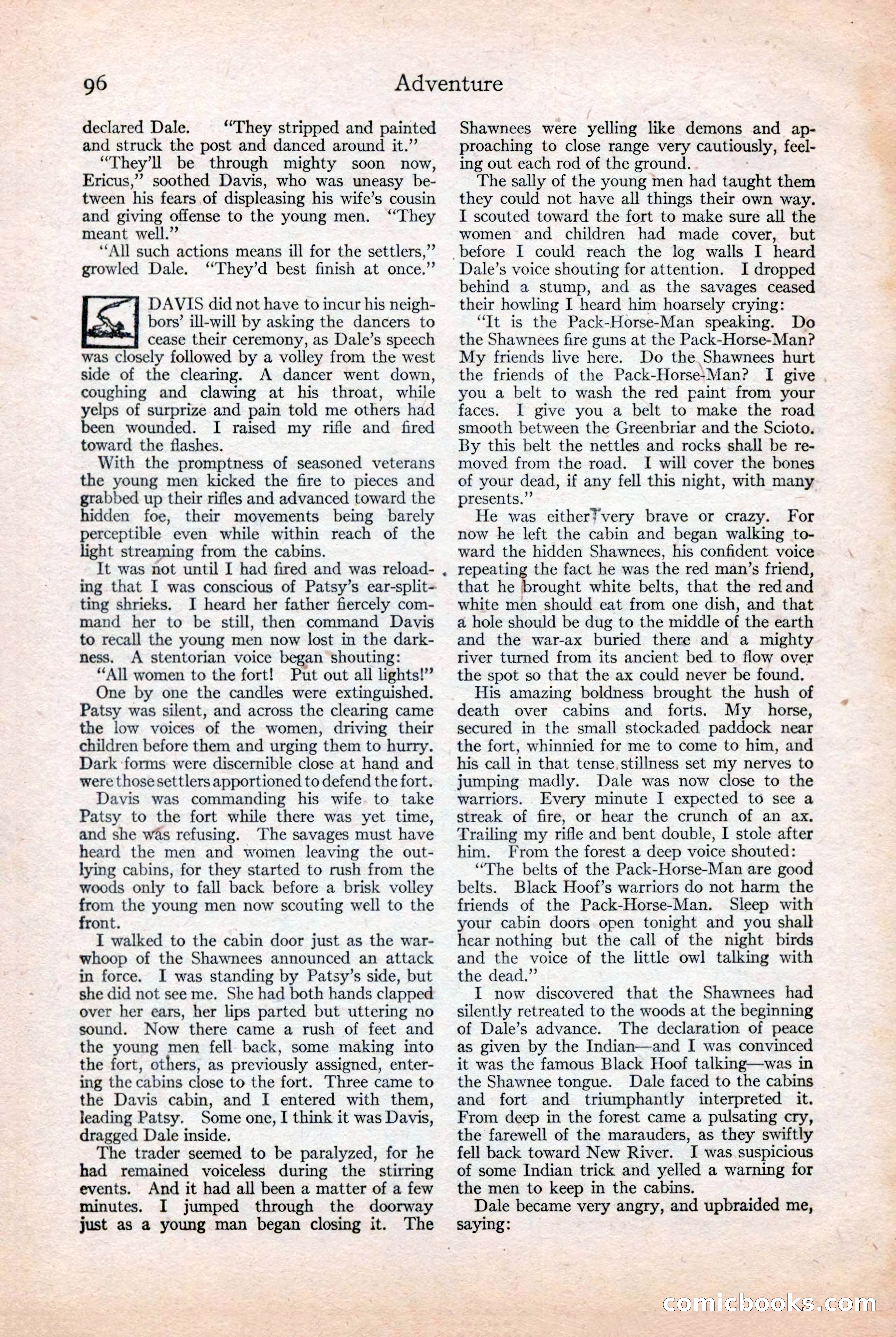
A restored page from Pulp Fiction, 1920. Page through the whole issue in the reader above.
📄 Transcribed text from this page (OCR, searchable)
Machine-transcribed from the original scan — historical spelling and the odd misread are preserved.
96 declared Dale. “They stripped and painted and struck the post and danced around it.” “They'll be through mighty soon now, Ericus,” soothed Davis, who was uneasy be- tween his fears of displeasing his wife’s cousin and giving offense to the young men. ‘“They meant well.” ‘All such actions means ill for the settlers,” growled Dale. ‘“They’d best finish at once.” Se} bors’ ill-will by asking the dancers to 4 cease their ceremony, as Dale’s speech was closely followed by a volley from the west side of the clearing. A dancer went down, coughing and clawing at his throat, while yelps of surprize.and pain told me others had been wounded. I raised my rifle and fired toward the flashes. With the promptness of seasoned veterans the young men kicked the fire to pieces and grabbed up their rifles and advanced toward the hidden foe, their movements being barely perceptible even while within reach of the light streaming from the cabins. It was not until I had fired and was reload- DAVIS did not have to incur his neigh- ing that I was conscious of Patsy’s ear-split- ting shrieks. I heard her father fiercely com- mand her to be still, then command Davis to recall the young men now lost in the dark- ness. A stentorian voice an shouting: ‘All women to the fort! Put out all lights!” One by one the candles were extinguished. Patsy was silent, and across the clearing came the low voices of the women, driving their children before them and urging them to hurry. Dark ‘forms were discernible close at hand and were those settlers apportioned to defend the fort. Davis was commanding his wife to take Patsy to the fort while there was yet time, and she was refusing. The savages must have heard the men and women leaving the out- lying cabins, for they started to rush from the woods only to fall back before a brisk volley from the young men now scouting well to the front. I walked to the cabin door just as the war- whoop of the Shawnees announced an attack in force. I was standing by Patsy’s side, but she did not see me. She had both hands clapped over her ears, her lips parted but uttering no sound. Now there came a rush of feet and the young men fell back, some making into the fort, others, as previously assigned, enter- ing the cabins close to the fort. Three came to the Davis cabin, and I entered with them, leading Patsy. Some one, I think it was Davis, dragged Dale inside. The trader seemed to be paralyzed, for he had remained voiceless during the stirring events. And it had all been a matter of a few minutes. I jumped through the doorway just as a young man began closing it. The . Adventure Shawnees were yelling like demons and ap- proaching to close range very cautiously, feel- ing out each rod of the ground. The sally of the young men had taught them they could not have all things their own way. I scouted toward the fort to make sure all the women and children had made cover, but before I could reach the log walls I heard Dale’s voice shouting for attention. I dropped behind a stump, and as the savages ceased their howling I heard him hoarsely crying: “Tt is the Pack-Horse-Man speaking. Do the Shawnees fire guns at the Pack-Horse-Man? My friends live here. Do the Shawnees hurt the friends of the Pack-Horse+-Man? I give you a belt to wash the red paint from your faces. I give you a belt to make the road smooth between the Greenbriar and the Scioto. By this belt the nettles and rocks shall be re- moved from the road. I will cover the bones of your dead, if any fell this night, with many presents.” He was either? very brave or crazy. For now he left the cabin and began walking to- ward the hidden Shawnees, his confident voice repeating the fact he was the red man’s friend, that he brought white belts, that the red and white men should eat from one dish, and that a hole should be dug to the middle of the earth and the war-ax buried there and a mighty river turned from its ancient bed to flow over the spot so that the ax could never be found. His amazing boldness brought the hush of death over cabins and forts. My horse, secured in the small stockaded paddock near the fort, whinnied for me to come to him, and his call in that tense,stillness set my nerves to jumping madly. Dale was now close to the warriors. Every minute I expected to see a streak of fire, or hear the crunch of an ax. Trailing my rifle and bent double, I stole after him. From the forest a deep voice shouted: — “The belts of the Pack-Horse-Man are good belts. Black Hoof’s warriors do not harm the friends of the Pack-Horse-Man. Sleep with your cabin doors open tonight and you shalk hear nothing but the call of the night birds and the voice of the little owl talking with the dead.” I now discovered that the Shawnees had silently retreated to the woods at the beginning of Dale’s advance. The declaration of peace as given by the Indian—and I was convinced it was the famous Black Hoof talking—was in the Shawnee tongue. Dale faced to the cabins and fort and triumphantly interpreted it. From deep in the forest came a pulsating cry, the farewell of the marauders, as they swiftly fell back toward New River. I was suspicious of some Indian trick and yelled a warning for the men to keep in the cabins. Dale became very angry, and upbraided me, saying: (€(0) IOOkK (E@)