
Pulp Fiction, 1920 · page 109 of 172
Adventure, December 3, 1920 — page 109: what you’re looking at
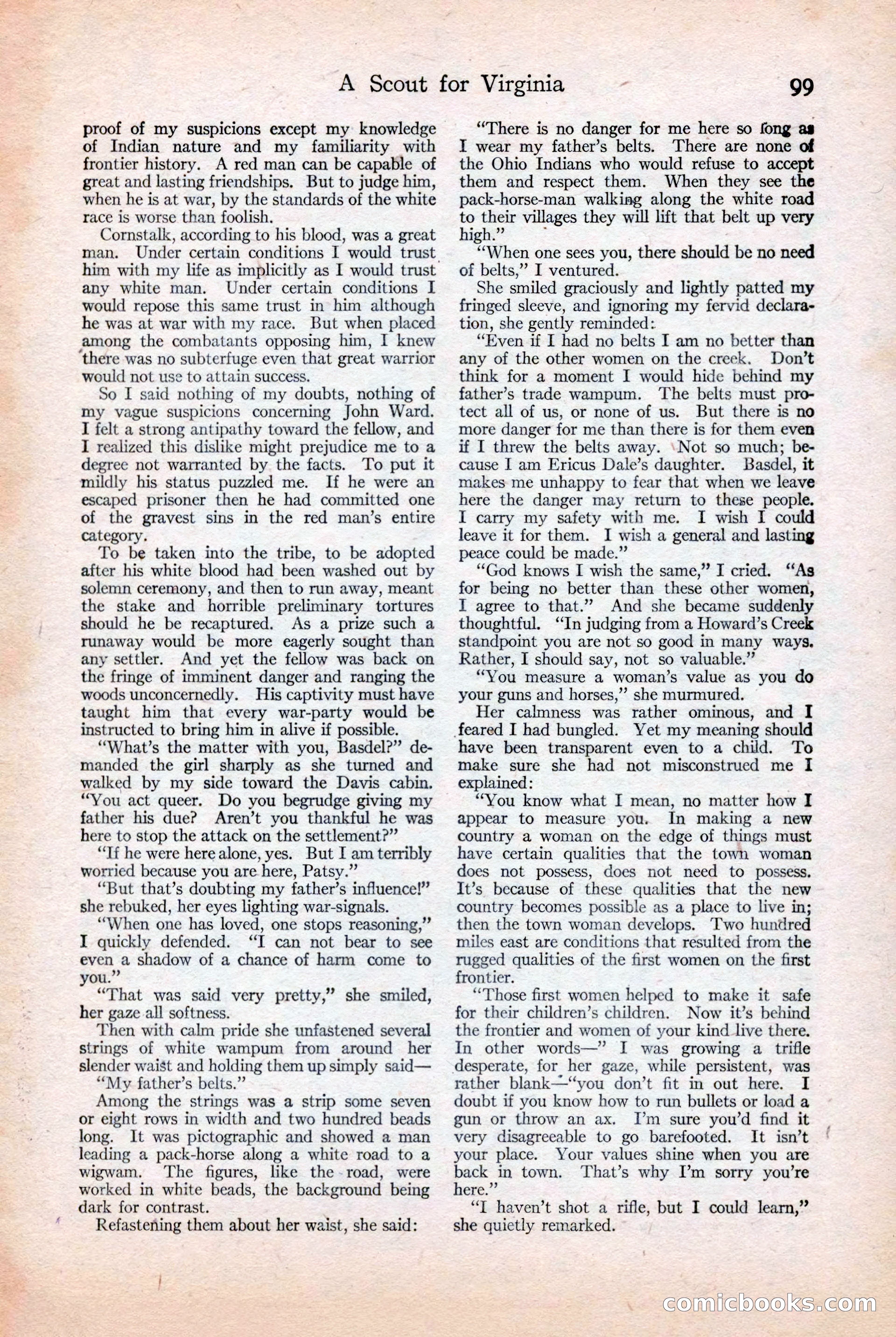
A restored page from Pulp Fiction, 1920. Page through the whole issue in the reader above.
📄 Transcribed text from this page (OCR, searchable)
Machine-transcribed from the original scan — historical spelling and the odd misread are preserved.
> A dt / F 4 A Scout for Virginia : 99 proof of my suspicions except my knowledge of Indian nature and my familiarity with frontier history. A red man can be capable of great and lasting friendships. But to judge him, when he is at war, by the standards of the white race is worse than foolish, Cornstalk, according to his blood, was a great man. Under certain conditions I would trust him with my life as implicitly as I would trust any white man. Under certain conditions I would repose this same trust in him although he was at war with my race. But when placed among the combatants opposing him, I knew ‘there was no subterfuge even that great warrior would not use to attain success. So I said nothing of my doubts, nothing of my vague suspicions concerning John Ward. I felt a strong antipathy toward the fellow, and I realized this dislike might prejudice me to a degree not warranted by the facts. To put it mildly his status puzzled me. If he were an escaped prisoner then he had committed one of the gravest sins in the red man’s entire category. To be taken into the tribe, to be adopted after his white blood had been washed out by solemn ceremony, and then to run away, meant the stake and horrible preliminary tortures should he be recaptured. As a prize such a runaway would be more eagerly sought than any settler. And yet the fellow was back on the fringe of imminent danger and ranging the woods unconcernedly. His captivity must have taught him that every war-party would be instructed to bring him in alive if possible. “What’s the matter with you, Basdel?” de- manded the girl sharply as she turned and walked by my side toward the Davis cabin. “You act queer. Do you begrudge giving my father his due? Aren’t you thankful he was here to stop the attack on the settlement?” “Tf he were here alone, yes. But I am terribly worried because you are here, Patsy.” “But that’s doubting my father’s influence!” she rebuked, her eyes lighting war-signals. “When one has loved, one stops reasoning,” I quickly defended. “I can not bear to see even a shadow of a chance of harm come to you.” “That was said very pretty,” she smiled, her gaze all softness. Then with calm pride she unfastened several strings of white wampum from around her slender waist and holding them up simply said— “My. father’s belts.” Among the strings was a strip some seven or eight rows in width and two hundred beads long. It was pictographic and showed a man leading a pack-horse along a white road to a wigwam. The figures, like the-road, were worked in white beads, the background being dark for contrast. Refastening them about her waist, she said: “There is no danger for me here so fong as I wear my father’s belts. There are none of the Ohio Indians who would refuse to accept them and respect them. When they see the pack-horse-man walking along the white road to their villages they will lift that belt up very high.” “(When one sees you, there should be no need of belts,” I ventured. She smiled graciously and lightly patted my fringed sleeve, and ignoring my fervid declara- tion, she gently reminded: “Even if I had no belts I am no better than any of the other women on the creek. Don’t think for a moment I would hide behind my father’s trade wampum. ‘The belts must pro- tect all of us, or none of us. But there is no more danger for me than there is for them even if I threw the belts away. ‘Not so much; be- cause I am Ericus Dale’s daughter. Basdel, it makes me unhappy to fear that when we leave here the danger may return to these people. I carry my safety with me. I wish I could leave it for them. I wish a general and lasting peace could be made.” “God knows I wish the same,” I cried. “As for being no better than these other women, I agree to that.” And she became suddenly thoughtful. “In judging from a Howard’s Creek standpoint you are not so good in many ways, Rather, I should say, not so valuable.” “You measure a woman’s value as you do your guns and horses,”’ she murmured. Her calmness was rather ominous, and I feared I had bungled. Yet my meaning should have been transparent even to a child. To make sure she had not misconstrued me I explained: “You know what I mean, no matter how I appear to measure you. In making a new country a woman on the edge of things must have certain qualities that the town woman does not possess, does not need to possess, It’s because of these qualities that the new country becomes possible as a place to live in; then the town woman develops. Two hundred miles east are conditions that resulted from the rugged qualities of the first women on the first frontier. “Those first women helped to make it safe for their children’s children. Now it’s behind the frontier and women of your kind live there. In other words—”’ I was growing a trifle desperate, for her gaze, while persistent, was rather blank—“you don’t fit in out here. I doubt if you know how to run bullets or load a gun or throw an ax. I’m sure you’d find it very disagreeable to go barefooted. It isn’t your place. Your values shine when you are back in town. That’s why I’m sorry you’re here.” “T haven’t shot a rifle, but I could learn,” she quietly remarked. EOPMNICLOOOKS (F@)