
Pulp Fiction, 1920 · page 112 of 172
Adventure, December 3, 1920 — page 112: what you’re looking at
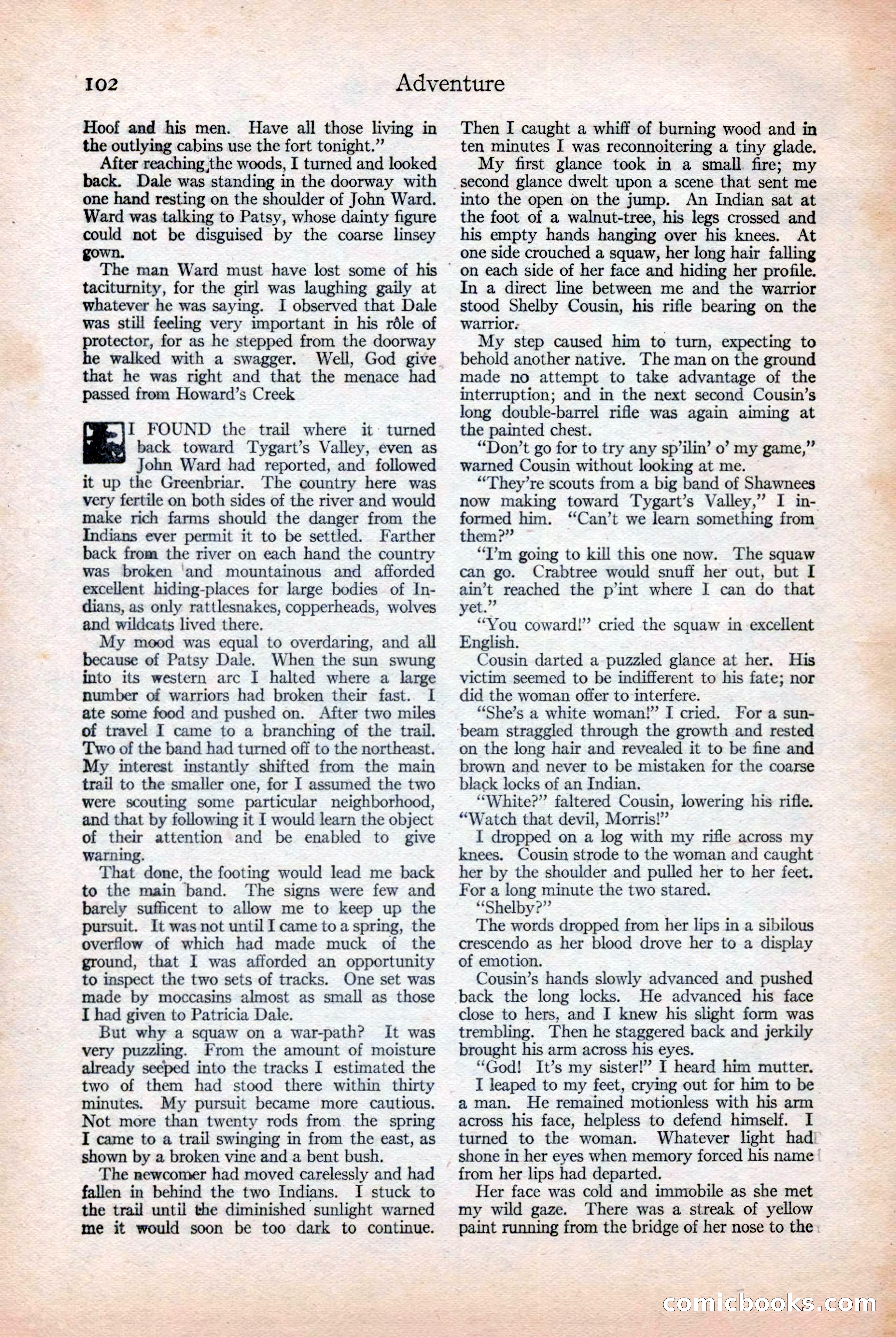
A restored page from Pulp Fiction, 1920. Page through the whole issue in the reader above.
📄 Transcribed text from this page (OCR, searchable)
Machine-transcribed from the original scan — historical spelling and the odd misread are preserved.
102 Hoof and his men. Have all those living in the outlying cabins use the fort tonight.” After reaching the woods, I turned and looked back. Dale was standing in the doorway with one hand resting on the shoulder of John Ward. Ward was talking to Patsy, whose dainty figure could not be disguised by the coarse linsey wn. The man Ward must have lost some of his taciturnity, for the girl was laughing gaily at whatever he was saying. I observed that Dale was still feeling very important in his rdéle of protector, for as he stepped from the doorway he walked with a swagger. Well, God give that he was right and that the menace had passed from Howard’s Creek I FOUND the trail where it: turned back toward Tygart’s Valley, even as John Ward had reported, and followed it up the Greenbriar. The country here was very fertile on both sides of the river and would make rich farms should the danger from the Indians ever permit it to be settled. Farther back from the river on each hand the country was broken ‘and mountainous and afforded excellent hiding-places for large bodies of In- dians, as only rattlesnakes, copperheads, wolves and wildcats lived there. My mood was equal to overdaring, and all because of Patsy Dale. When the sun swung into its western arc I halted where a large number of warriors had broken their fast. I ate some food and pushed on. After two miles of travel I came to a branching of the trail. Two of the band had turned off to the northeast. My interest instantly shifted from the main trail to the smaller one, for I assumed the two were scouting some particular neighborhood, and that by following it I would learn the object of their attention and be enabled to give warning. That done, the footing would lead me back to the main band. ‘The signs were few and barely sufficent to allow me to keep up the pursuit. It was not until I came to a spring, the overflow of which had made muck of the ground, that I was afforded an opportunity to inspect the two sets of tracks. One set was made by moccasins almost as small as those I had given to Patricia Dale. But why a squaw on a war-path? It was very puzzling. From the amount of moisture already seeped into the tracks I estimated the two of them had stood there within thirty minutes. My pursuit became more cautious. Not more than twenty rods from. the spring I came to a trail swinging in from the east, as shown by a broken vine and a bent bush. The newcomer had moved carelessly and had fallen in behind the two Indians. I stuck to the trail until the diminished sunlight warned me it would soon be too dark to continue. Adventure Then I caught a whiff of burning wood and in ten minutes I was reconnoitering a tiny glade. My first glance took in a small. fire; my _second glance dwelt upon a scene that sent me into the open on the jump. An Indian sat at the foot of a walnut-tree, his legs crossed and his empty hands hanging over his knees. At one side crouched a squaw, her long hair falling ~ on each side of her face and hiding her profile. In a direct line between me and the warrior stood Shelby Cousin, his rifle bearing on the warrior: | My step caused him to turn, expecting to behold another native. The man on the ground made no attempt to take advantage of the interruption; and in the next second Cousin’s long double-barrel rifle was again aiming at the painted chest. “Don’t go for to try any sp’ilin’ o’ my game,” warned Cousin without looking at me. “They’re scouts from a big band of Shawnees now making toward Tygart’s Valley,” I in- formed him. “Can’t we learn something from them?” “I’m going to kill this one now. The squaw can go. Crabtree would snuff her out, but I ain’t reached the p’int where I can do that yet.” “You coward!” cried the squaw in excellent English. Cousin darted a puzzled glance at her. His victim seemed to be indifferent to his fate; nor did the woman offer to interfere. “She’s a white woman!” I cried. For a sun- beam straggled through the growth and rested on the long hair and revealed it to be fine and brown and never to be mistaken for the coarse black locks of an Indian. “White?” faltered Cousin, lowering his rifle. “Watch that devil, Morris!’ I dropped on a log with my rifle across my knees. Cousin strode to the woman and caught her by the shoulder and pulled her to her feet. For a long minute the two stared. “Shelby?” The words dropped from her lips in a sibilous crescendo as her blood drove her to a display of emotion. Cousin’s hands slowly advanced and pushed back the long locks. He advanced his face close to hers, and I knew his slight form was trembling. Then he staggered back and jerkily brought his arm across his eyes. “God! It’s my sister!” I heard him mutter. I leaped to my feet, crying out for him to be aman. He remained motionless with his arm across his face, helpless to defend himself. I turned to the woman. from her lips had departed. Her face was cold and immobile as she met my wild gaze. There was a streak of yellow paint running from the bridge of her nose to the: EOPMICGLOOOL< Whatever light had’ shone in her eyes when memory forced his name | (E@)