
Pulp Fiction, 1920 · page 116 of 172
Adventure, December 3, 1920 — page 116: what you’re looking at
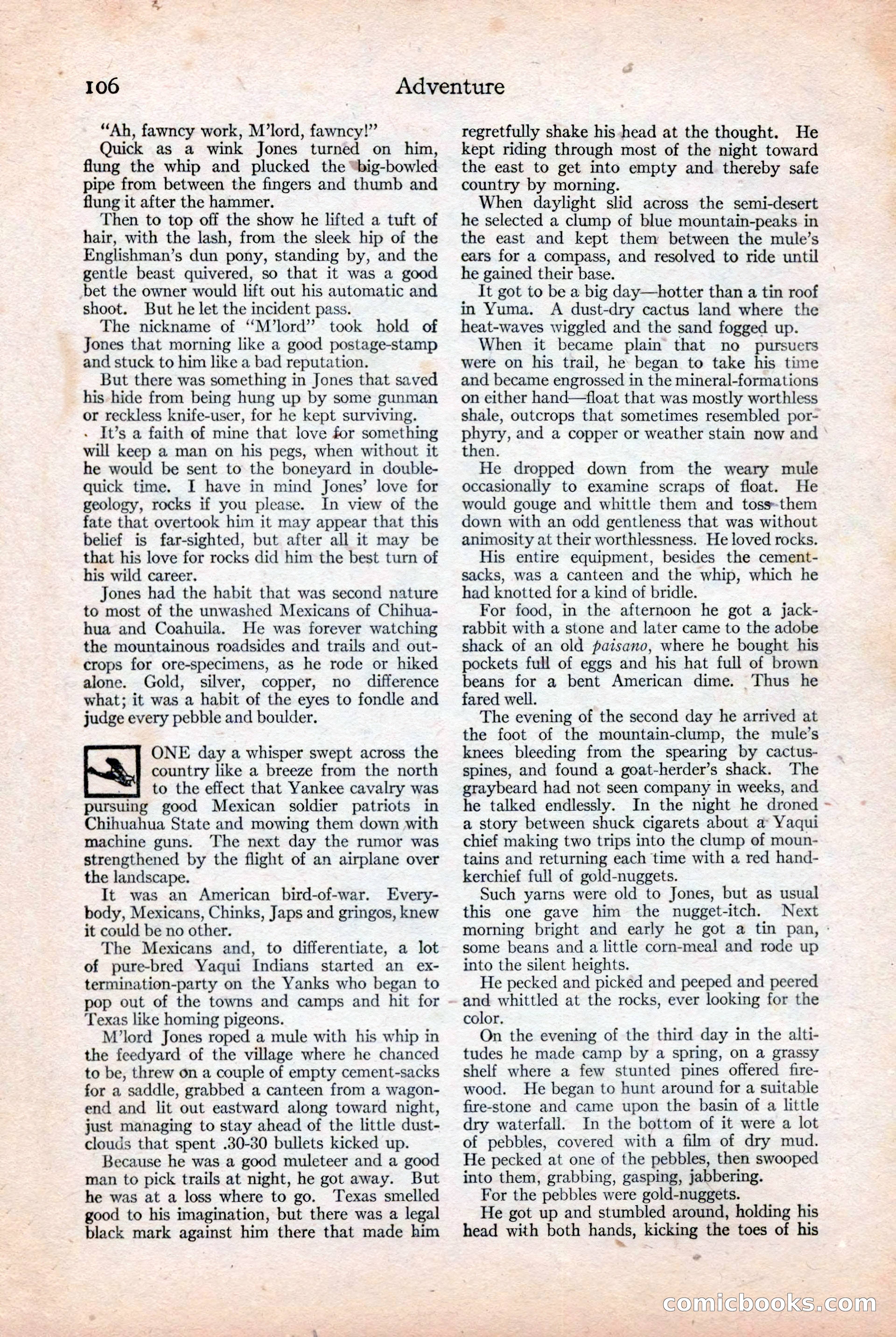
A restored page from Pulp Fiction, 1920. Page through the whole issue in the reader above.
📄 Transcribed text from this page (OCR, searchable)
Machine-transcribed from the original scan — historical spelling and the odd misread are preserved.
106 “Ah, fawncy work, M’lord, fawncy!’’ Quick as a wink Jones turned on him, flung the whip and plucked the “big-bowled pipe from between the fingers and thumb and flung it after the hammer. Then to top off the show he lifted a tuft of hair, with the lash, from the sleek hip of the Englishman’s dun pony, standing by, and the gentle beast quivered, so that it was a good bet the owner would lift out his automatic and shoot. But he let the incident pass. The nickname of ‘‘M’lord” took hold of Jones that morning like a good postage-stamp and stuck to him like a bad reputation. But there was something in Jones that saved his hide from being hung up by some gunman or reckless knife-user, for he kept surviving. . It’s a faith of mine that love for something will keep a man on his pegs, when without it he would be sent to the boneyard in double- quick time. I have in mind Jones’ love for geology, rocks if you please. In view of the fate that overtook him it may appear that this belief is far-sighted, but after all it may be that his love for rocks did him the best turn of his wild career. Jones had the habit that was second nature to most of the unwashed Mexicans of Chihua- hua and Coahuila. He was forever watching the mountainous roadsides and trails and out- crops for ore-specimens, as he rode or hiked alone. Gold, silver, copper, no difference what; it was a habit of the eyes to fondle and judge every pebble and boulder. CN country like a breeze from the north | “ST to the effect that Yankee cavalry was pursuing good Mexican soldier patriots in Chihuahua State and mowing them down with machine guns. The next day the rumor was strengthened by the flight of an airplane over the landscape. It was an American bird-of-war. Every- body, Mexicans, Chinks, Japs and gringos, knew it could be no other. The Mexicans and, to differentiate, a lot of pure-bred Yaqui Indians started an ex- termination-party on the Yanks who began to pop out of the towns and camps and hit for Texas like homing pigeons. M’lord Jones roped a mule with his whip in the feedyard of the village where he chanced to be, threw on a couple of empty cement-sacks for a saddle, grabbed a canteen from a wagon- end and lit out eastward along toward night, just managing to stay ahead of the little dust- clouds that spent .30-30 bullets kicked up. Because he was a good muleteer and a good man to pick trails at night, he got away. But he was at a loss where to go. Texas smelled good to his imagination, but there was a legal black mark against him there that made him ONE day a whisper swept across the Adventure regretfully shake his head at the thought. He kept riding through most of the night toward the east to get into empty and thereby safe country by morning. When daylight slid across the semi-desert he selected a clump of blue mountain-peaks in the east and kept them between the mule’s ears for a compass, and resolved to ride until he gained their base. It got to be a big day—hotter than a tin roof in Yuma. A dust-dry cactus land where the heat-waves wiggled and the sand fogged up. When it became plain that no pursuers were on his trail, he began to take his time and became engrossed in the mineral-formations on either hand—float that was mostly worthless shale, outcrops that sometimes resembled por- phyry, and a copper or weather stain now and en. He dropped down from the weary mule occasionally to examine scraps of float. He would gouge and whittle them and toss-them down with an odd gentleness that was without animosity at their worthlessness. He loved rocks. His entire equipment, besides the cement- sacks, was a canteen and the whip, which he had knotted for a kind of bridle. For food, in the afternoon he got a jack- rabbit with a stone and later came to the adobe shack of an old paisano, where he bought his pockets full of eggs and his hat full of brown beans for a bent American dime. Thus he fared well. The evening of the second day he arrived at the foot of the mountain-clump, the mule’s knees bleeding from the spearing by cactus- spines, and found a goat-herder’s shack. The graybeard had not seen company in weeks, and he talked endlessly. In the night he droned a story between shuck cigarets about a Yaqui chief making two trips into the clump of moun- tains and returning each time with a red hand- kerchief full of gold-nuggets. Such yarns were old to Jones, but as usual this one gave him the nugget-itch. Next / morning bright and early he got a tin pan, ° some beans and a little corn-meal and rode up into the silent heights. He pecked and picked and peeped and peered and whittled at the rocks, ever looking for the color. On the evening of the third day in the alti- tudes he made camp by a spring, on a grassy shelf where a few stunted pines offered fire- wood. He began to hunt around for a suitable fire-stone and came upon the basin of a little dry waterfall. In the bottom of it were a lot of pebbles, covered with a film of dry mud. He pecked at one of the pebbles, then swooped into them, grabbing, gasping, jabbering. For the pebbles were gold-nuggets. He got up and stumbled around, holding his head with both hands, kicking the toes of his - NOOLKS ANIC (C@) (E@)