
Pulp Fiction, 1920 · page 129 of 172
Adventure, December 3, 1920 — page 129: what you’re looking at
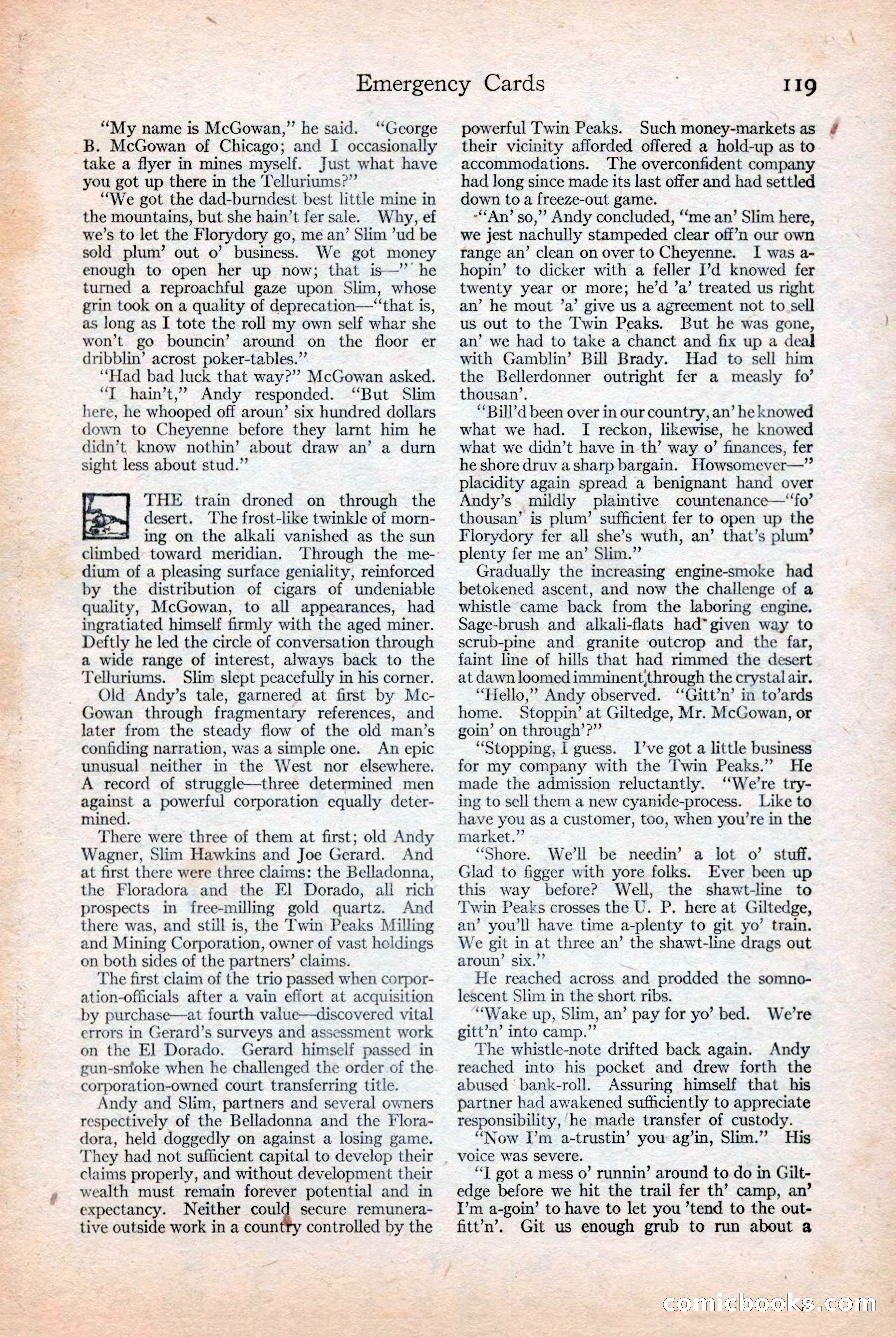
A restored page from Pulp Fiction, 1920. Page through the whole issue in the reader above.
📄 Transcribed text from this page (OCR, searchable)
Machine-transcribed from the original scan — historical spelling and the odd misread are preserved.
Emergency Cards “My name is McGowan,” he said. ‘George B. McGowan of Chicago; and I occasionally take a flyer in mines myself. Just what have you got up there in the elluriums?” “We got the dad-burndest best little mine in the mountains, but she hain’t fer sale. Why, ef we’s to let the Florydory go, me an’ Slim ’ud be sold plum’ out o’ business. We got money enough to open her up now; that is—” he turned a reproachful gaze upon Slim, whose grin took on a quality of deprecation—‘‘that is, as long as I tote the roll my own self whar she won’t go bouncin’ around on the floor er dribblin’ acrost poker-tables.”’ “Had bad luck that way?” McGowan asked. “YT hain’t,” Andy responded. “But Slim here, he whooped off aroun’ six hundred dollars down to Cheyenne before they larnt him he didn’t know nothin’ about draw an’ a durn sight less about stud.” 3S THE train droned on through the ees desert. ‘The frost-like twinkle of morn- —=——% ing on the alkali vanished as the sun climbed toward meridian. Through the me- _ dium of a pleasing surface geniality, reinforced by the distribution of cigars of undeniable quality, McGowan, to all appearances, had ingratiated himself firmly with the aged miner. Deftly he led the circle of conversation through a wide range of interest, always back to the Telluriums. Slim slept peacefully in his corner. _ Old Andy’s tale, garnered at first by Mc- Gowan through fragmentary references, and later from the steady flow of the old man’s confiding narration, was a simple one. An epic unusual neither in the West nor elsewhere. A record of struggle—three determined men against a powerful corporation equally deter- mined. There were three of them at first; old Andy Wagner, Slim Hawkins and Joe Gerard. And at first there were three claims: the Belladonna, the Floradora and the El Dorado, all rich prospects in free-milling gold quartz. And there was, and still is, the Twin Peaks Milling and Mining Corporation, owner of vast holdings on both sides of the partners’ claims. The first claim of the trio passed when corpor- ation-officials after a vain effort at acquisition by purchase—at fourth value—discovered vital errors in Gerard’s surveys and assessment work on the El Dorado. Gerard himself passed in gun-smioke when he challenged the order of the corporation-owned court transferring title. Andy and Slim, partners and several owners respectively of the Belladonna and the Flora- dora, held doggedly on against a losing game. They had not sufficient capital to develop their . claims properly, and without development their wealth must remain forever potential and in expectancy. Neither could secure remunera- tive outside work in a countfy controlled by the 119 powerful Twin Peaks. Such money-markets as their vicinity afforded offered a hold-up as to accommodations. The overconfident company had long since made its last offer and had settled down to a freeze-out game. An’ so,” Andy concluded, “me an’ Slim here, we jest nachully stampeded clear off’n our own range an’ clean on over to Cheyenne. I was a- hopin’ to dicker with a feller I'd knowed fer twenty year or more; he’d ’a’ treated us right an’ he mout ’a’ give us a agreement not to sell us out to the Twin Peaks. But he was gone, an’ we had to take a chanct and fix up a deal with Gamblin’ Bill Brady. Had to sell him the Bellerdonner outright fer a measly fo’ thousan’. ‘‘Bill’d been over in our country, an’ he knowed what we had. I reckon, likewise, he knowed what we didn’t have in th’ way o’ finances, fer he shore druv a sharp bargain. Howsomever—” placidity again spread a benignant hand over Andy’s mildly plaintive countenance—‘‘fo’ thousan’ is plum’ sufficient fer to open up the Florydory fer all she’s wuth, an’ that’s plum’ plenty fer me an’ Slim.”’ Gradually the increasing engine-smoke had betokened ascent, and now the challenge of a whistle came back from the laboring engine. Sage-brush and alkali-flats had” given way to scrub-pine and granite outcrop and the far, faint line of hills that had rimmed the desert at dawn loomed imminent,through the crystal air. “Hello,” Andy observed. “Gitt’n’ in to’ards home. Stoppin’ at Giltedge, Mr. McGowan, or goin’ on through’?” “Stopping, I guess. I’ve got a little business for my company with the Twin Peaks.” He made the admission reluctantly. ‘“‘We’re try- ing to sell them a new cyanide-process. Like to have you as a customer, too, when you’re in the market.” “Shore. We'll be needin’ a lot o’ stuff. Glad to figger with yore folks. Ever been up this way before? Well, the shawt-line to Twin Peaks crosses the U. P. here at Giltedge, an’ you'll have time a-plenty to git yo’ train. We git in at three an’ the shawt-line drags out aroun’ six.” He reached across and prodded the somno- lescent Slim in the short ribs. “Wake up, Slim, an’ pay for yo’ bed. We’re gitt’n’ into camp.” The whistle-note drifted back again. Andy reached into his pocket and drew forth the abused bank-roll. Assuring himself that his partner had awakened sufficiently to appreciate responsibility, he made transfer of custody. “Now I’m a-trustin’ you ag’in, Slim.” His voice was severe. “T got a mess 0’ runnin’ around to do in Gilt- edge before we hit the trail fer th’ camp, an’ I’m a-goin’ to have to let you ’tend to the out- fitt’n’. Git us enough grub to run about a EOPNICGLOO (E@)