
Pulp Fiction, 1920 · page 159 of 172
Adventure, December 3, 1920 — page 159: what you’re looking at
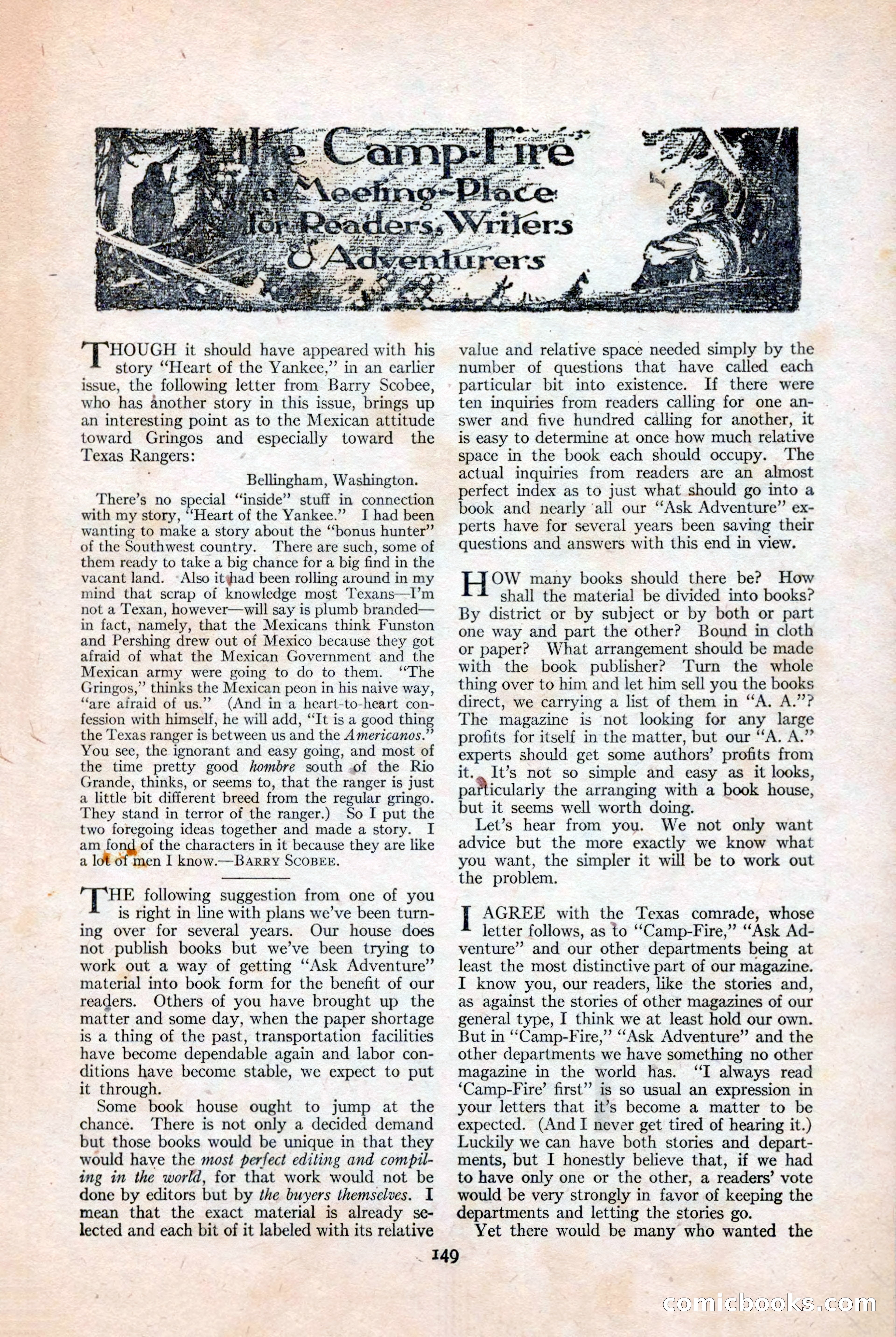
A restored page from Pulp Fiction, 1920. Page through the whole issue in the reader above.
📄 Transcribed text from this page (OCR, searchable)
Machine-transcribed from the original scan — historical spelling and the odd misread are preserved.
"THOUGH it should have appeared with his story ‘‘Heart of the Yankee,” in an earlier issue, the following letter from Barry Scobee, who has another story in this issue, brings up an interesting point as to the Mexican attitude toward Gringos and especially toward the Texas Rangers: Bellingham, Washington. There’s no special “inside” stuff in connection with my story, ‘‘Heart of the Yankee.” I had been wanting to make a story about the “bonus hunter” of the Southwest country. There are such, some of them ready to take a big chance for a big find in the vacant land. ~Also itghad been rolling around in my mind that scrap of knowledge most Texans—I’m not a Texan, however—will say is plumb branded— in fact, namely, that the Mexicans think Funston and Pershing drew out of Mexico because they got afraid of what the Mexican Government and the Mexican army were going to do to them. ‘The Gringos,” thinks the Mexican peon in his naive way, “are afraid of us.’”’ (And in a heart-to-heart con- fession with himself, he will add, “It is a good thing the Texas ranger is between us and the Americanos.” You see, the ignorant and easy going, and most of the time pretty good hombre south of the Rio Grande, thinks, or seems to, that the ranger is just a little bit different breed from the regular gringo. They stand in terror of the ranger.) So I put the two foregoing ideas together and made a story. I am fone! the characters in it because they are like al men I know.—Barry SCOBEE. "THE following suggestion from one of you is right in line with plans we’ve been turn- ing over for several years. Our house does not publish books but we’ve been trying to work out a way of getting “Ask Adventure” material into book form for the benefit of our readers. Others of you have brought up the matter and some day, when the paper shortage is a thing of the past, transportation facilities have become dependable again and labor con- ditions have become stable, we expect to put it through. Some book house ought to jump at the chance. ‘There is not only a decided demand but those books would be unique in that they would have the most perfect editing and compil- ing in the world, for that work would not be done by editors but by the buyers themselves. I mean that the exact material is already se- lected and each bit of it labeled with its relative value and relative space needed simply by the number of questions that have called each particular bit into existence. If there were ten inquiries from readers calling for one an- swer and five hundred calling for another, it is easy to determine at once how much relative space in the book each should occupy. The actual inquiries from readers are an almost perfect index as to just what should go into a book and nearly ‘all our “Ask Adventure”’ ex- perts have for several years been saving their questions and answers with this end in view. How many books should there be? How shall the material be divided into books? By district or by subject or by both or part one way and part the other? Bound in cloth or paper? What arrangement should be made with the book publisher? Turn the whole thing over to him and let him sell you the books direct, we carrying a list of them in “A. A.”? The magazine is not looking for any large profits for itself in the matter, but our “A. A.” a should get some authors’ profits from It’s not so simple and easy as it looks, aaleularty the arranging with a book house, but it seems well worth doing. Let’s hear from you. We not only want advice but the more exactly we know what you want, the simpler it will be to work out the problem. I AGREE with the Texas comrade, whose letter follows, as to ““‘Camp-Fire,”’ ‘Ask Ad- venture” and our other departments being at least the most distinctive part of our magazine. I know you, our readers, like the stories and, as against the stories of other magazines of our general type, I think we at least hold our own. But in “Camp-Fire,” “Ask Adventure” and the other departments we have something no other magazine in the world has. “I always read ‘Camp-Fire’ first”’ is so usual an expression in your letters that it’s become a matter to be expected. (And I never get tired of hearing it.) Luckily we can have both stories and depart- ments, but I honestly believe that, if we had to have only one or the other, a readers’ vote would be very strongly in favor of keeping the departments and letting the stories go. Yet there would be many who wanted the _ 149 VOOLK (C@