
Pulp Fiction, 1920 · page 163 of 172
Adventure, December 3, 1920 — page 163: what you’re looking at
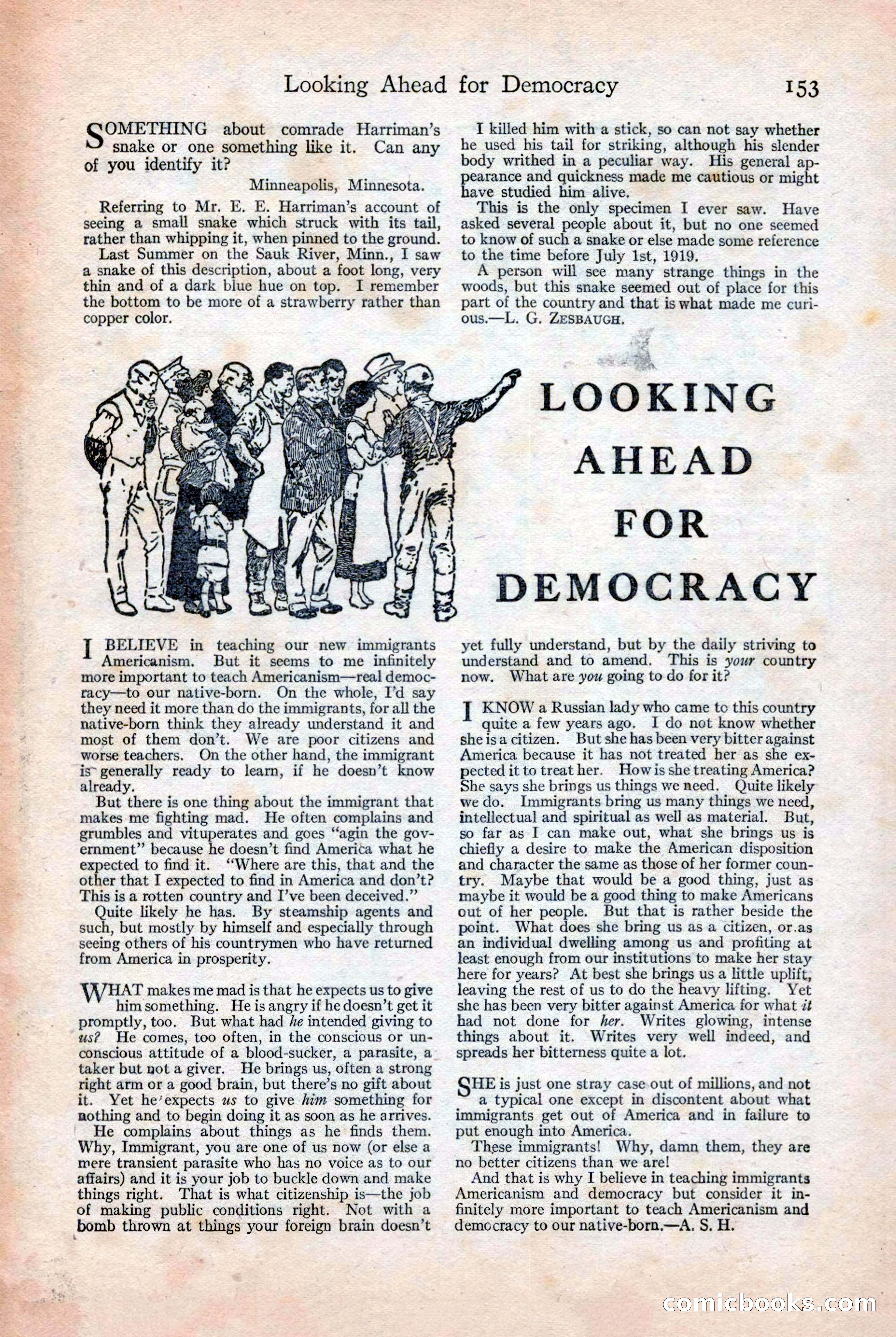
A restored page from Pulp Fiction, 1920. Page through the whole issue in the reader above.
📄 Transcribed text from this page (OCR, searchable)
Machine-transcribed from the original scan — historical spelling and the odd misread are preserved.
: Wael epee Looking Ahead for Democracy OMETHING about comrade Harriman’s snake or one something like it. Can any of you identify it? Minneapolis, Minnesota. _ Referring to Mr. E. E. Harriman’s account of seeing a small snake which struck with its tail, rather than whipping it, when pinned to the ground. Last Summer on the Sauk River, Minn., I saw a snake of this description, about a foot long, very thin and of a dark blue hue on top. I remember the bottom to be more of a strawberry rather than copper color. I BELIEVE in teaching our new immigrants Americanism. But it seems to me infinitely more important to teach Americanism—real democ- racy—to our native-born. On the whole, I’d say they need it more than do the immigrants, for all the native-born think they already understand it and most of them don’t. We are poor citizens and worse teachers. On the other hand, the immigrant is> generally ready to learn, if he doesn’t know already. But there is one thing about the immigrant that makes me fighting mad. He often complains and grumbles and vituperates and goes “agin the gov- ernment” because he doesn’t find America what he expected to find it. ‘Where are this, that and the other that I expected to find in America and don’t? This is a rotten country and I’ve been deceived.” Quite likely he has. By steamship agents and such, but mostly by himself and especially through seeing others of his countrymen who have returned from America in prosperity. AT makes me mad is that he expects us to give him something. He is angry if he doesn’t get it promptly, too. But what had he intended giving to us? He comes, too often, in the conscious or un- conscious attitude of a blood-sucker, a parasite, a taker but not a giver. He brings us, often a strong right arm or a good brain, but there’s no gift about it. Yet he’expects ws to give him something for nothing and to begin doing it as soon as he arrives. He complains about things as he finds them. Why, Immigrant, you are one of us now (or else a mere transient parasite who has no voice as to our affairs) and it is your job to buckle down and make things right. That is what citizenship is—the job of making public conditions right. Not with a bomb thrown at things your foreign brain doesn’t 153 I killed him with a stick, so can not say whether he used his tail for striking, although his slender body writhed in a peculiar way. His general ap- pearance and quickness made me cautious or might have studied him alive. This is the only specimen I ever saw. Have asked several people about it, but no one seemed to know of such a snake or else made some reference to the time before July Ist, 1919. A person will see many strange things in the woods, but this snake seemed out of place for this part of the country and that is what made me curi- ous.—L. G. ZESBAUGH. soy PY LOOKING AHEAD FOR DEMOCRACY yet fully understand, but by the daily striving to understand and to amend. This is your country now. What are you going to do for it? 4 i KNOW a Russian lady who came to this country quite a few years ago. I do not know whether sheisa citizen. But she has been very bitter against America because it has not treated her as she ex- pected it to treat her. Howis she treating America? She says she brings us things we need. Quite likely we do. Immigrants bring us many things we need, intellectual and spiritual as wel] as material. But, so far as I can make out, what she brings us is chiefly a desire to make the American disposition and character the same as those of her former coun- try. Maybe that would be a good thing, just as maybe it would be a good thing to make Americans out of her people. But that is rather beside the point. What does she bring us as a citizen, or.as an individual dwelling among us and profiting at least enough from our institutions to make her stay here for years? At best she brings us a little uplift, leaving the rest of us to do the heavy lifting. Yet she has been very bitter against America for what i had not done for her. Writes glowing, intense things about it. Writes very well indeed, and spreads her bitterness quite a lot. QHE is just one stray case out of millions, and not a typical one except in discontent about what immigrants get out of America and in failure to put enough into America. These immigrants! Why, damn them, they are no better citizens than we are! And that is why I believe in teaching immigrants Americanism and democracy but consider it in- finitely more important to teach Americanism and democracy to our native-born.—A. S. H. COPNICLOOOKS (E@)