
Pulp Fiction, 1920 · page 26 of 172
Adventure, December 3, 1920 — page 26: what you’re looking at
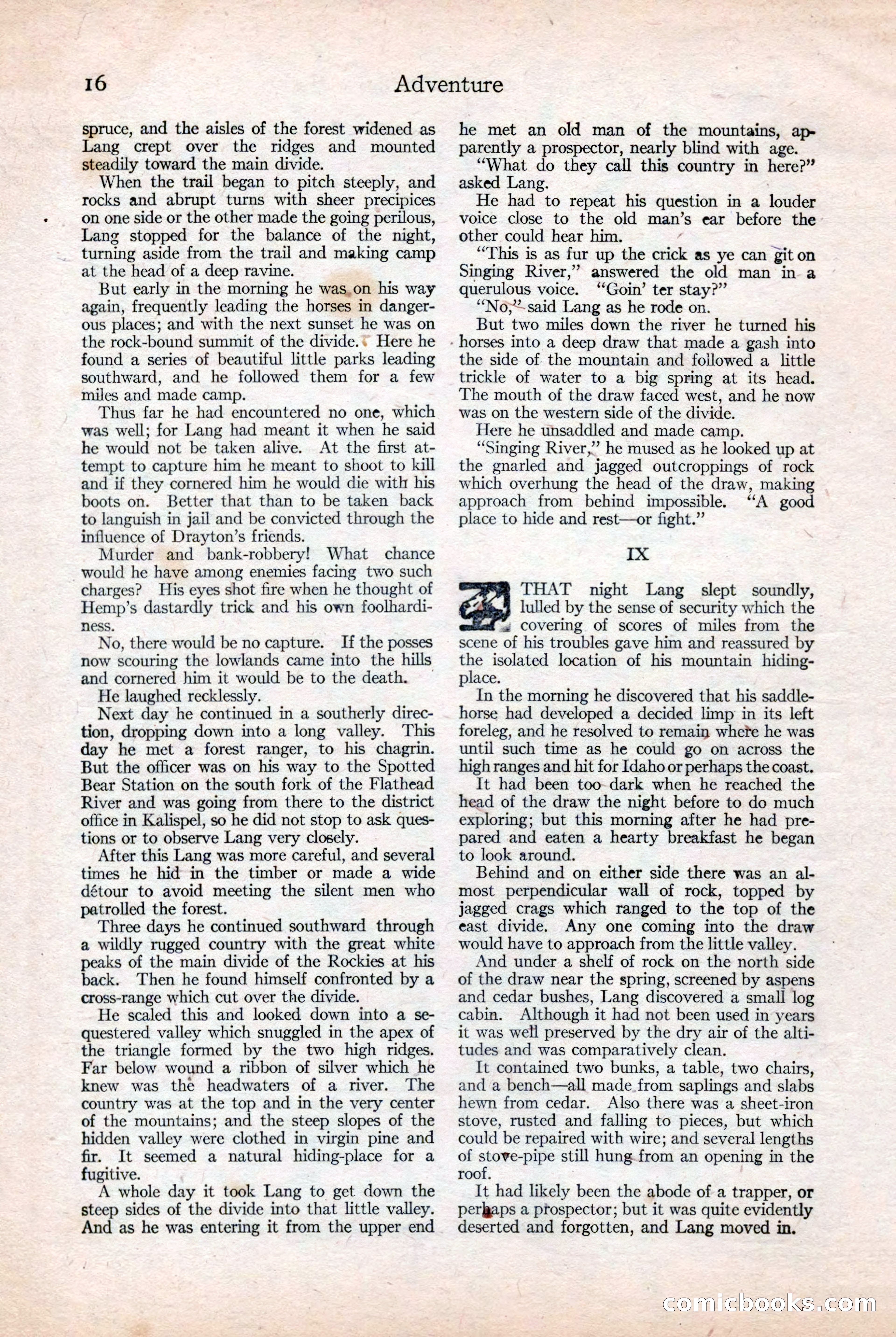
A restored page from Pulp Fiction, 1920. Page through the whole issue in the reader above.
📄 Transcribed text from this page (OCR, searchable)
Machine-transcribed from the original scan — historical spelling and the odd misread are preserved.
16 spruce, and the aisles of the forest widened as Lang crept over the ridges and mounted steadily toward the main divide. When the trail began to pitch steeply, and rocks and abrupt turns with sheer precipices on one side or the other made the going perilous, Lang stopped for the balance of the night, turning aside from the trail and making camp at the head of a deep ravine. But early in the morning he was.on his way again, frequently leading the horses in danger- ous places; and with the next sunset he was on the rock-bound summit of the divide.» Here he found a series of beautiful little parks leading southward, and he followed them for a few miles and made camp. Thus far he had encountered no one, which was well; for Lang had meant it when he said he would not be taken alive. At the first at- tempt to capture him he meant to shoot to kill and if they cornered him he would die with his boots on. Better that than to be taken back to languish in jail and be convicted through the influence of Drayton’s friends. Murder and bank-robbery! What chance would he have among enemies facing two such charges? His eyes shot fire when he thought of Hemp’s dastardly trick and his own foolhardi- ness. No, there would be no capture. If the posses now scouring the lowlands came into the hills and cornered him it would be to the death. He laughed recklessly. Next day he continued in a southerly direc- tion, dropping down into a long valley. This day he met a forest ranger, to his chagrin. But the officer was on his way to the Spotted Bear Station on the south fork of the Flathead River and was going from there to the district office in Kalispel, so he did not stop to ask ques- tions or to observe Lang very closely. After this Lang was more careful, and several times he hid in the timber or made a wide détour to avoid meeting the silent men who patrolled the forest. Three days he continued southward through a wildly rugged country with the great white peaks of the main divide of the Rockies at his back. Then he found himself confronted by a cross-range which cut over the divide. He scaled this and looked down into a se- questered valley which snuggled in the apex of the triangle formed by the two high ridges. Far below wound a ribbon of silver which he knew was the headwaters of a river. The country was at the top and in the very center of the mountains; and the steep slopes of the hidden valley were clothed in virgin pine and fir. It seemed a natural hiding-place for a fugitive. A whole day it took Lang to get down the steep sides of the divide into that little valley. And as he was entering it from the upper end Adventure he met an old man of the mountains, ap- parently a prospector, nearly blind with age. “What do they call this country in here?” asked Lang. He had to repeat his question in a inde: voice close to the old man’s ear before the other could hear him. “This is as fur up the erick as ye can git on Singing River,’’ answered the old man in a querulous voice. ‘Goin’ ter stay?” “No;’-said Lang as he rode on. But two miles down the river he turned his - horses into a deep draw that made a gash into the side of the mountain and followed a little trickle of water to a big spring at its head. The mouth of the draw faced west, and he now was on the western side of the divide. Here he unsaddled and made camp. “Singing River,’’ he mused as he looked up at the gnarled and jagged outcroppings of rock which overhung the head of the draw, making approach from behind impossible. ‘A good place to hide and rest—or fight.” IX THAT night Lang slept soundly, lulled by the sense of security which the # covering of scores of miles from the scene of his troubles gave him and reassured by ihe isolated location of his mountain hiding- place. In the morning he discovered that his saddle- horse had developed a decided limp in its left foreleg, and he resolved to remain whete he was until such time as he could go on across the high ranges and hit for Idaho or perhaps the coast. It had been too dark when he reached the head of the draw the night before to do much exploring; but this morning after he had pre- pared and eaten a hearty breakfast he began to look around. Behind and on either side there was an al- most perpendicular wall of rock, topped by jagged crags which ranged to the top of the east divide. Any one coming into the draw would have to approach from the little valley. And under a shelf of rock on the north side of the draw near the spring, screened by aspens and cedar bushes, Lang discovered a small log cabin. Although it had not been used in years it was well preserved by the dry air of the alti- tudes and was comparatively clean. It contained two bunks, a table, two chairs, and a bench—all made. from saplings and slabs hewn from cedar. Also there was a sheet-iron stove, rusted and falling to pieces, but which could be repaired with wire; and several lengths of stove-pipe still hung. from an opening in the roof. It had likely been the abode of a trapper, or pergaps a prospector; but it was quite evidently deserted and forgotten, and Lang moved in. COPMICLOOOKS (E©)