
Pulp Fiction, 1920 · page 31 of 172
Adventure, December 3, 1920 — page 31: what you’re looking at
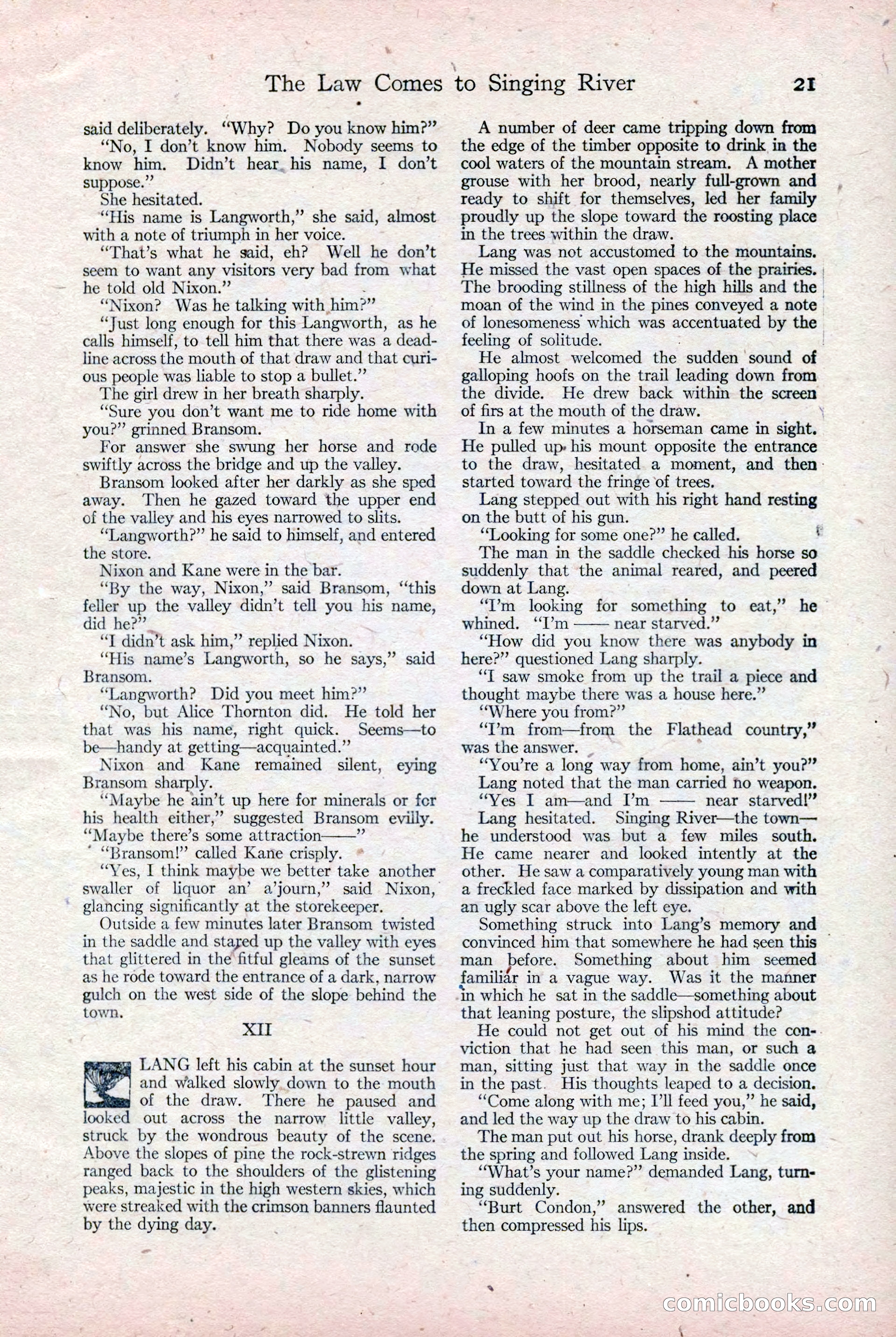
A restored page from Pulp Fiction, 1920. Page through the whole issue in the reader above.
📄 Transcribed text from this page (OCR, searchable)
Machine-transcribed from the original scan — historical spelling and the odd misread are preserved.
% The Law Comes to Singing River said deliberately. “Why? Do you know him?” “No, I don’t know him. Nobody seems to know him. Didn’t hear. his name, I don’t suppose.” : : She hesitated. “His name is Langworth,” she said, almost with a note of triumph in her voice. “That’s what he said, eh? Well he don’t seem to want any visitors very bad from what he told old Nixon.” “Nixon? Was he talking with him?” “Just long enough for this Langworth, as he calls himself, to tell him that there was a dead- line across the mouth of that draw and that curi- ous people was liable to stop a bullet.” The girl drew in her breath sharply. “Sure you don’t want me to ride home with you?” grinned Bransom. For answer she swung her horse and rode swiftly across the bridge and up the valley. Bransom looked after her darkly as she sped away. ‘Then he gazed toward the upper end of the valley and his eyes narrowed to slits. “Langworth?” he said to himself, and entered the store. Nixon and Kane were in the bar. “By the way, Nixon,” said Bransom, ‘“‘this feller up the valley didn’t tell you his name, did he?” _ “T didn’t ask him,” replied Nixon. “His name’s Langworth, so he says,” Bransom. “Langworth? Did you meet him?” “No, but Alice Thornton did. He told her that was his name, right quick. Seems—to be—handy at getting—acquainted.”’ Nixon and Kane remained silent, eying Bransom sharply. “Maybe he ain’t up here for minerals or fer his health either,” suggested Bransom evilly. “Maybe there’s some attraction——” ' “Bransom!”’ called Kane crisply. “Ves, I think maybe we better take another swaller of liquor an’ a’journ,” glancing significantly at the storekeeper. Outside a few minutes later Bransom twisted in the saddle and staged up the valley with eyes that glittered in the fitful gleams of the sunset as he rode toward the entrance of a dark, narrow guich on the west side of the slope behind the town. ia and walked slowly down to the mouth of the draw. There he paused and looked out across the narrow little valley, struck by the wondrous beauty of the scene. Above the slopes of pine the rock-strewn ridges ranged back to the shoulders of the glistening peaks, majestic in the high western skies, which were streaked with the crimson banners flaunted by the dying day. said XII LANG left his cabin at the sunset hour = said Nixon, 2I A number of deer came tripping down from the edge of the timber opposite to drink in the cool waters of the mountain stream. A mother grouse with her brood, nearly full-grown and ready to shift for themselves, led her family proudly up the slope toward the roosting place in the trees within the draw. Lang was not accustomed to the mountains. He missed the vast open spaces of the prairies. | The brooding stillness of the high hills and the , moan of the wind in the pines conveyed a note of lonesomeness which was accentuated by the feeling of solitude. He almost welcomed the: sudden sound of galloping hoofs on the trail leading down from the divide. of firs at the mouth of the draw. In a few minutes a horseman came in sight. He pulled up» his mount opposite the entrance to the draw, hesitated a moment, and then- started toward the fringe of trees. Lang stepped out with his right hand resting on the butt of his gun. “Looking for some one?” he called. t The man in the saddle checked his horse so suddenly that the animal reared, and peered down at Lang. “T’m looking for something to eat,’ he whined. “I’m near starved.” “How did you know there was anybody in here?”’ questioned Lang sharply. “T saw smoke from up the trail a piece and thought maybe there was a house here.” “Where you from?” “I’m from—from the Flathead country,” was the answer. | “Youre a long way from home, ain’t you?” Lang noted that the man carried ho weapon. “Ves I am—and I’m —— near starved!’ Lang hesitated. Singing River—the town— he understood was but a few miles south. He came nearer and looked intently at the other. He saw a comparatively young man with a freckled face marked by dissipation and with an ugly scar above the left eye. Something struck into Lang’s memory and He drew back within the screen convinced him that somewhere he had seen this © man before. Something about him seemed familiar in a vague way. Was it the manner in which he sat in the saddle—something about that leaning posture, the slipshod attitude? He could not get out of his mind the con-. viction that he had seen this man, or such @ man, sitting just that way in the saddle once in the past. His thoughts leaped to a decision. “Come along with me; I’ll feed you,” he said, and led the way up the draw to his cabin. The man put out his horse, drank deeply from the spring and followed Lang inside. ‘“‘What’s your namer’”’ demanded Lang, turn- ing suddenly. “Burt Condon,” answered the other, and then compressed his lips. ECORMICGLOO© (C@