
Pulp Fiction, 1920 · page 51 of 172
Adventure, December 3, 1920 — page 51: what you’re looking at
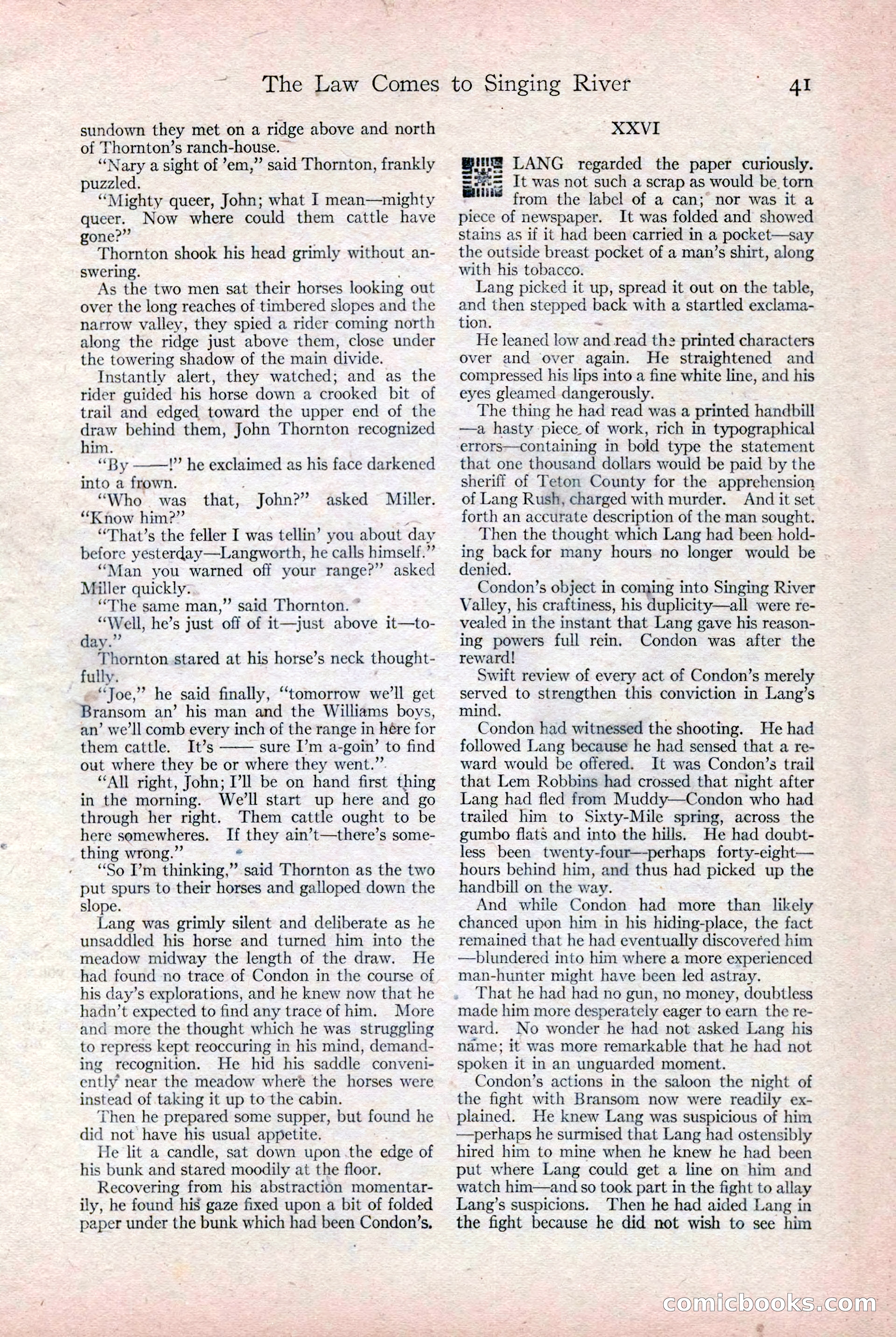
A restored page from Pulp Fiction, 1920. Page through the whole issue in the reader above.
📄 Transcribed text from this page (OCR, searchable)
Machine-transcribed from the original scan — historical spelling and the odd misread are preserved.
~ The Law Comes to Singing River sundown they met on a ridge above and north of Thornton’s ranch-house. © “Nary a sight of ’em,” said Thornton, frankly puzzled. “Mighty queer, John; what I mean—mighty queer. Now where could them cattle have gone?” Thornton shook his head grimly without an- swering. As the two men sat their horses looking out over the long reaches of timbered slopes and the narrow valley, they spied a rider coming north along the ridge just above them, close under the towering shadow of the main divide. Instantly alert, they watched; and as the rider guided his horse down a crooked bit of trail and edged toward the upper end of the draw behind them, John Thornton recognized him. “By ——1” he exclaimed as his face darkened into a frown. “Who was that, John?” asked Miller. “Know him?” “That’s the feller I was tellin’ you about day before yesterday—Langworth, he calls himself.” “Man you warned off your range?” asked Miller quickly. “The same man,” said Thornton. * “Well, he’s just off of it—just above it—to- day.” Thornton stared at his horse’s neck thought- fully. “Joe,” he said finally, “tomorrow we'll get Bransom an’ his man and the Williams boys, an’ we'll comb every inch of the range in hére for them cattle. It’s sure I’m a-goin’ to find out where they be or where they went.” “All right, John; Pll be on hand first thing in the morning. We'll start up here and go through her right. Them cattle ought to be here somewheres. If they ain’t—there’s some- thing wrong.” ° “So I’m thinking,” said Thornton as the two put spurs to their horses and galloped down the slope. Lang was grimly silent and deliberate as he unsaddled his horse and turned him into the meadow midway the length of the draw. He had found no trace of Condon in the course of his day’s explorations, and he knew now that he hadn’t expected to find any trace of him. More and more the thought which he was struggling to repress kept reoccuring in his mind, demand- ing recognition. He hid his saddle conveni- ently near the meadow wheré the horses were instead of taking it up to the cabin. Then he prepared some supper, but found he did not have his usual appetite. He lit a candle, sat down upon .the edge of his bunk and stared moodily at the floor. Recovering from his abstraction momentar- ily, he found his gaze fixed upon a bit of folded paper under the bunk which had been Condon’s, 4I XXVI pe LANG regarded the paper curiously. It was not such a scrap as would be torn ini from the label of a can; nor was it a piece of newspaper. It was folded and showed stains as if it had been carried in a pocket—say the outside breast pocket of a man’s shirt, along with his tobacco. Lang picked it up, spread it out on the table, and then stepped back with a startled exclama- tion. He leaned low and read the printed characters over and over again. He straightened and compressed his lips into a fine white line, and his eyes gleamed dangerously. The thing he had read was a printed handbill —a hasty piece of work, rich in typographical errors—containing in bold type the statement that one thousand dollars would be paid by the sheriff of Teton County for the apprehension of Lang Rush, charged with murder. And it set forth an accurate description of the man sought. Then the thought which Lang had been. hold- ing backfor many hours no longer would be denied. Condon’s object in coming into Singing River Valley, his craftiness, his duplicity—all were re- vealed in the instant that Lang gave his reason- ing powers full rein. Condon was after the reward! Swift review of every act of Condon’s merely served to strengthen this conviction in Lang’s mind, Condon had witnessed the shooting. He had followed Lang because he had sensed that a re- ward would be offered. It was Condon’s trail that Lem Robbins had crossed that night after Lang had fled from Muddy—Condon who had trailed him to Sixty-Mile spring, across the gumbo flats and into the hills. He had doubt- less been twenty-four—-perhaps forty-cight— hours behind him, and thus had picked up the handbill on the way. And while Condon had more than likely chanced upon him in his hiding-place, the fact remained that he had eventually discovered him —blundered into him where a more experienced man-hunter might have been led astray. That he had had no gun, no money, doubtless made him more desperately eager to earn the re- ward. No wonder he had not asked Lang his name; it was more remarkable that he had not spoken it in an unguarded moment. Condon’s actions in the saloon the night of the fight with Bransom now were readily ex- plained. He knew Lang was suspicious of him —perhaps he surmised that Lang had ostensibly hired him to mine when he knew he had been put where Lang could get a line on him and watch him—and so took part in the fight to allay Lang’s suspicions. Then he had aided Lang in the fight because he did not wish to see him EOMICGLOO© x (F@)