
Pulp Fiction, 1920 · page 63 of 172
Adventure, December 3, 1920 — page 63: what you’re looking at
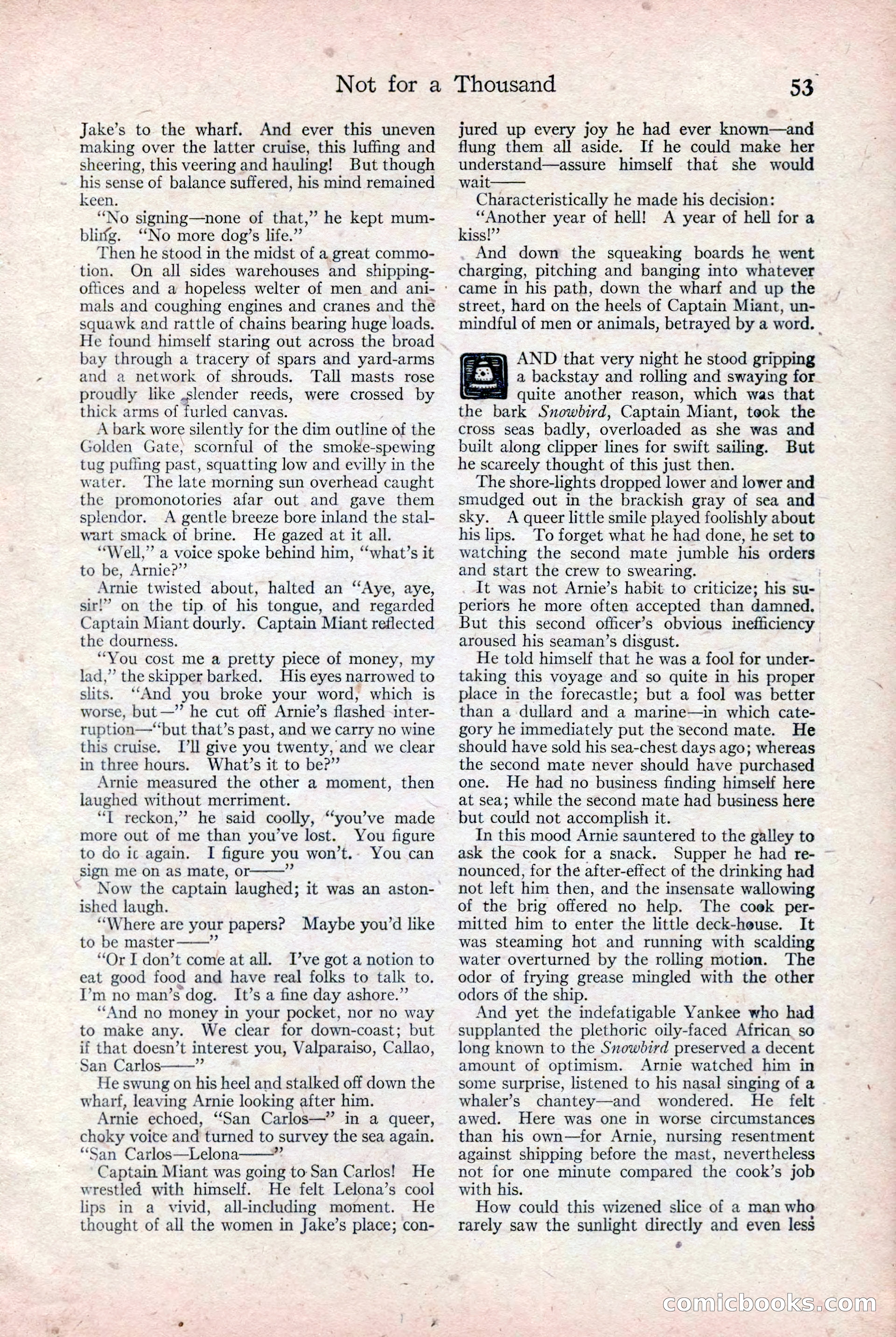
A restored page from Pulp Fiction, 1920. Page through the whole issue in the reader above.
📄 Transcribed text from this page (OCR, searchable)
Machine-transcribed from the original scan — historical spelling and the odd misread are preserved.
Not for a Thousand Jake’s to the wharf. And ever this uneven making over the latter cruise, this luffing and sheering, this veering and hauling! But though - his sense of balance suffered, his mind remained keen. “No signing—none of that, ” he kept mum- bliffg. “No more dog’s life.” Then he stood in the midst of a great commo- tion. On all sides warehouses and shipping- oftices and a hopeless welter of men and ani- ° mals and coughing engines and cranes and the squawk and rattle of chains bearing huge loads. He found himself staring out across the broad bay through a tracery of spars and yard-arms and a network of shrouds. Tall masts rose proudly like ,slender reeds, were crossed by thick arms of furled canvas. A bark wore silently for the dim outline of the Golden Gate, scornful of the smoke-spewing tug puffing past, squatting low and evilly in the water. The late morning sun overhead caught the promonotories afar out and gave them splendor. A gentle breeze bore inland the stal- wart smack of brine. He gazed at it all. “Well,” a voice spoke behind him, ‘‘what’s it to be, Arnie?” Arnie twisted about, halted an “Aye, aye, sir!” on the tip of his tongue, and regarded Captain Miant dourly. Captain Miant reflected the dourness. “You cost me a pretty piece of money, my lad,” the skipper barked. His eyes narrowed to slits. ‘And you broke your word, which is worse, but —’’ he cut off Arnie’s flashed inter- ruption—“but that’s past, and we carry no wine this cruise. I'll give you twenty, and we clear in three hours. What’s it to be?” Arnie measured the other a moment, then laughed without merriment. “Tt reckon,” he said coolly, “‘you’ve made more out of me than you’ve lost. You figure to do ic again. I figure you won’t.- You can sign me on as mate, or os Now the captain laughed; it was an aston- ished laugh. “Where are your papers? Maybe you’d like to be master-——” “Or I don’t come at all. I’ve got a notion to eat good food and have real folks to talk to. I’m no man’s dog. It’s a fine day ashore.” “And no money in your pocket, nor no way to make any. We clear for down-coast; but if that doesn’t interest you, Valparaiso, Callao, San Carlos——” He swung on his heel and stalked off down the wharf, leaving Arnie looking after him. Arnie echoed, “San Carlos—” in a queer, choky voite and turned to survey the sea again. “San Carlos—Lelona “ Captain Miant was going to San Carlos! He wrestled with himself. He felt Lelona’s cool lips in a vivid, all-including moment. He thought of all the women in Jake’s place; con- jured up every joy he had ever known—and flung them all aside. If he could make her understand—assure himself that she would wait 2 Characteristically he made his decision: “Another year of hell! A year of hell for a kiss!” And down the squeaking boards he went charging, pitching and banging into whatever came in his path, down the wharf and up the street, hard on the heels of Captain Miant, un- mindful of men or animals, betrayed by a word. ey) AND that very night he stood gripping E 3 | a backstay and rolling and swaying for = quite another reason, which was that the bark Snowbird, C aptain Miant, took the cross seas badly, overloaded as she was and built along clipper lines for swift sailing. But he scareely thought of this just then. The shore-lights dropped lower and lower and smudged out in the brackish gray of sea and sky. A queer little smile played foolishly about his lips. To forget what he had done, he set to watching the second mate jumble his orders and start the crew to swearing. It was not Arnie’s habit to criticize; his su- periors he more often accepted than damned. But this second officer’s obvious inefficiency aroused his seaman’s disgust. He told himself that he was a fool for under- taking this voyage and so quite in his proper place in the forecastle; but a fool was better than a dullard and a marine—in which cate- gory he immediately put the second mate. He should have sold his sea-chest days ago; whereas the second mate never should have purchased one. He had no business finding himself here at sea; while the second mate had business here but could not accomplish it. In this mood Arnie sauntered to the galley to ask the cook for a snack. Supper he had re- nounced, for thé after-effect of the drinking had not left him then, and the insensate wallowing of the brig offered no help. The coek per- mitted him to enter the little deck-heuse. It was steaming hot and running with scalding water overturned by the rolling motion. The odor of frying grease mingled with the other odors of the ship. And yet the indefatigable Yankee who had supplanted the plethoric oily-faced African so long known to the Snowbird preserved a decent amount of optimism. Arnie watched him in some surprise, listened to his nasal singing of a whaler’s chantey—and wondered. He felt awed. Here was one in worse circumstances than his own—for Arnie, nursing resentment against shipping before the mast, nevertheless not for one minute compared the cook’s job with his. How could this wizened slice of a man who rarely saw the sunlight directly and even less a COnmicloool< 53 (C@