
Pulp Fiction, 1920 · page 65 of 172
Adventure, December 3, 1920 — page 65: what you’re looking at
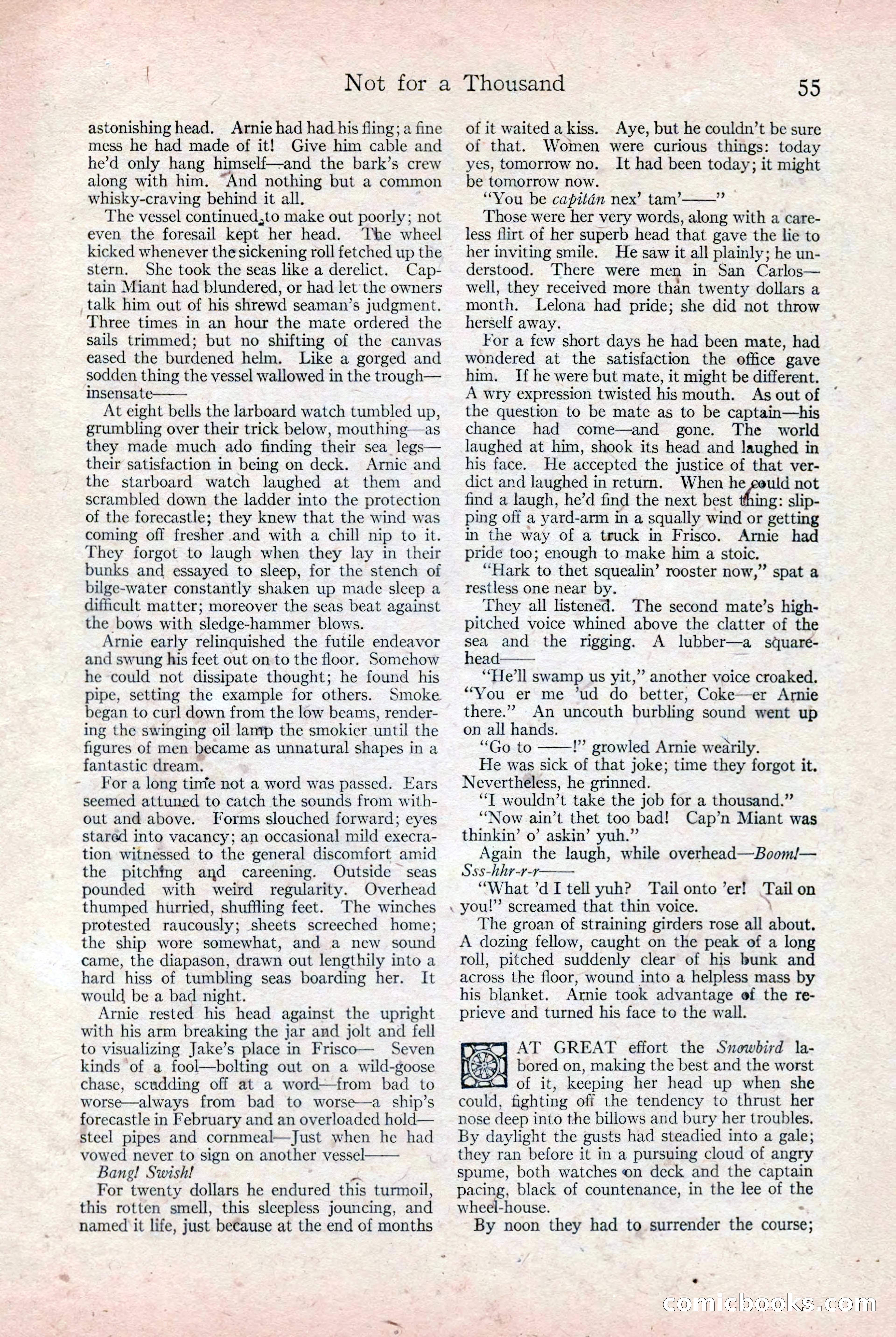
A restored page from Pulp Fiction, 1920. Page through the whole issue in the reader above.
📄 Transcribed text from this page (OCR, searchable)
Machine-transcribed from the original scan — historical spelling and the odd misread are preserved.
Not for a Thousand astonishing head. Arnie had had his fling; a fine mess he had made of it! Give him cable and he’d only hang himself—and the bark’s crew along with him. “And nothing but a common whisky-craving behind it all. | - The vessel continued,to make out poorly; not even the foresail kept her head. The wheel kicked whenever the sickening roll fetched up the stern. She took the seas like a derelict. Cap- tain Miant had blundered, or had let the owners talk him out of his shrewd seaman’s judgment. Three times in an hour the mate ordered the sails trimmed; but no shifting of the canvas eased the burdened helm. Like a gorged and sodden thing the vessel wallowed in the trough— insensate—— At eight bells the larboard watch tumbled up, grumbling over their trick below, mouthing—as they made much ado finding their sea legs— their satisfaction in being on deck. Arnie and the starboard watch laughed at them and scrambled down the ladder into the protection of the forecastle; they knew that the wind was coming off fresher and with a chill nip to it. They forgot to laugh when they lay in their bunks and essayed to sleep, for the stench of bilge-water constantly shaken up made sleep a difficult matter; moreover the seas beat against the bows with sledge-hammer blows. Arnie early relinquished the futile endeavor and swung his feet out on to the floor. Somehow he could not dissipate thought; he found his pipe, setting the example for others. began to curl down from the low beams, render- ing the swinging oil lanyp the smokier until the figures of men became as unnatural shapes in a fantastic dream. For a long tine not a word was passed. Ears seemed attuned to catch the sounds from with- out and above. Forms slouched forward; eyes stared into vacancy; an occasional mild execra- tion witnessed to the general discomfort amid the pitching and careening. Outside seas pounded with weird regularity. Overhead thumped hurried, shuffling feet. The winches protested raucously; sheets screeched home; the ship wore somewhat, and a new sound came, the diapason, drawn out lengthily into a hard hiss of tumbling seas boarding her. It would be a bad night. Arnie rested his head against the upright with his arm breaking the jar and jolt and fell to visualizing Jake’s place in Frisco— Seven kinds of a fool—bolting out on a wild-goose chase, scudding off at a word—from bad to worse—always from bad to worse—a ship’s forecastle in February and an overloaded hold— Steel pipes and cornmeal—Just when he had vowed never to sign on another vessel Bang! Swish! f For twenty dollars he endured this turmoil, this rotten smell, this sleepless jouncing, and named it life, just because at the end of months Smoke o9 of it waited a kiss. Aye, but he couldn’t be sure of that. Women were curious things: today yes, tomorrow no. It had been today; it might be tomorrow now. “You be capitdn nex’ tam’——” Those were her very words, along with a care- less flirt of her superb head that gave the lie to her inviting smile. He saw it all plainly; he un- derstood. There were men in San Carlos— well, they received more than twenty dollars a month. Lelona had pride; she did not throw | herself away. For a few short days he had been mate, had wondered at the satisfaction the office gave him. If he were but mate, it might be different. A wry expression twisted his mouth. As out of * the question to be mate as to be captain—his chance had come—and gone. The world laughed at him, shook its head and laughed in his face. He accepted the justice of that ver- dict and laughed in return. When he could not find a laugh, he’d find the next best thing: slip- ping off a yard-arm in a squally wind or getting in the way of a truck in Frisco. Arnie had pride too; enough to make him a stoic. “Hark to thet squealin’ rooster now,” spat a restless one near by. They all listened. The second mate’s high- pitched voice whined above the clatter of the sea and the rigging. A lubber—a squareé- head “He'll swamp us yit,” another voice croaked. “You er me ’ud do better, Coke—er Arnie there.” An uncouth burbling sound went up on all hands. “Go to !” growled Arnie wearily. He was sick of that joke; time they forgot it. Nevertheless, he grinned. “T wouldn’t take the job for a thousand.” “Now ain’t thet too bad! Cap’n Miant was thinkin’ o’ askin’ yuh.” Again the laugh, while overhead—Boom!— Sss-hhr-r-r “What ’dI tell yuh? Tail onto ’er! Tail on . you!”’ screamed that thin voice. \ The groan of straining girders rose all about. A dozing fellow, caught on the peak of a long roll, pitched suddenly clear of his bunk and across the floor, wound into a helpless mass by his blanket. Arnie took advantage ef the re- prieve and turned his face to the wall. AT GREAT effort the Snxowbird la- 1] bored on, making the best and the worst C503 of it, keeping her head up when she could, fighting off the tendency to thrust her nose deep into the billows and bury her troubles. By daylight the gusts had steadied into a gale; they ran before it in a pursuing cloud of angry spume, both watches on deck and the captain pacing, black of countenance, in the lee of the wheel-house. : By noon they had to surrender the course; : ema, vase Go 0)(0)(6) (C@