
Pulp Fiction, 1920 · page 72 of 172
Adventure, December 3, 1920 — page 72: what you’re looking at
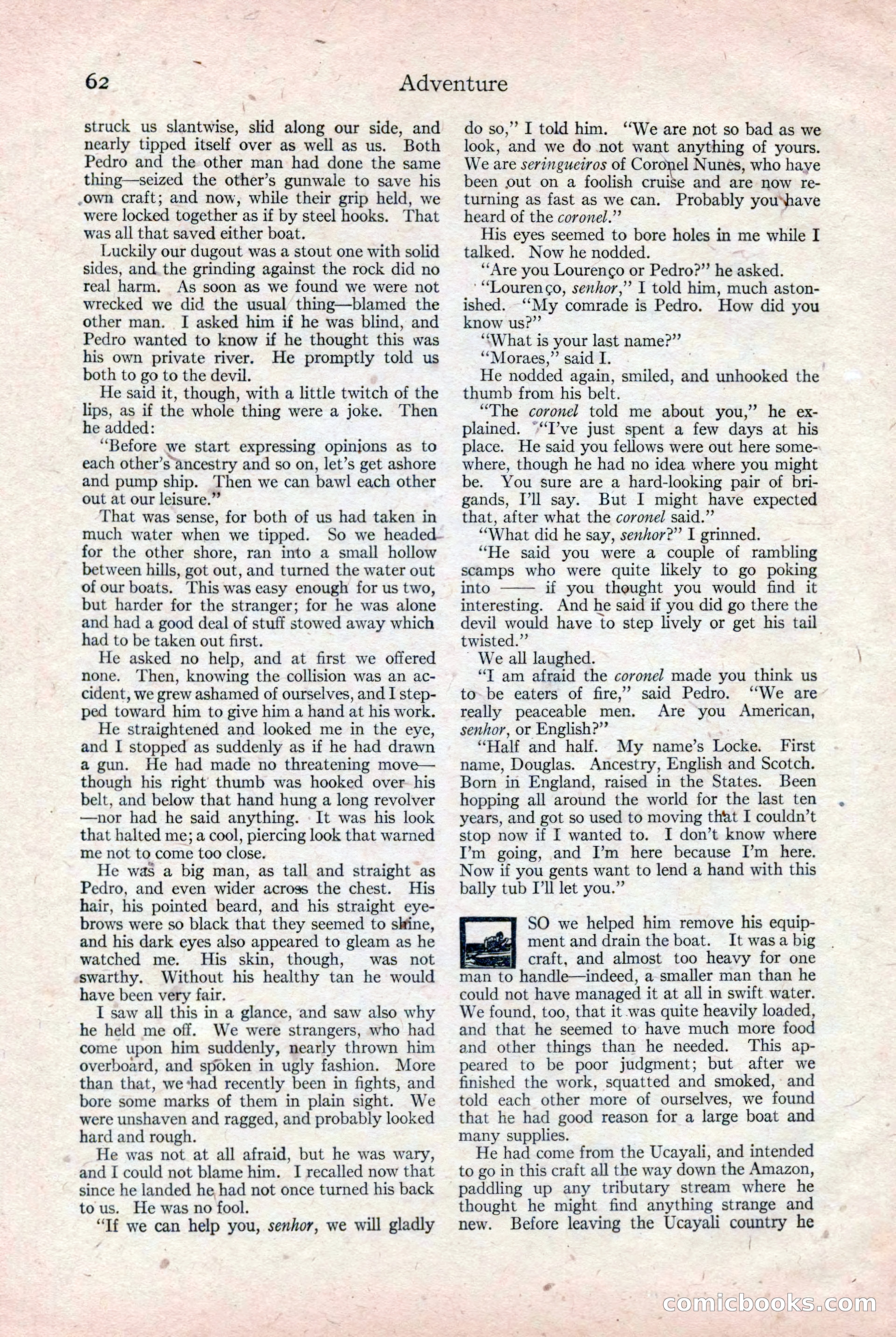
A restored page from Pulp Fiction, 1920. Page through the whole issue in the reader above.
📄 Transcribed text from this page (OCR, searchable)
Machine-transcribed from the original scan — historical spelling and the odd misread are preserved.
62 struck us slantwise, slid along our side, and nearly tipped itself over as well as us. Both Pedro and the other man had done the same thing—seized the other’s gunwale to save his -own craft; and now, while their grip held, we were locked together as if by steel hooks. That was all that saved either boat. Luckily our dugout was a stout one with solid sides, and the grinding against the rock did no real harm. As soon as we found we were not wrecked we did the usual thing—blamed the other man. I asked him if he was blind, and Pedro wanted to know if he thought this was his own private river. He promptly told us both to go to the devil. He said it, though, with a little twitch of the lips, as if the whole thing were a joke. Then he added: ‘Before we start expressing opinions as to each other’s ancestry and so on, let’s get ashore and pump ship. Then we can bawl each other out at our leisure.” That was sense, for both of us had taken in much water when we tipped. So we headed for the other shore, ran into a small hollow between hills, got out, and turned the water out of our boats. This was easy enough for us two, but harder for the stranger; for he was alone and had a good deal of stuff stowed away which had to be taken out first. He asked no help, and at first we offered none. Then, knowing the collision was an ac- cident, we grew ashamed of ourselves, and I step- ped toward him to give him a hand at his work. He straightened and looked me in the eye, and I stopped as suddenly as if he had drawn a gun. He had made no threatening move— though his right thumb was hooked over. his belt, and below that hand hung a long revolver —nor had he said anything. It was his look that halted me; a cool, piercing look that warned me not to come too close. He was a big man, as tall and straight as Pedro, and even wider across the chest. His hair, his pointed beard, and his straight eye- brows were so black that they seemed to skiine, and his dark eyes also appeared to gleam as he watched me. His skin, though, was not swarthy. Without his healthy tan he would have been very fair. I saw all this in a glance, and saw also why he held me off. We were strangers, who had come upon him suddenly, nearly thrown him overboard, and spoken in ugly fashion. More than that, we*had recently been in fights, and bore some marks of them in plain sight. We were unshaven and ragged, and probably looked hard and rough. He was not at all afraid, but he was wary, and I could not blame him. I recalled now that since he landed he had not once turned his back tous. He was no fool. “If we can help you, senhor, we will gladly Adventure do so,” I told him. ‘‘We are not so bad as we look, and we do not want anything of yours. We are seringueiros of Coronel Nunes, who haye been out on a foolish cruise and are now re- turning as fast as we can. Probably you‘have heard of the coronel.”’ His eyes seemed to bore holes in me while I talked. Now he nodded. ‘‘Are you Lourenco or Pedro?” he asked. ‘“Lourenco, senhor,’’ I told him, much aston- ished. “My comrade is Pedro. How did you know us?” ‘What is your last name?”’ ““Moraes,”’ said I. ; He nodded again, smiled, and unhooked the thumb from his belt. “The coronel told me about you,” he ex- plained. ““‘I’ve just spent a few days at his place. He said you fellows were out here some- where, though he had no idea where you might be. You sure are a hard-looking pair of bri- gands, I'll say. But I might have expected that, after what the coronel said.” “What did he say, senhor?” I grinned. “He said you were a couple of rambling scamps who were quite likely to go poking into if you theught you would find it interesting. And he said if you did go there the devil would have to step lively or get his tail twisted.”’ - We all laughed. “T am afraid the coronel made you think us to-be eaters of fire,” said Pedro. ‘We are really peaceable men. Are you American, senhor, or English?” “Half and half. My name’s Locke. First name, Douglas. Ancestry, English and Scotch. Born in England, raised in the States. Been hopping all around the world for the last ten years, and got so used to moving that I couldn’t stop now if I wanted to. I don’t know where I’m going, and I’m here because I’m here. Now if you gents want to lend a hand with this bally tub I’ll let you.” s'7 SO we helped him remove his equip- ment and drain the boat. It wasa big eemege craft, and almost too heavy for one man to handle—indeed, a smaller man than he could not have managed it at all in swift water. We found, too, that it was quite heavily loaded, and that he seemed to have much more food and other things than he needed. This ap- peared to be poor judgment; but after we finished the work, squatted and smoked, and told each other more of ourselves, we found that he had good reason for a large boat and many supplies. He had come from the Ucayali, and intended to go in this craft all the way down the Amazon, paddling up any tributary stream where he thought he might find anything strange and new. Before leaving the Ucayali country he Gomichbooks (C@