
Pulp Fiction, 1920 · page 75 of 172
Adventure, December 3, 1920 — page 75: what you’re looking at
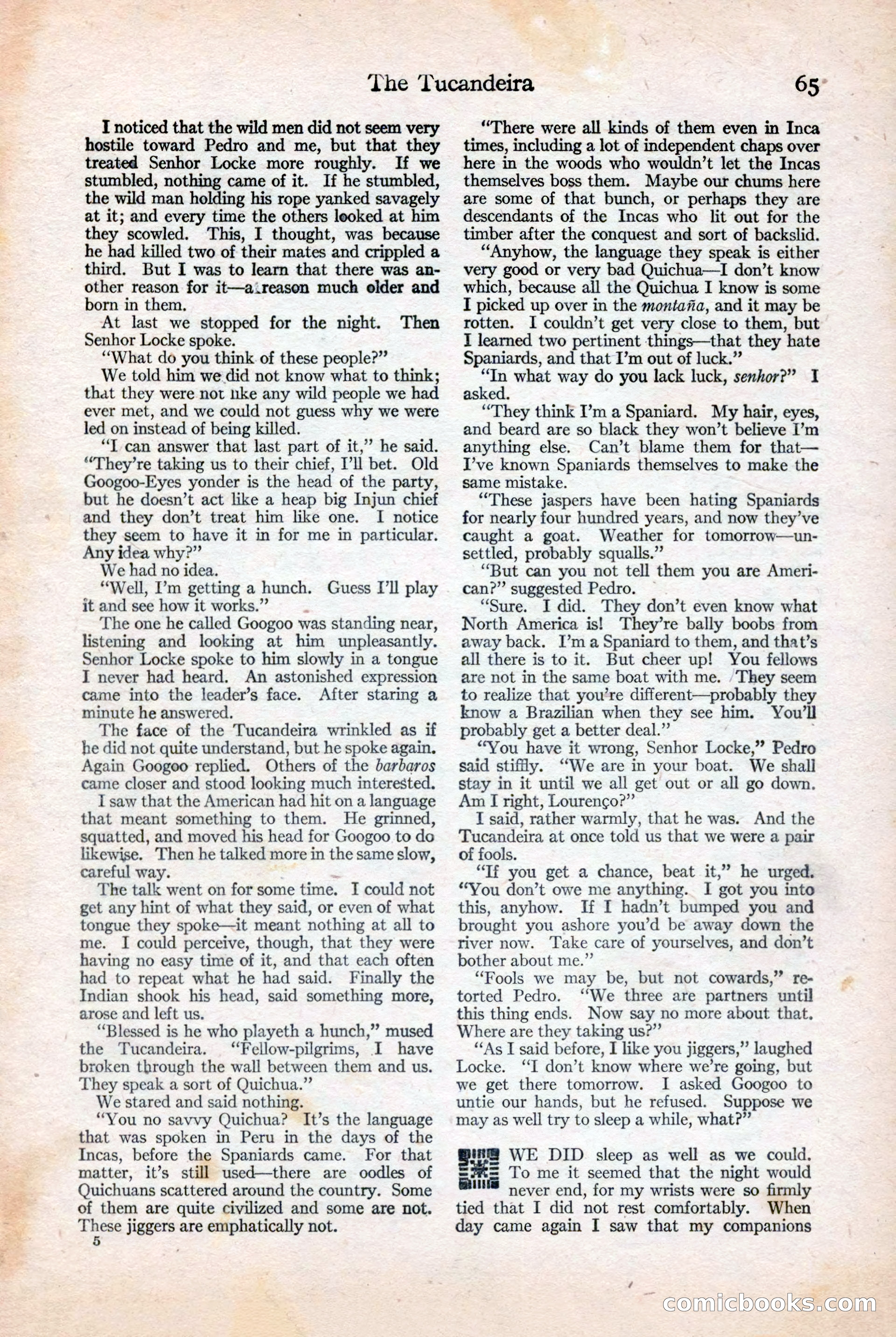
A restored page from Pulp Fiction, 1920. Page through the whole issue in the reader above.
📄 Transcribed text from this page (OCR, searchable)
Machine-transcribed from the original scan — historical spelling and the odd misread are preserved.
Seer MP lg awe, +5) ‘The ‘Tucandeira I noticed that the wild men did not seem very hostile toward Pedro and me, but that they treated Senhor Locke more roughly. If we stumbled, nothing came of it. If he stumbled, the wild man holding his rope yanked savagely at it; and every time the others looked at him they scowled. ‘This, I thought, was because he had killed two of their mates and crippled a third. But I was to learn that there was an- other reason for it—aireason much older and born in them. At last we stopped for the night. Then Senhor Locke spoke. “What do you think of these people?” We told him we did not know what to think; that they were not ike any wild people we had ever met, and we could not guess why we were led on instead of being killed. “T can answer that last part of it,’”’ he said. “They’re taking us to their chief, ll bet. Old Googoo-Eyes yonder is the head of the party, but he doesn’t act like a heap big Injun chief and they don’t treat him like one. I notice they seem to have it in for me in particular. Any idea why?” We had no idea. “Well, I’m getting a hunch. Guess I’ll play it and see how it works.” The one he called Googoo was standing near, listening and looking at him unpleasantly. Senhor Locke spoke to him slowly in a tongue I never had heard. An astonished expression came into the leader’s face. After staring a minute he answered. The face of the Tucandeira wrinkled as if he did not quite understand, but he spoke again. Again Googoo replied. Others of the barbaros came closer and stood looking much interested. I saw that the American had hit on a language that meant something to them. He grinned, squatted, and moved his head for Googoo to do likewise. Then he talked more in the same slow, careful way. The talk went on for some time. I could not get any hint of what they said, or even of what tongue they spoke—it meant nothing at all to me. I could perceive, though, that they were having no easy time of it, and that each often had to repeat what he had said. Finally the Indian shook his head, said something more, arose and left us. “Blessed is he who playeth a hunch,” mused the Tucandeira. ‘‘Fellow-pilgrims, I have broken through the wall between them and us. They speak a sort of Quichua.” We stared and said nothing. “You no savvy Quichua? It’s the language that was spoken in Peru in the days of the Incas, before the Spaniards came. For that matter, it’s still used—there are oodles of Quichuans scattered around the country. Some of them are quite civilized and some are not. Js ae jiggers are emphatically not. 65° “There were all kinds of them even in Inca times, including a lot of independent chaps over here in the woods who wouldn’t let the Incas themselves boss them. Maybe our chums here are some of that bunch, or perhaps they are descendants of the Incas who lit out for the timber after the conquest and sort of backslid. “Anyhow, the language they speak is either very good or very bad Quichua—lI don’t know which, because all the Quichua I know is some I picked up over in the montafia, and it may be rotten. I couldn’t get very close to them, but I learned two pertinent things—that they hate Spaniards, and that I’m out of luck.” “In what way do you lack luck, senhor?” I asked. “They think I’m a Spaniard. My hair, eyes, and beard are so black they won’t believe I’m anything else. Can’t blame them for that— I’ve known Spaniards themselves to make the same mistake. “These jaspers have been hating Spaniards for nearly four hundred years, and now they’ve caught a goat. Weather for tomorrow—un- settled, probably squalls.” ‘But can you not tell them you are Ameri- can?” suggested Pedro. “Sure. I did. They don’t even know what North America is! They’re bally boobs from away back. I’m a Spaniard to them, and that’s all there is to it. But cheer up! You fellows are not in the same boat with me. ‘They seem to realize that you’re different—probably they know a Brazilian when they see him. You'll probably get a better deal.” “You have it wrong, Senhor Locke,” Pedro said stiffly. ‘We are in your boat. We shall stay in it until we all get out or all go down. Am I right, Lourengo?” I said, rather warmly, that he was. And the Tucandeira at once told us that we were a pair of fools. “Tf you get a chance, beat it,” he urged. ‘You don’t owe me anything. I got you into this, anyhow. If I hadn’t bumped you and brought you ashore you’d be away down the river now. Take care of yourselves, and don’t bother about me.” “Fools we may be, but not cowards,” re- torted Pedro. ‘‘We three are partners until this thing ends. Now say no more about that, Where are they taking us?” ‘“‘As I said before, I like you jiggers,” laughed Locke. “I don’t know where we’re going, but we get there tomorrow. I asked Googoo to untie our hands, but he refused. Suppose we may as well try to sleep a while, what?” oe WE DID sleep as well as we could. To me it seemed that the night would Gantt never end, for my wrists were so firmly tied that I did not rest comfortably. When day came again I saw that my companions - CoOmmicbooks (F@