
Pulp Fiction, 1920 · page 87 of 172
Adventure, December 3, 1920 — page 87: what you’re looking at
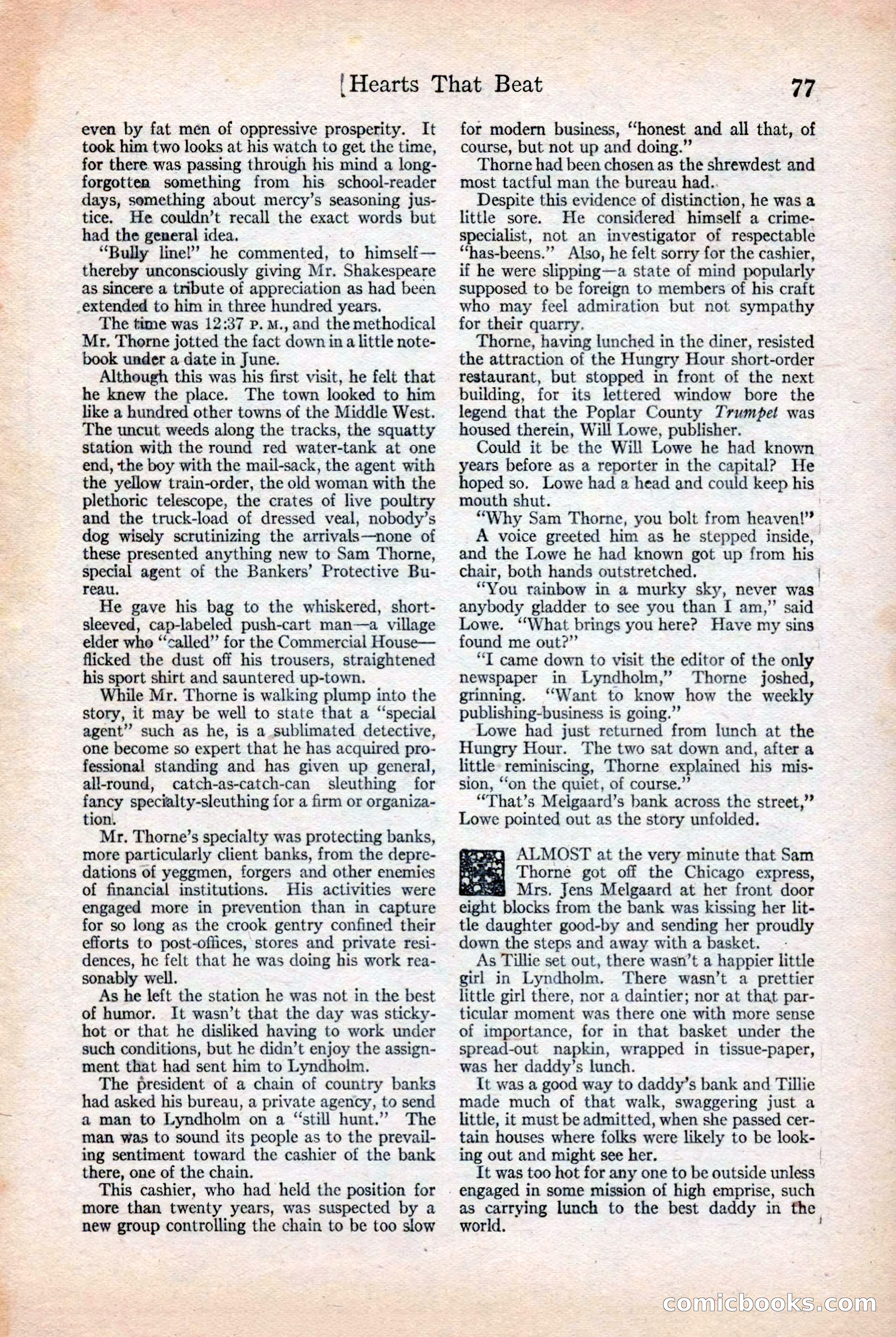
A restored page from Pulp Fiction, 1920. Page through the whole issue in the reader above.
📄 Transcribed text from this page (OCR, searchable)
Machine-transcribed from the original scan — historical spelling and the odd misread are preserved.
CR i uae ‘Hearts That Beat 77 even by fat men of oppressive prosperity. It took him two looks at his watch to get the time, for there. was passing through his mind a long- forgotten something from his school-reader days, something about mercy’s seasoning jus- tice. He couldn’t recall the exact words but had the general idea. “Bully line!’ he commented, to himself— thereby unconsciously giving Mr. Shakespeare as sincere a tribute of appreciation as had been extended to him in three hundred years. The time was 12:37 p. M., and the methodical Mr. Thorne jotted the fact down in a little note- book under a date in June. Although this was his first visit, he felt that he knew the place. The town looked to him like a hundred other towns of the Middle West. The uncut. weeds along the tracks, the squatty station with the round red water-tank at one end, the boy with the mail-sack, the agent with the yellow train-order, the old woman with the plethoric telescope, the crates of live poultry and the truck-load of dressed veal, nobody’s dog wisely scrutinizing the arrivals—none of these presented anything new to Sam Thorne, special agent of the Bankers’ Protective Bu- reau. He gave his bag to the whiskered, short- sleeved, cap-labeled push-cart man—a village elder whe “‘called” for the Commercial House— flicked the dust off his trousers, straightened his sport shirt and sauntered up-town. While Mr. Thorne is walking plump into the story, it may be well to state that a “special agent”? such as he, is a_sublimated detective, one become so expert that he has acquired pro- fessional standing and has given up general, all-round, catch-as-catch-can sleuthing for fancy specialty-sleuthing for a firm or organiza- tion, Mr. Thorne’s specialty was protecting banks, more particularly client banks, from the depre- dations of yeggmen, forgers and other enemies of financial institutions. His activities were engaged more in prevention than in capture for so long as the crook gentry confined their efforts to post-oflices, stores and private resi- dences, he felt that he was doing his work rea- sonably well. As he left the station he was not in the best of humor. It wasn’t that the day was sticky- hot or that he disliked having to work under such conditions, but he didn’t enjoy the assign- ment that had sent him to Lyndholm. The president of a chain of country banks had asked his bureau, a private agency, to send a man to Lyndholm on a “still hunt.” The man was to sound its people as to the prevail- ing sentiment toward the cashier of the bank there, one of the chain. This cashier, who had held the position for more than twenty years, was suspected by a new group controlling the chain to be too slow for modern business, ‘honest and all that, of course, but not up and doing.” Thorne had been chosen as the shrewdest and most tactful man the bureau had.. Despite this evidence of distinction, he was a little sore. He considered himself a crime- specialist, not an investigator of respectable “thas-beens.”’ Also, he felt sorry for the cashier, if he were slipping—a state of mind popularly supposed to be foreign to members of his craft who may feel admiration but not sympathy for their quarry. Thorne, having lunched in the diner, resisted the attraction of the Hungry Hour short-order restaurant, but stopped in front of the next building, for its lettered window bore the legend that the Poplar County Trumpet was housed therein, Will Lowe, publisher. Could it be the Will Lowe he had known years before as a reporter in the capital? He hoped so. Lowe had a head and could keep his mouth shut. “Why Sam Thorne, you bolt from heaven!” A voice greeted him as he stepped inside, and the Lowe he had known got up from his chair, both hands outstretched. “You rainbow in a murky sky, never was anybody gladder to see you than I am,” said Lowe. ‘“‘What brings you here? Have my sins found me out?” “I came down to visit the editor of the only newspaper in Lyndholm,” Thorne joshed, grinning. ‘‘Want to know how the weekly publishing-business is going.” Lowe had just returned from lunch at the Hungry Hour. The two sat down and, after a little: reminiscing, Thorne explained his mis- sion, ‘‘on the quiet, of course.” “That’s Melgaard’s bank across the street,” Lowe pointed out as the story unfolded. 1 ALMOST at the very minute that Sam m1 Thorne got off the Chicago express, cava Mrs. Jens Melgaard at her front door eight blocks from the bank was kissing her lit- tle daughter good-by and sending her proudly down the steps and away witha basket. - As Tillie set out, there wasn’t a happier little girl in Lyndholm. There wasn’t a prettier little girl there, nor a daintier; nor at that par- ticular moment was there one with more sense of importance, for in that basket under the spread-out napkin, wrapped in tissue-paper, was her daddy’s lunch. It was a good way to daddy’s bank and Tillie made much of that walk, swaggering just a little, it must be admitted, when she passed cer- tain houses where folks were likely to be look- ing out and might see her. It was too hot for any one to be outside unless - engaged in some mission of high emprise, such as carrying lunch to the best daddy in the world. COPMMICLOOOKS (C@)