
Pulp Fiction, 1920 · page 90 of 172
Adventure, December 3, 1920 — page 90: what you’re looking at
A restored page from Pulp Fiction, 1920. Page through the whole issue in the reader above.
📄 Transcribed text from this page (OCR, searchable)
Machine-transcribed from the original scan — historical spelling and the odd misread are preserved.
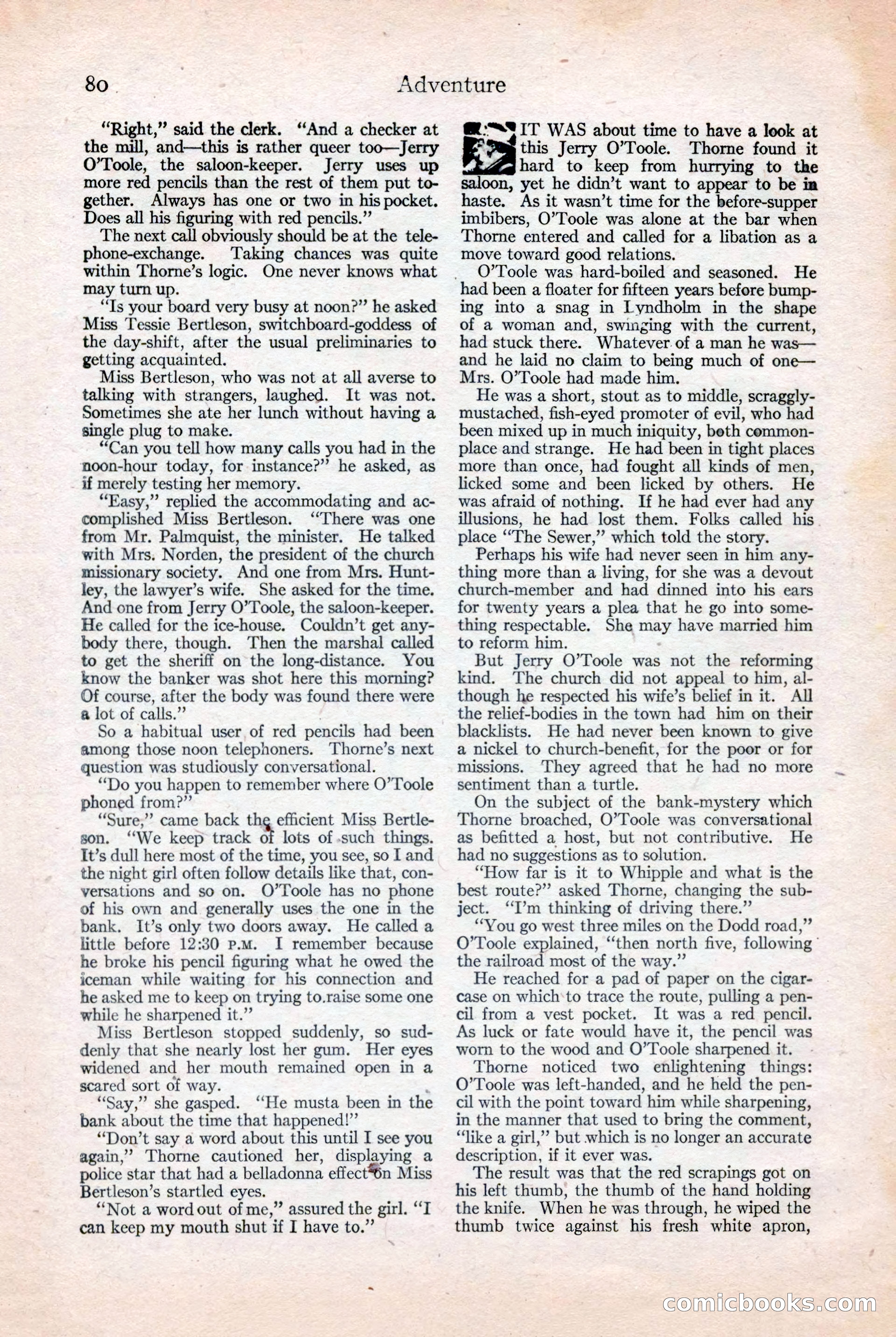
80. “Right,” said the clerk. “And a checker at the mill, and—this is rather queer too—Jerry O’Toole, the saloon-keeper. Jerry uses up more red pencils than the rest of them put to- gether. Always has one or two in his pocket. Does all his figuring with red pencils.” The next call obviously should be at the tele- phone-exchange. Taking chances was quite within Thorne’s logic. One never knows what may turn up. “Ts your board very busy at noon?” he asked Miss Tessie Bertleson, switchboard-goddess of the day-shift, after the usual preliminaries to getting acquainted. Miss Bertleson, who was not at all averse to talking with strangers, laughed. It was not. Sometimes she ate her lunch without having a single plug to make. “Can you tell how many calls you had in the noon-hour today, for instance?”’ he asked, as if merely testing her memory. “Easy,” replied the accommodating and ac- complished Miss Bertleson. ‘“There was one from Mr. Palmquist, the minister. He talked with Mrs. Norden, the president of the church missionary society. And one from Mrs. Hunt- ley, the lawyer’s wife. She asked for the time. And one from Jerry O’Toole, the saloon-keeper. He called for the ice-house. Couldn’t get any- body there, though. Then the marshal called to get the sheriff on the long-distance. You know the banker was shot here this morning? Of course, after the body was found there were a lot of calls.” | So a habitual user of red pencils had been among those noon telephoners. Thorne’s next question was studiously conversational. “Do you happen to remember where O’Toole phoned from?” “Sure,;”’ came back the efficient Miss Bertle- son. ‘We keep track of lots of .such things. It’s dull here most of the time, you see, so I and the night girl often follow details like that, con- versations and so on. O’Toole has no phone of his own and generally uses the one in the bank. It’s only two doors away. He called a little before 12:30 p.m. I remember because he broke his pencil figuring what he owed the iceman while waiting for his connection and he asked me to keep on trying to.raise some one while he sharpened it.” Miss Bertleson stopped suddenly, so sud- denly that she nearly lost her gum. Her eyes widened and her mouth remained open in a scared sort of way. “Say,” she gasped. “He musta been in the bank about the time that happened!” “Don’t say a word about this until I see you again,’ Thorne cautioned her, displaying a police star that had a belladonna effect*6n Miss Bertleson’s startled eyes. “Not a word out of me,” assured the girl. “I can keep my mouth shut if I have to.” Adventure @:““2 TT WAS about time to have a look at this Jerry O’Toole. Thorne found it Zag hard to keep from hurrying to the saloon, yet he didn’t want to appear to be in haste. As it wasn’t time for the before-supper imbibers, O’Toole was alone at the bar when Thorne entered and called for a libation as a move toward good relations. O’Toole was hard-boiled and seasoned. He had been a floater for fifteen years before bump- ing into a snag in Lyndholm in the shape of a woman and, swinging with the current, had stuck there. Whatever of a man he was— and he laid no claim to being much of one— Mrs. O’Toole had made him. He was a short, stout as to middle, scraggly- mustached, fish-eyed promoter of evil, who had been mixed up in much iniquity, beth common- place and strange. He had been in tight places more than once, had fought all kinds of men, licked some and been licked by others. He was afraid of nothing. If he had ever had any illusions, he had lost them. Folks called his place ““The Sewer,”’ which told the story. Perhaps his wife had never seen in him any- thing more than a living, for she was a devout church-member and had dinned into his ears for twenty years a plea that he go into some- thing respectable. She may have married him to reform him. But Jerry O’Toole was not the reforming kind. The church did not appeal to him, al- though he respected his wife’s belief in it. All the relief-bodies in the town had him on their blacklists. He had never been known to give a nickel to church-benefit, for the poor or for missions. They agreed that he had no more sentiment than a turtle. On the subject of the bank-mystery which Thorne broached, O’Toole was conversational as befitted a host, but not contributive. He had no suggestions as to solution. “How far is it to Whipple and what is the best route?” asked Thorne, changing the sub- ject. “I’m thinking of driving there.” “You go west three miles on the Dodd road,” O’Toole explained, “then north five, following’ the railroad most of the way.” He reached for a pad of paper on the cigar- case on which‘to trace the route, pulling a pen- cil from a vest pocket. It was a red pencil. As luck or fate would have it, the pencil was worn to the wood and O’Toole sharpened it. Thorne noticed two enlightening things: O’Toole was left-handed, and he held the pen- cil with the point toward him while sharpening, in the manner that used to bring the comment, “like a girl,”’ but which is no longer an accurate description, if it ever was. The result was that the red scrapings got on his left thumb, the thumb of the hand holding the knife. When he was through, he wiped the thumb twice against his fresh white apron, COPMICLOOOKS (C@