
Pulp Fiction, 1920 · page 96 of 172
Adventure, December 3, 1920 — page 96: what you’re looking at
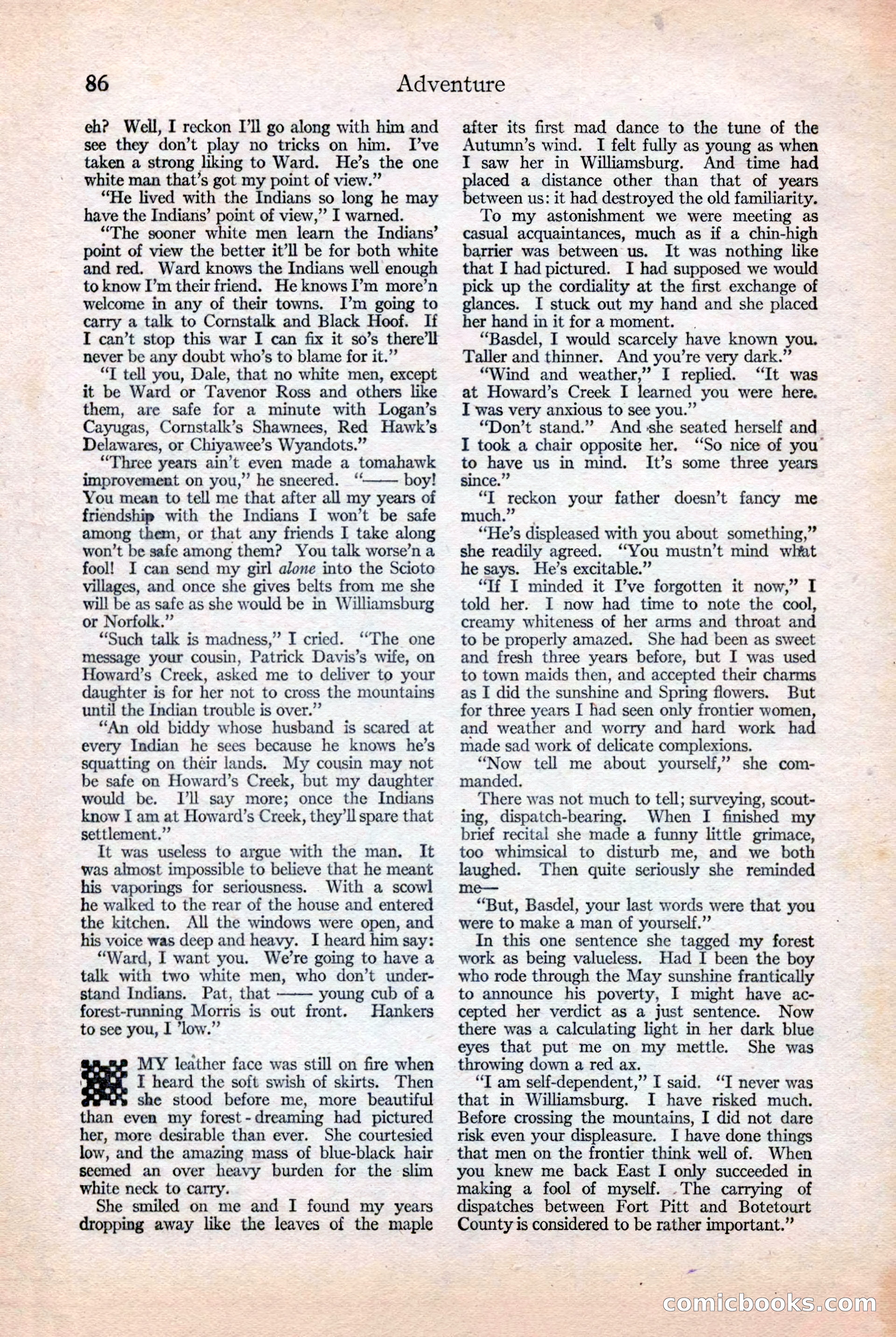
A restored page from Pulp Fiction, 1920. Page through the whole issue in the reader above.
📄 Transcribed text from this page (OCR, searchable)
Machine-transcribed from the original scan — historical spelling and the odd misread are preserved.
86 eh? Well, I reckon I'll go along with him and see they don’t play no tricks on him. I’ve taken a strong liking to Ward. He’s the one white man that’s got my point of view.” “He lived with the Indians so long he may have the Indians’ point of view,” I warned. “The sooner white men learn the Indians’ point of view the better it’ll be for both white and red. Ward knows the Indians well enough to know I’m their friend. He knows I’m more’n welcome in any of their towns. I’m going to carry a talk to Cornstalk and Black Hoof. If I can’t stop this war I can fix it so’s there'll never be any doubt who’s to blame for it.” “T tell you, Dale, that no white men, except it be Ward or Tavenor Ross and others like them, are safe for a minute with Logan’s Cayugas, Cornstalk’s Shawnees, Red Hawk’s Delawares, or Chiyawee’s Wyandots.” “Three years ain’t even made a tomahawk improvement on you,” he sneered. ‘“‘—— boy! You mean to tell me that after all my years of friendship with the Indians I won’t be safe among them, or that any friends I take along won’t be safe among them? You talk worse’n a fool! I can send my girl alone into the Scioto villages, and once she gives belts from me she will be as safe as she would be in Williamsburg or Norfolk.” “Such talk is madness,” I cried. “The one message your cousin, Patrick Davis’s wife, on Howard’s Creek, asked me to deliver to your daughter is for her not to cross the mountains until the Indian trouble is over.” “An old biddy whose husband is scared at every Indian he sees because he knows he’s squatting on their lands. My cousin may not be safe on Howard’s Creek, but my daughter would be. Ill say more; once the Indians know I am at Howard’s Creek, they’ll spare that settlement.” It was useless to argue with the man. It was almost impossible to believe that he meant his vaporings for seriousness. With a scowl he walked to the rear of the house and entered the kitchen. All the windows were open, and his voice was deep and heavy. I heard him say: “Ward, I want you. We're going to have a talk with two white men, who don’t under- stand Indians. Pat, that —— young cub of a forest-running Morris is out front. Hankers to see you, I ’low.”’ | MY leather face was still on fire when I heard the soft swish of skirts. Then she stood before me, more beautiful than even my forest-dreaming had pictured her, more desirable than ever. She courtesied low, and the amazing mass of blue-black hair seemed an over heavy burden for the slim white neck to carry. She smiled on me and I found my years dropping away like the leaves of the maple Adventure after its first mad dance to the tune of the Autumn’s wind. I felt fully as young as when I saw her in Williamsburg. And time had placed a distance other than that of years between us: it had destroyed the old familiarity. To my astonishment we were meeting as casual acquaintances, much as if a chin-high barrier was between us. It was nothing like that I had pictured. I had supposed we would pick up the cordiality at the first exchange of glances. I stuck out my hand and she placed her hand in it fora moment. . “Basdel, I would scarcely have known you. Taller and thinner. And you’re very dark.” “Wind and weather,” I replied. “It was at Howard’s Creek I learned you were here. I was very anxious to see you.” ‘Don’t stand.” And she seated herself and I took a chair opposite her. “‘So nice of you’ to have us in mind. It’s some three years since.” “IT reckon your father doesn’t fancy me much.” | “He’s displeased with you about something,” she readily agreed. “You mustn’t mind what he says. He’s excitable.” “Tf I minded it I’ve forgotten it now,” I told her. I now had time to note the cool, creamy whiteness of her arms and throat and to be properly amazed. She had been as sweet and fresh three years before, but I was used to town maids then, and accepted their charms as I did the sunshine and Spring flowers. But for three years I had seen only frontier women, and weather and worry and hard work had made sad work of delicate complexions. “Now tell me about yourself,” she com- manded. There was not much to tell; surveying, scout- ing, dispatch-bearing. When I finished my brief recital she made a funny little grimace, too whimsical to disturb me, and we both laughed. Then quite seriously she reminded me— “But, Basdel, your last words were that you were to make a man of yourself.” In this one sentence she tagged my forest work as being valueless. Had I been the boy who rode through the May sunshine frantically to announce his poverty, I might have ac- cepted her verdict as a just sentence. Now there was a calculating light in her dark blue eyes that put me on my mettle. She was throwing down a red ax. “T am self-dependent,” I said. “I never was that in Williamsburg. I have risked much. Before crossing the mountains, I did not dare risk even your displeasure. I have done things that men on the frontier think well of. When you knew me back East I only succeeded in making a fool of myself. .The carrying of dispatches between Fort Pitt and Botetourt County is considered to be rather important.” JOOK (©) (E)